


Quick Summary:
- Ask the agent to confirm non-smoking status on your rental agreement.
- Do a two-minute sniff test of cabin, vents, boot, and seats.
- Photograph ash, burns, residue, and air fresheners before driving away.
- Report any smoke smell immediately, request a swap or written notation.
Smoke odours are one of the easiest issues to miss when collecting a car hire in Florida, and one of the hardest to prove later. Heat and humidity can make smells stronger after the car has been closed up, and a quick handover in a busy airport garage can mean you drive away before noticing anything. The goal is simple: confirm the car is genuinely non-smoking, and if it is not, document it properly so you are not blamed for pre-existing odours.
Whether you are collecting at Orlando Airport (MCO), Tampa Airport (TPA), Miami Airport (MIA), or Fort Lauderdale (FLL), the same approach works. It takes about five minutes and can prevent an argument at return.
Before you get the keys: get clarity at the counter
Start with what can be recorded in writing. Ask the agent to confirm the vehicle is marked “non-smoking” in their system and, if possible, that your paperwork reflects this. Many fleets are officially non-smoking, but enforcement can vary, and a previous driver may have broken the rule.
Also ask how smoke claims are handled at that location. Some branches rely on staff inspection, others add fees if the vehicle returns with noticeable odour. Knowing the process helps you understand why immediate reporting matters.
Practical tip: if you are handed a stall number, do not leave the garage. Do the inspection in the bay while you can still walk back to the kiosk or counter quickly.
Fast non-smoking inspection checklist (do this before moving the car)
This is a quick, repeatable routine you can do every time you collect a car hire in Florida.
1) First sniff test: doors closed, then open
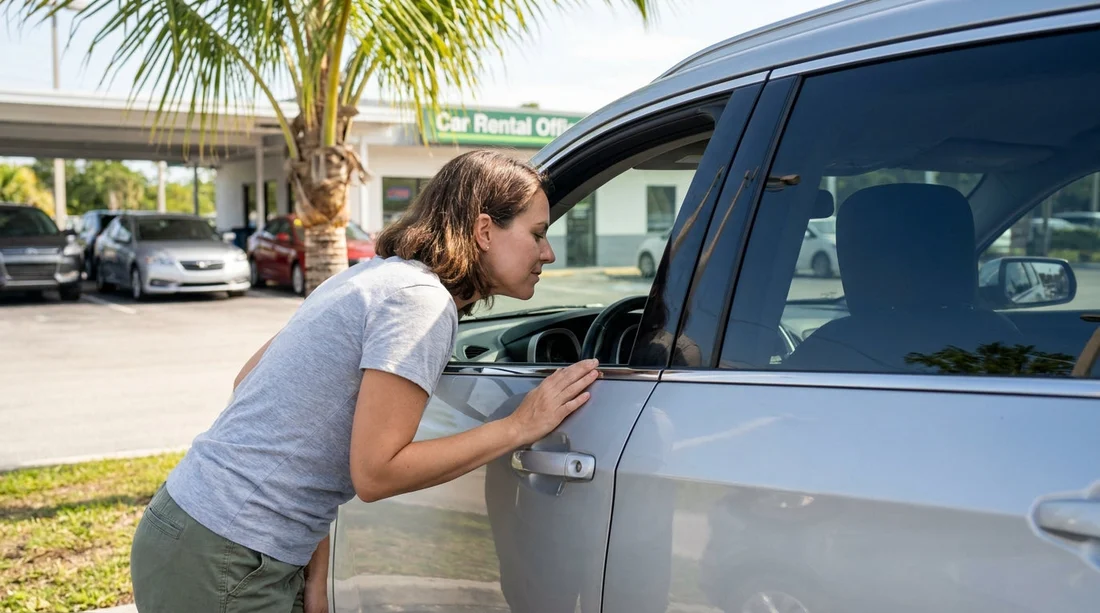
Stand outside with the doors closed for a moment, then open the driver’s door and lean in. A stale cigarette smell can be obvious as soon as the seal breaks. If it smells “masked” with heavy perfume or air freshener, treat that as a warning sign. Masking products are often used to cover smoke.
2) Check the key smoke hotspots
Use your phone torch and look closely at the places where evidence tends to hide:
Driver area: seat base, seat belt webbing, steering wheel, headliner above the driver, and the window edge. Smoke residue can leave a slightly sticky sheen.
Cupholders and console: crumbs of ash, small burn marks, or a dusty grey film in corners.
Door pockets: empty packets, filters, or a faint lingering odour in fabric.
Rear seats: check the back seat fabric and the floor around rear doors. If the rear has a stronger smell, passengers may have smoked there.
Boot (trunk): open it and sniff. People sometimes smoke while loading luggage or stash smoky items in the boot.
3) Run the air conditioning for 30 seconds
Start the car and run the fan at medium to high. Switch between fresh air and recirculation if you can. Smoke odour trapped in cabin filters or vents can be strongest when air first starts moving. If the smell intensifies with the fan on, take it seriously.
If there is a strong smell, check the cabin air filter access area only visually, do not disassemble anything. Your aim is documentation, not repair.
4) Look for physical clues that support your nose
Even if the smell is mild, physical signs make your report more credible:
Ash or grey dust: in window switches, cupholders, door sills.
Burn marks: tiny pinholes on seats, the headliner, or floor mats.
Air fresheners: hanging cards, vent clips, or a strong “clean” scent. These are not proof of smoking, but they support your note that the scent is being covered.
Windows and mirrors: a faint haze can be residue. It is subtle, but a quick wipe with a tissue can show grime. Do not scrub, just note it.
What to photograph and how to make it useful
Photos cannot capture smell directly, so you need images that show context, potential causes, and timing. Use your phone’s normal camera mode, and keep shots sharp and well lit.
1) The car’s identity: photograph the licence plate, the windscreen VIN plate (if visible), and the dashboard showing the mileage. This links your evidence to that specific vehicle.
2) The interior overview: take wide shots of the front cabin, rear seats, and boot. Wide shots show you inspected the whole vehicle, not just one detail.
3) Close-ups of any smoke-related signs: ash in cupholders, burn marks, stained headliner, residue around window edges, or any cigarette-related litter. Hold the camera steady and include a second photo with the area in context so staff can locate it.
4) Air fresheners or masking products: photograph them in place. Again, not proof by itself, but it supports your description if the cabin smells “covered”.
Do not photograph staff or other customers. Focus on the vehicle and the stall number signage if it is visible, which helps show where you found the issue.
What to write down, so it matches what staff can record
If you report the issue, the wording matters. Staff typically record facts, not opinions. Use simple statements:
Time and place: “Collected at 14:10, garage level 3, bay B17.”
What you noticed: “Noticeable cigarette smell on opening driver’s door, stronger with AC on.”
Supporting evidence: “Ash-like dust in front cupholder and small burn mark on rear seat fabric.”
What you requested: “Requested vehicle swap or non-smoking odour note on contract.”
This makes it easier for the agent to add a remark to your file, and it reads like an inspection note rather than a complaint.
If you find smoke odour: the best options before you leave
You generally have two workable outcomes, and the right one depends on how strong the smell is and how busy the location is.
Option 1, swap the car: If the smell is clear or you can see ash or burns, a different vehicle is the cleanest solution. It also avoids the lingering smell during your trip.
Option 2, get an on-record note: If you are happy to keep the car but want protection, ask for a written notation that smoke odour was present at pickup. If the agent cannot change the printed agreement, ask for a supervisor note in the system and keep a screenshot or photo of any written confirmation they provide.
Avoid trying to “fix” the smell yourself with strong sprays before you report it. That can muddy the timeline and can look like you caused the problem.
How this protects you at return
Smoke claims are often subjective, so your best protection is a combination of immediate reporting, clear photos of supporting clues, and a note in the rental record. If you return the car with your own timestamped photos from pickup and a documented remark, it is far easier to show the odour was not caused during your rental.
Keep your photos until the deposit is fully released and you have received the final receipt or closure email. If there is a dispute, respond with your pickup documentation and the exact note that was added at collection.
FAQ
How long should the non-smoking inspection take at pickup? Two to five minutes is enough for a quick sniff test, AC check, and a few key photos. Do it before leaving the garage or lot.
Can photos prove a smoke smell if there is no visible ash? Photos cannot capture odour, but they can prove timing, vehicle identity, and any masking products. Pair them with a written note reported immediately.
What if the agent says all cars are non-smoking so it cannot be noted? Ask for a remark like “customer reports smoke odour at pickup” rather than a policy statement. The point is recording your observation, not changing the rule.
Should I clean the interior or use air freshener to remove the smell? Avoid doing that before you report it. Cleaning or adding fragrance can make it harder to show the odour was pre-existing and may complicate any inspection.
What if I only notice the smell later, after leaving the airport? Report it as soon as you notice, with the time and your photos from pickup. You may still be able to swap at a nearby location, but immediate on-site reporting is strongest.






























































































