


Quick Summary:
- Most Florida car hire deposits accept chip-and-signature, so no PIN.
- A PIN is usually needed only for debit cards, not credit.
- Use the main driver’s physical credit card to avoid verification delays.
- Tell your card issuer about US travel to reduce declined transactions.
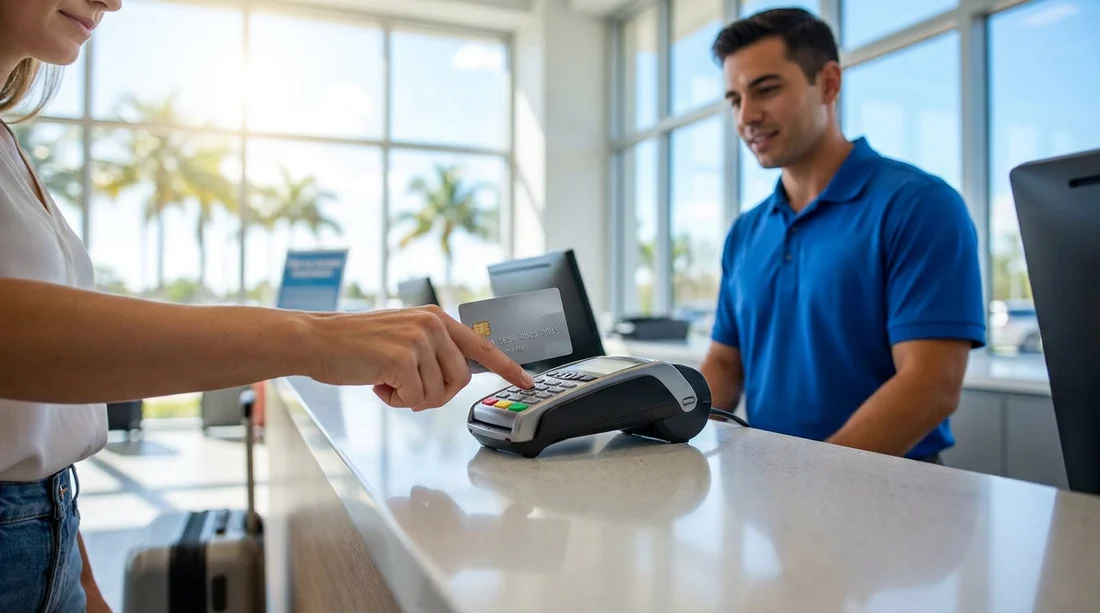
If you are hiring a car in Florida, it is normal to pay for the rental and authorise a security deposit at the pick-up counter. Many travellers from the UK and Europe wonder whether they will be asked for a credit-card PIN. The reassuring answer is that, in most cases, a true credit card deposit in Florida is processed as a chip-and-signature transaction, so you are asked to insert or tap the card and sign, not enter a PIN.
Where people run into problems is when the card being presented is not accepted for the type of transaction the counter is trying to run, or when the terminal routes it differently, for example treating it more like a debit purchase. Understanding the difference between paying for the hire and placing a deposit hold, plus the difference between credit and debit, is the simplest way to avoid delays.
How Florida car hire payments and deposits usually work
At pick-up, the rental desk typically completes two related steps. First, they take payment for any amount due now, for example local charges, extras, or pre-paid verification. Second, they place an authorisation hold for the security deposit. That hold is not a charge, it is a temporary reservation of funds against your available credit limit.
In Florida, mainstream rental desks commonly run these transactions through card-present systems designed for US usage, where signature is still a frequent method for credit cards. Even when your card supports PIN, you may not be prompted to enter it for a credit transaction. Instead, the terminal prints a receipt or displays a signature panel.
This is why many UK visitors successfully collect a car at busy airport locations without ever using their credit-card PIN. For example, travellers picking up near Orlando International often find it is a straightforward chip-and-sign process at the counter, particularly when all documents match the booking, see car rental at Orlando MCO and Disney.
When you might actually be asked for a PIN
A PIN prompt can still happen, but it is more the exception than the rule for credit cards. The most common situations are linked to the card type, the network routing, or the merchant configuration.
1) Using a debit card instead of a credit card. Debit cards are far more likely to require a PIN, and many rental companies also have tighter rules for debit deposits. Some locations can accept debit for payment but restrict debit for the deposit, or require additional checks.
2) Presenting a card that behaves like a debit card. Some travel or prepaid products can be processed as debit, even if they look like a credit card. If the terminal routes it as debit, it may ask for a PIN and could fail if the deposit rules require credit.
3) Specific terminals that default to PIN for certain card networks. Occasionally, card readers prompt for a PIN due to how they are set up or how the transaction is recognised. If this happens with a credit card, staff may be able to rerun it as credit or complete a signature-based authorisation.
4) Unmanned or self-service kiosks. Some kiosks or pay-at-pump style terminals favour PIN verification. If you are collecting from a counter, you are less likely to face this issue. If you are collecting in a high-throughput setting such as Miami, it helps to be prepared for either method, see car hire at Miami MIA.
Why a deposit hold can fail even without a PIN
Even if no PIN is needed, deposit authorisations can still be declined. That is usually not a PIN problem, it is a verification or available-credit issue. Common causes include insufficient available credit, a mismatch between the driver name and card name, or anti-fraud blocks triggered by a sudden overseas authorisation.
Another frequent misunderstanding is the difference between your credit limit and your current available credit. The deposit hold reduces your available credit until it is released. If your card is near its limit, the hold may be declined. The same can happen if multiple holds are placed, for example if a previous hire has not yet had its authorisation released.
Location can also affect the size of the hold. Airport branches often have set deposit amounts that may differ from city branches. If you are comparing options around Fort Lauderdale, it is useful to plan for the deposit impact on your card limit, see car hire at Fort Lauderdale FLL.
Practical ways to avoid payment and deposit-hold delays at pick-up
Bring the right card, and make sure it is physical. Florida rental desks generally require the main driver to present a physical card in their own name. Mobile wallets are not always accepted for deposits, and a digital-only card can cause delays.
Know your PIN anyway. Although a PIN is usually not required for credit cards, it is sensible to know it in case the terminal prompts for it, or you end up using the card for other purchases during your trip. If you do not know it, contact your issuer before you travel, as PIN reminders can take time.
Check your available credit, not just the limit. Leave headroom for the deposit plus any other travel spending. If you are hiring a larger vehicle, the deposit can feel more noticeable against your limit. Families hiring people carriers often benefit from checking this in advance, see minivan rental in Florida.
Match the booking details to the cardholder. The driver collecting the vehicle should usually be the cardholder for the deposit card. If a different person plans to pay, it can create a mismatch that stops the deposit authorisation or triggers additional verification.
Tell your bank you are travelling. Some issuers still block unexpected US transactions as fraud. A quick travel notification, or ensuring your app permissions are set, can reduce the chance of a decline.
Avoid mixing payment methods at the counter. Paying with one card and attempting the deposit on another can be allowed in some cases, but it can also slow the process. If you must split, do it only when you know both cards meet the location’s requirements.
Allow extra time for the hold to release after return. When you bring the car back, the hold is typically released by the rental company quickly, but your bank may take longer to reflect the change. This is not a Florida-only issue, but it matters if you need the available credit for hotels or flights shortly after your trip.
Credit card PIN versus contactless, and what staff may ask you to do
In many US rental transactions, contactless tap is accepted for payment, but the deposit hold still requires the chip to be inserted. If the terminal requests a signature, sign the receipt as normal. If it requests a PIN and you are using a credit card, ask whether they can run it as credit. This is a common fix when a terminal defaults to debit routing.
If your card issuer has enabled PIN-first verification for certain international card-present transactions, you may be prompted for a PIN even though it is a credit card. That does not necessarily mean the transaction will fail, it simply means the verification step differs.
For travellers, the key is not to assume that “no PIN needed” means “no preparation needed”. Know your PIN, bring a suitable card, and keep sufficient available credit so the authorisation succeeds quickly.
FAQ
Do I need a PIN for a credit card to authorise a car hire deposit in Florida?
Usually no. Most Florida car hire deposits on credit cards are chip-and-signature, but it is wise to know your PIN in case a terminal requests it.
Is a debit card more likely to need a PIN at the rental counter?
Yes. Debit cards commonly require a PIN, and rental companies often apply stricter rules to debit deposits, including extra checks or higher holds.
What should I do if the terminal asks for a PIN and I do not know it?
Ask staff whether they can rerun the transaction as credit with signature. If not, you may need an alternative eligible card, so sorting your PIN before travel helps.
Why was my deposit authorisation declined if I entered the correct details?
Common causes include insufficient available credit, fraud prevention blocks, or a mismatch between the driver name and the cardholder name.
How long does it take for the deposit hold to be released after return?
The rental company may release it quickly, but banks can take several business days to update your available credit, depending on the issuer.






























































































