


Quick Summary:
- Check the fuel door sticker for the required AKI octane number.
- Choose 87, 89, or 91 based on the car’s stated minimum.
- Do not assume higher octane is better if the car specifies 87.
- Confirm petrol versus diesel at the pump before removing the nozzle.
For UK travellers, the confusing part about filling a rental car in California is not the word “gas” versus “petrol”, it is the octane system on the pump. In the UK, you will usually see RON numbers like 95 and 98. In the US, pumps show AKI, a different octane rating method. The good news is that your rental car will tell you exactly what it needs, and matching that number is the safest way to avoid misfuelling, engine issues, or a surprise charge at return.
If you are picking up at a busy airport location, it helps to know what to look for before you leave the car park. When comparing car hire in Los Angeles LAX or car hire in San Francisco SFO, the refuelling steps are the same statewide, but pump labels and premium availability can vary by station. Your priority is always the minimum octane required by the vehicle, not the most expensive option on the forecourt.
Understand California pump labels: AKI, not RON
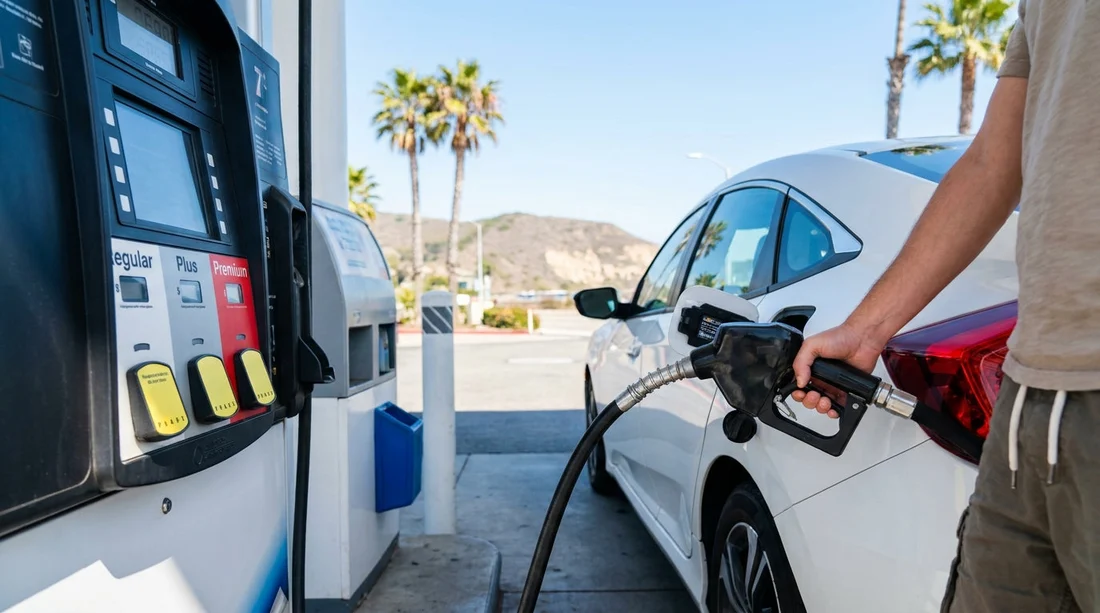
California petrol pumps typically offer three grades labelled with octane numbers such as 87, 89, and 91. Those numbers are AKI, which is the average of two test methods (often written as (R+M)/2 on the pump). In the UK, the RON numbers look higher, so 87 can feel “too low” to a UK driver. It is not directly comparable in a way that helps at the pump, because the rating system differs.
Practical takeaway: ignore UK RON habits, and match whatever AKI minimum is printed on the car. If the fuel door says “87 AKI minimum”, then 87 is correct even if it feels like “regular”. If it says “91 AKI required” or “premium required”, then you must choose 91 (or the nearest available premium grade) for proper performance and to avoid potential knocking.
Where to find the required octane on a rental car
Do not guess based on the model name or engine size. Rental fleets vary by trim level, and a badge on the boot lid does not reliably tell you the fuel requirement. Use these sources instead, in this order:
1) Fuel filler door sticker: Open the fuel door and look for a label stating “Unleaded gasoline only” plus a minimum AKI number. This is the quickest and most reliable method.
2) Owner’s handbook or quick reference guide: Many rentals keep a booklet in the glovebox. Look under “Fuel” or “Specifications” for “minimum octane rating”.
3) Infotainment or instrument menu: Some newer cars show fuel requirements digitally, but the fuel door sticker still wins for speed and certainty.
If you are collecting an SUV or a larger vehicle, do not assume it needs premium. Plenty of SUVs run on 87 AKI. Likewise, some smaller turbocharged engines may specify 91. If you are arranging SUV rental in San Jose SJC, check the specific car you are given, not the category label.
What to choose: 87 vs 89 vs 91 in simple terms
Most petrol stations in California sell unleaded in three main grades:
87 AKI (Regular): Commonly correct for many mainstream rental cars. If the car states 87 minimum, choose this.
89 AKI (Midgrade): Sometimes offered as a middle step. Only choose it if your car requires at least 89, or if 89 is the closest option above a stated minimum that is not available.
91 AKI (Premium): Often required for some performance, luxury, or certain turbocharged engines. If the car says “premium required” or “91 minimum”, choose 91.
Some stations may offer 92 or 93 in other states, but 91 is common in California due to regional fuel formulations. If your car requires 91 and the station only has 89 and 87, do not settle. Find another station. In most populated areas, premium is easy to locate, including around major pickup points like car hire at Sacramento SMF.
Is it OK to use a higher octane than required?
Using a higher octane than the minimum requirement is generally not harmful, but it is often a waste of money. Higher octane does not mean “better quality” in a way that benefits an engine designed for regular. Octane rating is mainly about resistance to knock under compression.
If your rental specifies 87 minimum, choosing 91 will not normally make it faster, smoother, or more economical. In some cases, you could even see slightly worse fuel economy due to different energy content, although the difference is usually small. The simplest approach for car hire refuelling is to buy exactly what the vehicle asks for.
What happens if you use a lower octane than required?
If the car requires premium and you put in regular, you may notice reduced performance, engine knock, or the engine management system reducing power to protect the engine. Modern cars can often adapt, but that does not make it a good idea, especially in hot weather, when climbing, or under heavy load, all of which are common on California road trips.
For a short, accidental top-up, you may be fine, but you should correct it as soon as practical by refuelling with the correct grade. If you have filled most of the tank with a lower grade than required, it is best to contact the rental provider for guidance.
Avoid misfuelling: petrol versus diesel and nozzle checks
Most rental cars in California are petrol. Diesel is less common than in the UK, but it does exist, especially in certain larger vehicles. Misfuelling risk is usually reduced because US diesel nozzles and labels are quite clear, but it still pays to pause before you lift the pump handle.
Use these quick checks:
Confirm the fuel type on the fuel door: Look for “Unleaded gasoline only” or “Diesel fuel only”.
Read the pump button before you select a grade: Do not rely on colour alone. Many pumps use black for multiple products.
Do not squeeze the handle until you are sure: A one-second double-check can save hours of hassle.
If you are returning a car at an airport, leave time to refuel somewhere calmer a few miles out. Stations right next to terminals can be busy, and a rushed decision is where mistakes happen. This is helpful whether you arranged a specific provider, such as Dollar car hire in San Diego SAN, or any other option.
Returning the car: receipts, full-to-full, and avoiding extra charges
Many car hire agreements use a full-to-full policy. If yours does, refuel close enough to return with a full tank, but not so close that you are forced into an overpriced forecourt right at the airport entrance. Keeping the fuel receipt can help if there is any question about fuel level at return.
If you are unsure which grade you used last time, do not rely on memory. Open the fuel door, read the sticker, and select that grade again. Consistency reduces the chance of accidentally choosing midgrade or premium simply because it is positioned at the top of the button stack.
FAQ
Q: I’m from the UK, which US octane equals UK 95 RON?
A: US pumps show AKI, which is not a direct match to UK RON. Do not convert, follow the car’s fuel door label for the minimum AKI required.
Q: My rental car says “87 AKI minimum”. Should I ever choose 89 or 91?
A: You can, but you do not need to. If 87 is available, use 87. Higher octane usually adds cost without benefits for an engine designed for regular.
Q: The pump has 87, 89, and 91. My fuel door says 91 required. What do I pick?
A: Choose 91. If a station does not offer 91, find another station rather than using a lower grade.
Q: What if I accidentally put regular in a car that needs premium?
A: Do not panic. Drive gently, avoid hard acceleration, and refuel with the correct premium grade as soon as possible. If you filled most of the tank, contact the rental provider for advice.
Q: Is diesel common for rental cars in California?
A: It is less common than in the UK, but it exists. Always check the fuel door for “unleaded gasoline” versus “diesel” before selecting a nozzle.




























































































