


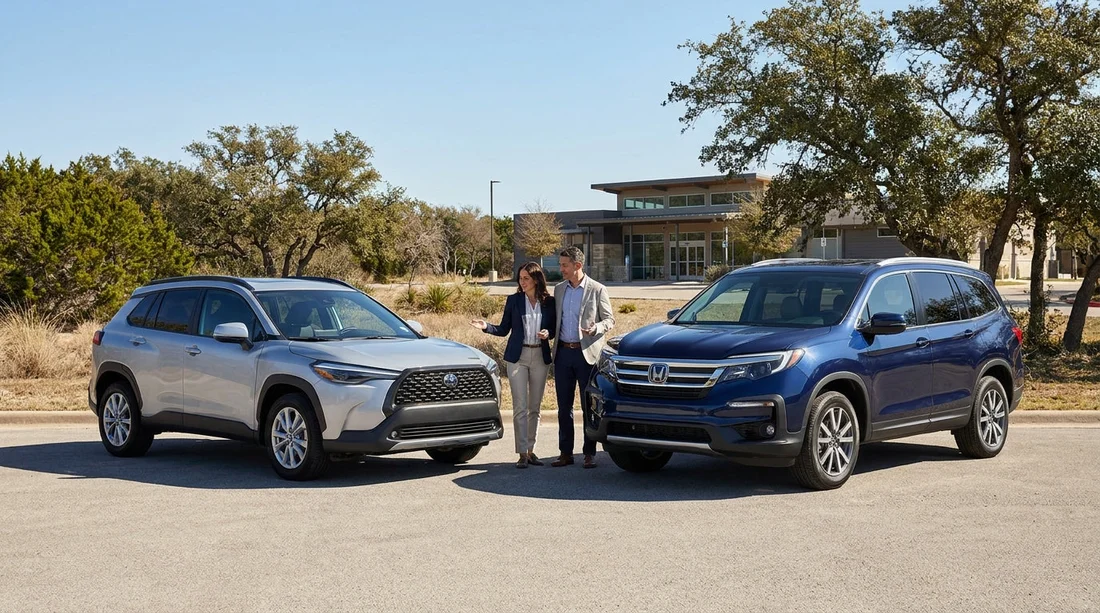
Quick Summary:
- Intermediate SUVs suit two or three travellers with moderate luggage.
- Standard SUVs add cabin width, rear comfort, and extra boot space.
- “Or similar” means a size class, not a specific model.
- Check seats, luggage, drivetrain, and safety tech before confirming hire.
When you’re comparing SUV options for car hire in Texas, “intermediate SUV” and “standard SUV” can sound similar, especially because you usually select a class rather than a specific model. The practical differences show up in cabin width, boot space, comfort on long drives, and sometimes engine performance. In Texas, where trips often mean long highway stretches, big parking lots, and occasional rougher rural roads, picking the right class can make your journey noticeably easier.
This guide breaks down what you typically get in each class, what “or similar” really means, and how to choose based on your passengers, luggage, and route.
How US SUV classes work for car hire
Most US car hire listings group vehicles by a size category, not by a guaranteed make, model, or trim level. The category is based on broad benchmarks such as passenger capacity, luggage volume, and overall vehicle footprint. That’s why you’ll see “Intermediate SUV or similar” or “Standard SUV or similar”.
The key is to focus on what the class is designed to deliver, then double check the listing details for seats, luggage, and features. If you’re collecting in a major hub, availability can shift quickly. For example, if you’re arriving via Houston, it helps to compare classes early via a location page such as car hire Houston IAH, then choose the class that matches your real needs rather than a favourite model.
Intermediate SUV: what you typically get
An intermediate SUV is usually a compact crossover sized vehicle. Think of a five seat cabin, a raised driving position, and a boot that works best for a couple of suitcases plus a few soft bags. It’s a popular choice for city and suburban driving because it’s easier to manoeuvre and park than larger SUVs, while still feeling more spacious than a standard saloon.
Seating and comfort: Usually five seats, but the rear bench may feel tighter for three adults. For two adults plus children, it’s often comfortable. On long drives between cities, you get the higher seating position without a full size SUV’s bulk.
Luggage space: Adequate for everyday travel, but the boot can shrink quickly once you add a stroller, cooler, or bulky sports gear. If everyone has a hard shell suitcase, you may need to stack higher or fold part of the rear seat, reducing passenger space.
Performance and fuel use: Often lighter and more fuel efficient than a standard SUV, which can matter on long highway runs. Engine power is generally fine for cruising, but acceleration with a full load can be more modest.
Standard SUV: what you typically get
A standard SUV typically sits a size step above intermediate, often close to a midsize SUV category. You still usually get five seats, but the cabin is commonly wider, the rear seats are more adult friendly, and the boot is meaningfully larger. This is the class many travellers prefer for Texas road trips because it balances space with drivability.
Seating and comfort: Still generally five seats, but with more shoulder room and legroom. That extra width matters if you’ll have three adults across the back, or if you’re fitting child seats. The ride can feel more settled on rougher road surfaces.
Luggage space: More space behind the second row, which reduces the need to pack up to the window line. This can improve visibility and comfort, and it helps if you’re carrying shopping, a cooler, or work equipment.
Performance: Often stronger highway merging and passing performance, particularly when fully loaded. It can feel less strained with passengers and luggage.
If you’re planning to drive between airports and larger metro areas, such as into the Dallas Fort Worth region, comparing what’s common at a hub like National car hire Fort Worth DFW can help you understand what’s frequently available in each class.
Intermediate vs standard SUV: the practical differences that matter
1) Boot space and packing stress
Most travellers feel the difference first in luggage room. Intermediate SUVs can handle a normal load for two or three people, but get tight with four adults, large suitcases, or bulky items. Standard SUVs are a safer bet for airport runs with multiple cases, especially if you want to avoid folding seats.
2) Rear seat comfort on long drives
Texas distances can be bigger than first expected. Standard SUVs are typically better for longer stints because rear passengers have more room, and the vehicle can feel more stable and quiet at speed, depending on the model.
3) Parking and city driving
Intermediate SUVs are easier in tighter urban areas and multi storey car parks. In Texas you’ll often find wide spaces, but if you’re spending time in busy downtown areas, the smaller footprint can reduce hassle.
4) Fuel costs over a week
Intermediate SUVs are often more efficient. If your trip is mostly city commuting and short drives, that difference can add up. If you’re carrying passengers and luggage across highways, the standard SUV’s comfort may outweigh the fuel impact.
5) All wheel drive and drivetrain expectations
In Texas, many SUVs are two wheel drive. If you specifically need AWD for certain routes or weather, treat it as a feature requirement, not something guaranteed by class. Confirm whether the listing states AWD, 4WD, or similar terminology.
What “or similar” really means, and what it does not
“Or similar” means the supplier will provide a vehicle that fits the same general category. It does not mean you will receive the exact model pictured, the exact luggage capacity you assume from that photo, or a specific trim level with premium features. Colour, engine, wheel size, infotainment options, and safety packages can all vary.
To manage expectations, focus on the details that are usually stated in the booking flow: number of seats, number of doors, transmission type, air conditioning, and sometimes luggage capacity. If a particular feature matters, such as built in navigation, adaptive cruise control, or AWD, look for it explicitly in the specifications.
Choosing the right SUV class for Texas trips
Pick an intermediate SUV if: you’re travelling with one to three people, you have moderate luggage, you’ll be doing plenty of city driving, and you want a balance of space and efficiency. It can be a smart choice for short breaks and lighter packing.
Pick a standard SUV if: you expect four or five passengers, you have larger suitcases, you’re planning longer drives, or you simply want more breathing room. It can also reduce the risk of needing to compromise on luggage and comfort.
If you realise you need even more space than a standard SUV offers, a people carrier can be worth comparing, especially for family groups. For Houston, the minivan hire Houston IAH page can help you assess whether a larger cabin is a better fit than sizing up within SUVs.
Texas airport collection tips that affect SUV class value
Inspect boot space before you leave: If you’re collecting at a border region airport, check your luggage fits comfortably before driving off. If you’re travelling through West Texas, browsing options around car rental airport El Paso ELP can be useful for understanding local supply and typical SUV mixes.
Confirm child seat needs: If you’re travelling with children, consider how many seats you need to fit and how wide the rear bench is likely to be. A standard SUV often makes fitting multiple child seats easier.
FAQ
Q: Is a standard SUV always bigger than an intermediate SUV in US car hire?
A: Typically yes, standard SUVs are a size step up, with more cabin width and boot capacity. Exact dimensions vary because “or similar” can include different models.
Q: Will I definitely get AWD if I choose a standard SUV in Texas?
A: Not necessarily. Many standard SUVs are two wheel drive in Texas fleets. If AWD matters, choose an option where AWD or 4WD is listed as a confirmed feature.
Q: How many suitcases fit in an intermediate SUV versus a standard SUV?
A: It depends on suitcase size, but intermediate SUVs often suit a couple of large cases plus smaller bags. Standard SUVs more reliably handle multiple large suitcases without folding seats.
Q: Are intermediate SUVs cheaper than standard SUVs for car hire?
A: Often they are priced lower, and they may use less fuel. However, pricing changes by season, location, and availability, so compare total cost rather than class name alone.
Q: If the pictured model is shown, can I insist on that exact SUV?
A: Usually no. The picture is illustrative, and the supplier provides a vehicle within the same class. Focus on confirmed specifications such as seats, luggage capacity, and transmission.




























































































