


Quick Summary:
- In Texas, right on red is often allowed after stopping fully.
- A red arrow usually forbids turning until it turns green.
- “No Turn on Red” signs override any general right-on-red permission.
- Stop behind the line, pause, then creep forward to check safely.
Driving on Texas roads during a car hire trip can feel straightforward until you reach a busy, camera-controlled junction showing a red arrow. Many visitors know the general US idea of “right on red”, but red arrows, “No Turn on Red” signs, and what police or cameras consider a full stop can catch you out. The aim of this guide is to help you handle those junctions confidently, especially around major airports and multi-lane urban roads.
If you are collecting a vehicle in Dallas, it can help to review local driving patterns before you leave the airport area, because the first few interchanges and signalised turns tend to be dense. See practical location notes on car hire at Dallas DFW Airport and plan extra time so you are not tempted to rush a stop.
Red light vs red arrow in Texas, what is the difference?
A standard circular red light controls the movement of traffic generally through the junction. In Texas, a driver may usually turn right on red after coming to a complete stop, provided the turn is not prohibited by a sign and the driver yields to pedestrians and other traffic with the right of way.
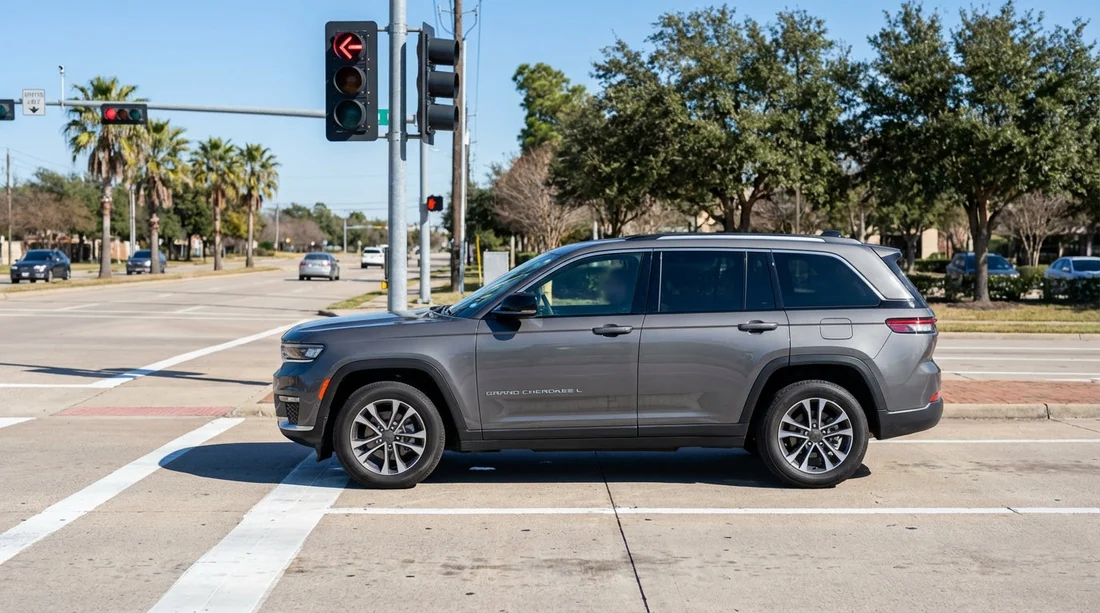
A red arrow is different. It indicates a specific movement, such as a right turn, is prohibited. In practice, a red right arrow means “do not turn right” until the arrow changes to green, even if other lanes have a circular red light and even if the cross street looks clear. Drivers sometimes treat a red arrow like a normal red light, but that can lead to citations, particularly where enforcement cameras are used.
Because signal designs vary by city, you may see junctions where the right-turn lane has its own arrow while through traffic uses circular signals. When your lane is governed by the arrow, follow the arrow. Do not assume the general right-on-red convention applies.
So, can you turn right on a red arrow during a car hire trip?
For day-to-day driving, the safest rule for a visitor is simple: treat a red right arrow as no turn. Wait for a green arrow or a permitted signal for your lane. This avoids the most common misunderstanding that triggers a “failure to obey traffic control device” style citation.
There are edge cases where local signal heads and sign plates modify what is allowed, but those are not the situations you want to rely on when you are unfamiliar with the area, driving a different vehicle, or navigating heavy traffic. If you do not see an explicit permission sign for that arrow-controlled lane, wait.
In Texas cities, right turns can also be restricted during certain hours, for example near commuter routes or stadium traffic plans. That is one more reason to focus on the current signal and any posted signs, not on what drivers behind you may be expecting.
When “No Turn on Red” overrides everything
Whether you are facing a circular red light or a red arrow, a posted “No Turn on Red” sign overrides the general permission to turn. If the sign is present, you must wait for a green signal to make the right turn, even if the road is empty.
Pay attention to sign placement. Some junctions post “No Turn on Red” on the right-hand pole, some place it on the signal mast arm, and some add additional wording such as “When pedestrians present” or “7am to 7pm”. If there are time-of-day restrictions, follow the restriction as written. If you are unsure whether the restriction applies at that moment, take the conservative approach and wait.
Areas around large airports often have extra restrictions to manage pedestrian flows and shuttle buses. If your trip includes Houston, it is worth scanning for turn restriction signage immediately after leaving the terminal roads. Practical orientation information can be found on car hire at Houston IAH, where the first turns can be heavily signposted.
What counts as a “full stop” in Texas?
A “full stop” means the vehicle’s wheels stop moving completely. Rolling slowly, even at walking pace, is not a stop. Cameras and police look for a clear stop behind the correct stopping point. If you are turning right on a permitted red (circular red with no prohibiting sign), the stop is still required before you creep forward to check visibility.
Use this practical sequence at a right-on-red junction:
1) Stop at the correct line. Aim to stop behind the thick white stop line. If there is no stop line, stop before the crosswalk markings. If neither is marked, stop before entering the intersection.
2) Pause long enough to show the stop. A brief, unmistakable pause helps ensure it is recorded as a stop on video. The goal is not a specific number of seconds, but a clear separation between stopping and moving again.
3) Yield correctly. Yield to pedestrians in or entering the crosswalk and to vehicles on the road you are turning into.
4) Creep forward only if needed. If your view is blocked, inch forward after stopping to gain sight lines, then yield again. Do not glide through without the initial stop.
This routine matters most at camera-controlled junctions, where a “rolling right” can be interpreted as failing to stop, even if you did not cut off any traffic.
Where exactly should you stop, line, crosswalk, or kerb?
Stopping location is a frequent source of confusion for visitors, especially where the stop line is set back to improve pedestrian safety. The order of priority is:
Stop line first. If there is a bold white line, stop before it.
Crosswalk second. If there is a zebra-style crosswalk or two parallel lines, stop before the crosswalk.
Intersection edge last. If markings are absent, stop before entering the junction area.
Do not stop with your bumper in the crosswalk. Even if you stop fully, blocking the crosswalk can still trigger enforcement or create a safety issue. This is particularly relevant in downtown areas with high foot traffic and multi-lane one-way streets.
How to avoid citations at camera-controlled junctions
Texas uses different enforcement approaches by city and corridor. Regardless of whether a junction has a camera, the safest approach is to drive as if it does, and make your actions obvious and compliant.
Practical habits that reduce risk:
Do not follow the car in front too closely. If they turn right on red without stopping, you are not obliged to mimic them. Leave space so you can stop at the line without being pressured.
Watch for dedicated right-turn signals. A right-turn lane with its own signal head often uses arrows. If your lane has an arrow, it governs your movement.
Be alert to “Right on Red After Stop” signs. These signs confirm permission, but they still require a complete stop and proper yielding.
Account for wide turns and large vehicles. In areas with lorries, buses, or big pickups, drivers may swing wide. A cautious right-on-red turn, taken only when clearly safe, protects you from collisions as well as tickets.
Keep distractions down at the line. Adjust sat nav and music before you approach the junction, so you can focus on pedestrians stepping off the kerb late in the cycle.
If your itinerary includes long urban stretches and multiple junction types, choosing a vehicle you are comfortable manoeuvring can help with smooth, compliant stops and turns. For larger groups, see options such as minivan hire in San Antonio, where extra cabin space can reduce in-car clutter that distracts at complex lights.
Common junction layouts that confuse visitors
Slip lanes with yield signs. Some right turns use a separate slip lane with a yield sign instead of a traffic signal. In that case, you must yield, and you may not need to stop unless pedestrians or traffic require it. Do not assume it is a right-on-red situation if you are not facing a red light at all.
Dual right-turn lanes. Texas junctions may allow two right-turn lanes. Make sure you turn into the correct lane and do not drift. A clean turn reduces the temptation to “cut” the corner and accidentally roll through the stop.
One-way to one-way turns. Some downtown grids allow a right turn into multiple lanes. Keep your lane discipline, and remember pedestrians may cross on a walk signal even when your right turn is permitted after stopping.
Protected vs permitted right turns. A green arrow is a protected movement, you can turn without yielding to cross traffic, but still watch for pedestrians. A green circular light may mean your right turn is permitted but you must yield depending on junction design. If unsure, yield.
What about left on red, is that ever allowed?
During a Texas car hire trip you may hear that “left on red” is sometimes legal in the US. In Texas, a left turn on red can be allowed only in a narrow scenario, typically from a one-way street onto another one-way street, after a complete stop and unless prohibited by signs. This is easy to get wrong, and many junctions explicitly ban it.
If you are not fully confident you are on a one-way to one-way configuration and that no prohibiting sign exists, wait for green. The time saved by attempting a marginal left-on-red is rarely worth the enforcement risk or stress.
Rental driver checklist before you pull away
Before you leave the car park, take 60 seconds to make compliance easier:
Set mirrors and seat height so you can see stop lines and crosswalks clearly.
Clean the windscreen inside if glare makes markings hard to spot at dusk.
Practise gentle braking in a quiet area so you can stop smoothly behind the line.
Learn the indicator feel on the hire vehicle so you do not fumble at the junction.
If you are beginning your trip in Dallas and expect to drive straight out onto multi-lane roads, browsing local pick-up notes can reduce early-route pressure, such as on car hire in Dallas DFW. If you are driving farther west where signage and road geometry can change, location guidance like Avis car hire in El Paso can also help you anticipate different junction styles.
FAQ
Can I turn right on red in Texas when hiring a car? Usually yes, you may turn right on a circular red after a complete stop, unless a sign prohibits it, and you must yield to pedestrians and traffic.
Is a red right arrow the same as a red light? No. A red arrow controls a specific movement and typically means you must not turn until the arrow turns green.
What if there is a “No Turn on Red” sign? The sign overrides general right-on-red rules. You must wait for a green signal to turn, even if the road appears clear.
What counts as a full stop at the line? Your wheels must stop completely behind the stop line or before the crosswalk. Rolling slowly or pausing past the line can still be treated as non-compliant.
How do I reduce the chance of a camera ticket at junctions? Stop clearly behind the line, pause, check for pedestrians, then proceed only when safe and permitted for your signal and lane.




























































































