


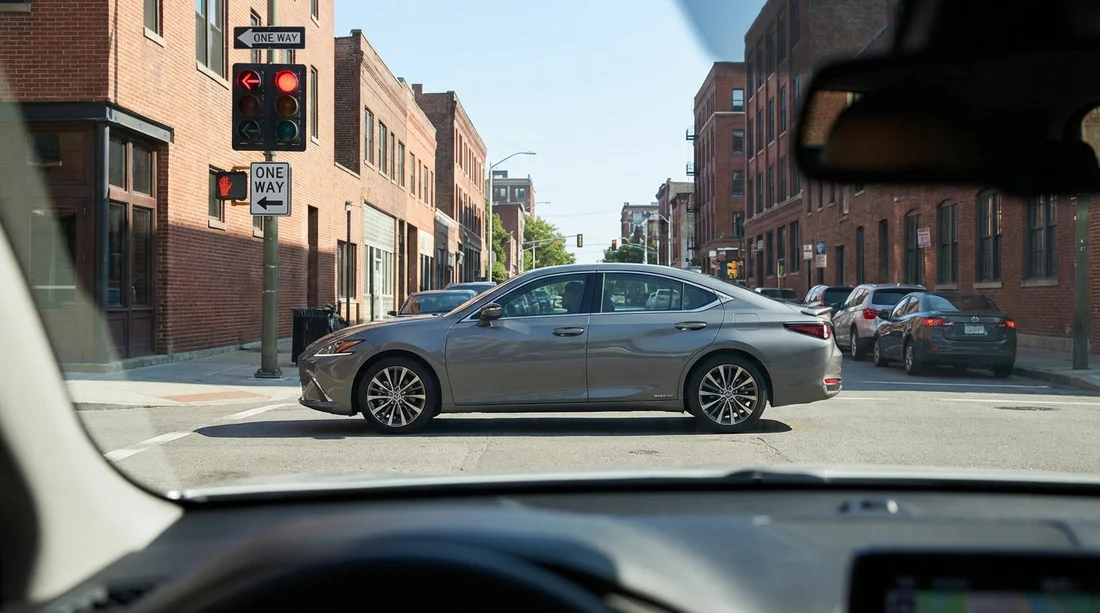
Quick Summary:
- Left on red is allowed only from one-way to one-way.
- Stop fully first, then yield to pedestrians, bikes, and crossing traffic.
- Obey “No Turn on Red” signs, including time-of-day restrictions.
- Use the checklist at Centre City junctions to avoid costly mistakes.
If you are driving on a Pennsylvania car hire in Philadelphia, the big question is whether you can turn left on a red light. In Pennsylvania, a left turn on red can be legal, but only in a specific setup that is common in Centre City: turning from a one-way street onto another one-way street. Even then, you must treat it like a stop, confirm the direction of travel, and watch for sign exceptions that can turn a legal manoeuvre into a ticket.
This guide gives a clear decision checklist for one-way-to-one-way turns, the key sign exceptions you will see in Philadelphia, and practical ways to avoid expensive errors at busy centre-city junctions where pedestrians, cyclists, buses, and delivery vehicles compete for the same space.
First, the basic Pennsylvania rule in plain English
Pennsylvania allows turns on red after a complete stop, unless a sign prohibits it. Most drivers know the right-on-red rule. The left-on-red rule is narrower: it is generally only allowed when you are turning left from a one-way street onto another one-way street, and you are turning into the nearest available lane in the direction of travel. If either street is two-way, assume left on red is not permitted.
Philadelphia’s Centre City grid uses many one-way streets, so the one-way-to-one-way scenario happens often. That said, local signing, heavy foot traffic, and complex junction geometry mean it is easy to misread what is one-way, or miss a restriction sign that applies at certain hours.
Decision checklist: is left turn on red legal here?
Use this sequence every time. It is designed for fast judgement at junctions, without guessing.
Step 1: Confirm you are on a one-way street. Check for “One Way” signs, lane arrows, and the parked-car orientation. In Philadelphia, a street can feel one-way but still be two-way for a short block, or have a contraflow cycle lane that changes where bikes may appear.
Step 2: Confirm the street you are turning into is also one-way. Look across the intersection for “One Way” signs facing you, directional arrows, and the flow of oncoming vehicles. If you see traffic approaching you from the destination street, it is not one-way in the direction you need for a legal left-on-red.
Step 3: Look specifically for prohibition signs. The decisive sign is “No Turn on Red”. In the city centre, it may be paired with time windows, for example restricting turns during weekday peaks. If the sign exists, it overrides the general permission, even if both streets are one-way.
Step 4: Stop completely at the stop line. Rolling through is the quickest way to turn a permissible manoeuvre into a violation. Stop behind the line, then creep forward only if sightlines require it.
Step 5: Yield to pedestrians in the crosswalk. Philadelphia has heavy foot traffic, and pedestrians may enter late or cross against the signal. You must yield regardless of whether your turn is allowed.
Step 6: Check for cyclists and bus lanes. Bikes can appear from behind on your left or right, especially near marked cycle lanes. Bus lanes and turning restrictions can also affect which lane you may enter.
Step 7: Turn into the nearest appropriate lane. Avoid swinging wide into a far lane. Keep the turn tight and predictable, and do not cut across lanes.
If any step is uncertain, treat the red light as a full stop-and-wait situation. With unfamiliar signage, that is often the safest and cheapest choice.
What “one-way to one-way” means in real Centre City driving
Centre City’s pattern includes long one-way corridors and quick, signalised blocks. You may approach a red light in the left lane intending to turn left, and the geometry makes the turn feel natural. The legality hinges on the destination street’s direction. If the destination street carries traffic only in the direction you will be travelling after the turn, that is the classic one-way-to-one-way case.
Be careful with streets that change direction by block, or where signage is partially obstructed by buses, delivery vans, or scaffolding. When you pick up a vehicle, it helps to take a moment to set your navigation and get used to the street grid before you enter the densest areas. For travellers arriving by air and driving straight into town, a location overview can help you plan an easier approach, see car hire at Philadelphia airport.
Sign exceptions that commonly catch visitors
Philadelphia uses standard US traffic control signs, but the frequency of restrictions is higher in busy areas. These are the exceptions that most often lead to costly mistakes.
“No Turn on Red” is the headline restriction. If you see it, you must wait for green, even when the one-way-to-one-way rule would otherwise allow a left on red.
Time-of-day restrictions may appear beneath the main sign. A left on red might be allowed at midday but prohibited during weekday commuting hours. Always read the full sign stack, not just the top plate.
Directional turn restrictions can limit movements to manage congestion, such as “Left Turn Only” from a lane, or bans on certain turns to protect pedestrian flows. These restrictions do not always mention the red-light aspect, but they still control what you can do at that corner.
Work zones and temporary signs are common in the centre. Temporary “No Turn” or lane-closure signage can change normal patterns. In roadworks, do not rely on memory from a previous day.
Signal arrows matter. A red left arrow generally means you cannot turn, even if a circular red on a different head might allow a turn after stopping. If the movement is controlled by an arrow signal, treat it as a direct instruction for that turn.
Avoiding costly mistakes at busy junctions
For visitors in a car hire, the cost of a mistake is not only a fine. A hurried turn can lead to a near miss with pedestrians, an abrupt stop in a junction, or a sideswipe in multi-lane traffic. Here are practical habits that reduce risk in Centre City.
Choose the simplest lane early. If you think you may want a left turn, move to the correct lane with plenty of notice. Late lane changes at short blocks create conflict with cyclists and buses.
Scan for the crosswalk first, then the lanes. In Philadelphia, pedestrians often start crossing at the first hint of a walk signal, and some will cross regardless. Make the crosswalk your first check after stopping.
Do not let honking pressure you. Local drivers may expect you to know the one-way-to-one-way rule. If you cannot verify one-way status or you suspect a restriction sign, wait for green.
Expect bikes on both sides. Some cyclists filter up the left of your vehicle at a red light. Before turning, check mirrors and the blind spot, and keep your speed low.
Watch for “dooring” and delivery vehicles. Even while stopped, a sudden door opening or a van pulling out can force cyclists into your path just as you begin turning.
Be conservative in poor visibility. Rain, night driving, and glare on wet road markings make “One Way” signs and lane arrows easier to miss. If you cannot read the signs clearly, do not turn on red.
If you are basing yourself in the city and doing short urban trips, the best preparation is to familiarise yourself with where the major one-way corridors run and where you will be parking. If you are comparing pickup options and neighbourhood access, see car hire in Philadelphia for a city-focused overview.
Common scenarios, with the correct choice
Scenario 1: One-way street, turning left into a two-way street. Not legal on red. Wait for a green signal, unless directed otherwise by a police officer or temporary traffic control.
Scenario 2: Two-way street, turning left into a one-way street. Generally not legal on red. The one-way-to-one-way condition is not met.
Scenario 3: One-way to one-way, but a “No Turn on Red” sign is posted. Not legal. The sign overrides the general rule.
Scenario 4: One-way to one-way, no restriction signs, clear crosswalk, no conflicting traffic. Potentially legal after a full stop. Yield, then make the turn into the nearest appropriate lane.
Scenario 5: One-way to one-way, but you cannot confirm the destination street direction. Treat it as not legal. Wait for green rather than guess.
Why this matters for visitors using a car hire
Philadelphia’s street layout can be straightforward on a map, yet demanding in motion. Short blocks and frequent signals mean you make more turn decisions per mile than on suburban roads. When you add unfamiliar signage, pedestrian density, and navigation prompts arriving late, the risk of a wrong turn on red goes up.
Plan routes that reduce the number of centre-city left turns during peak times, and use navigation settings that prioritise main roads rather than cutting through narrow streets. If you are travelling with a group and want better visibility and space for luggage, consider vehicle size as part of stress reduction, see SUV hire in Philadelphia for a higher seating position that can improve sightlines at crowded junctions.
Also remember that enforcement and driving culture vary by neighbourhood. A movement that seems common does not make it legal. The only safe basis is the checklist: one-way to one-way, no prohibition sign, complete stop, and yield to all road users.
Quick mental script to use at the lights
If you like a simple phrase to run through while stationary, try: “Both one-way, any sign, full stop, crosswalk clear, bikes clear, nearest lane.” It takes two seconds and prevents the most common errors.
Finally, if you are extending your trip beyond Centre City, remember that the left-on-red exception still depends on the street setup, not the city. You will see fewer one-way-to-one-way opportunities outside the densest grid, but the same sign override applies everywhere in Pennsylvania.
For travellers comparing providers and pickup locations, you can also review car rental in Philadelphia to understand how city driving fits into your broader itinerary.
FAQ
Is a left turn on red legal in Philadelphia? Yes, but only when turning left from a one-way street onto another one-way street, after a complete stop, and only if no sign prohibits it.
Do I have to stop completely before turning left on red? Yes. You must come to a full stop at the stop line or before entering the crosswalk, then yield before turning.
What if I see a “No Turn on Red” sign? Then you must not turn on red, even if both streets are one-way. Some signs also apply only at certain times, so read the full sign.
Can I turn left on red from a two-way street into a one-way street? No, not under the usual Pennsylvania rule. The permitted case is one-way to one-way, not two-way to one-way.
What is the safest approach if I am unsure the destination street is one-way? Wait for the green light. In busy Centre City junctions, guessing increases the risk of a fine or a conflict with pedestrians and cyclists.




























































































