


Quick Summary:
- Scan every pole for paper notices, then recheck the next pole.
- Match the listed dates, hours, and arrow direction to your exact bay.
- Assume restrictions apply immediately if signs conflict or look freshly posted.
- If towed, note the street, call 311, and bring ID promptly.
Temporary ‘No Parking’ restrictions are common in New York, especially in Manhattan and busy Brooklyn and Queens corridors. They pop up for film shoots, utility works, scaffolding, parades, street fairs, moving operations, and emergency repairs. If you are using a car hire vehicle, one missed detail can mean a tow, a ticket, and a long detour to recover the car.
The good news is that most temporary restrictions in NYC follow recognisable patterns. They are usually posted on street sign poles, fencing, or scaffolding, and they nearly always specify dates, times, and an arrow showing the affected stretch. This guide explains what to look for, how to read the details that matter, and what to do when signs seem unclear or contradictory.
Where temporary ‘No Parking’ signs are posted in NYC
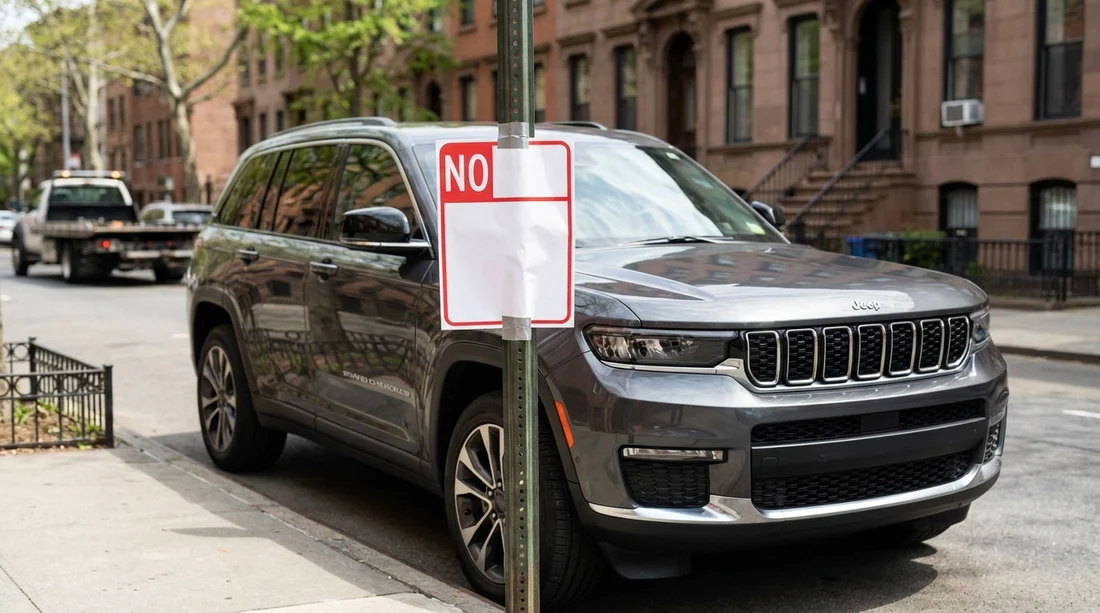
In New York, permanent parking rules are shown on the standard metal street signs, for example “No Parking 8AM to 6PM Except Sunday” or “No Standing Anytime”. Temporary rules are often added with paper notices or bright placards attached to the same pole. Your job is to treat every pole like a mini noticeboard.
Common places to look:
Street sign poles at the start and end of a block. Temporary notices are frequently tied around these, sometimes at eye level, sometimes above the normal sign.
Mid-block poles. In many areas there are extra poles, especially near hydrants, loading zones, schools, and bus stops.
Construction fencing and scaffolding. Work zones can extend beyond the exact building footprint. If you see cones, barriers, or a fresh work site, assume signage may be nearby.
Event infrastructure. Barricades, portable toilets, stages, and generator trucks are good hints that a temporary restriction might be active or imminent.
If you are arriving from an airport pickup, it helps to plan for a few extra minutes to walk the block before you park. For travellers collecting outside the city, Hola Car Rentals has options such as car rental at Newark Airport (EWR) and car hire at New York JFK, which can be useful if you want to sort luggage and navigation before tackling Manhattan kerbside rules.
What film-shoot, construction and event notices look like
Temporary NYC restrictions vary by agency and organiser, but there are three common categories you will see.
Film and TV shoots. Look for notices mentioning “Film Unit”, “Base Camp”, “No Parking”, “No Standing”, “Tow Away Zone”, production company names, or a permit reference. They are often printed on bright coloured paper and taped or zip-tied to poles. Film restrictions can be very specific, covering a short stretch for trucks and trailers, sometimes overnight.
Construction and utilities. These may reference Department of Transportation work, “Sidewalk Shed”, “Scaffold”, “Utility Company”, “Con Edison”, “DEP”, or “Street Opening”. They can be on plain paper or a more official-looking notice. Some relate to safety clearances, crane work, or lane closures, so they may be enforced strictly.
Special events and parades. These often include event names and dates, and can cover multiple blocks. You might see “No Parking” and “No Standing” for race routes, street fairs, religious processions, or marathon-related traffic management.
Whatever the source, the enforcement risk is real. If a posted restriction says “Tow Away”, the city or an authorised operator can remove vehicles so the permitted activity can proceed.
The details that matter: dates, times, arrows, and locations
Temporary signs are only useful if you read them like a checklist. Before you leave a car hire vehicle unattended, confirm four things.
1) The exact date range. Many signs show a single day, but others cover several days, or a window like “Between 01/10 and 01/15”. Do not assume it is only for the day you notice it. Also watch for US date format, which is month/day, so 01/10 means 10 January, not 1 October.
2) The hours, including overnight rules. A common trap is an overnight restriction, for example “10PM to 6AM”. If you park at 8PM, you are still in violation later. Another trap is a morning start like “7AM”, which can be earlier than most people move their cars.
3) Arrow direction and the boundaries. Arrows show which direction along the kerb is restricted. Some notices use one arrow, others show arrows pointing both ways to indicate a stretch centred on the pole. Your space might be legal on one side of the pole and tow-away on the other. Walk to the next pole and check if the restriction continues or ends.
4) The street name and side of street. Some temporary notices specify “North side”, “South side”, “East side”, or “West side”. In Manhattan, avenue numbers can confuse visitors. Confirm you are on the right street and the right side. If the notice says “W 23 St between 8 Ave and 9 Ave”, that is a specific segment, not the entire block you can see from where you stand.
If you are transporting a group, choosing a larger vehicle can make legal parking harder because you may need a longer gap. If that is relevant to your trip, compare vehicle sizes and turning circles when considering options like minivan rental at JFK.
How to scan a block before you commit to a space
NYC kerb rules are rarely communicated by a single sign. A sensible routine reduces mistakes.
Step 1: Stop safely, then walk the full length of your intended parking segment. Look at every pole, not just the one nearest the front of the car. Temporary signs are sometimes posted only at the ends of the affected stretch.
Step 2: Compare temporary notices against permanent metal signs. If a temporary notice contradicts a permanent “No Parking” sign, treat the stricter rule as the one to follow. If the permanent sign allows parking but a temporary notice removes it for certain hours, treat the temporary notice as controlling for those hours.
Step 3: Check for multiple temporary notices. One pole can have film parking for one date, construction parking removal for another, and a moving permit for a short window. You need to ensure you are clear for the entire time you plan to leave the vehicle.
Step 4: Look for clues that enforcement is imminent. Fresh cones, chalk marks on the kerb, “tow away” wording, barricades staged nearby, or crews setting up can indicate the restriction will be enforced promptly.
Step 5: Re-check when you return later. In some situations, new notices appear after you parked, but the city’s posting rules and timing can be complex. Practically, if you will be away for many hours, it is safer to park in a garage rather than rely on a block that looks quiet.
What if signage conflicts or seems unclear?
Conflicts happen, especially on blocks with heavy construction or overlapping permits. Here is how to handle it without gambling on a tow.
Prioritise the most restrictive instruction. “No Standing” is stricter than “No Parking”. “Tow Away Zone” indicates active removal. If one notice suggests you can park and another suggests you cannot, assume you cannot for the time window in question.
Do not rely on other parked cars as proof. Locals sometimes take risks, sometimes they misread a sign, and sometimes they are about to move. Your car hire agreement will not feel any better because other cars were towed too.
Photograph the signs and your car’s position. Take clear photos showing the pole, the notice text, the arrow direction, the street name sign if visible, and your car in relation to the pole. This helps if you need to contest a ticket later, and it helps you recall where you left the vehicle.
Use 311 for clarification when possible. In NYC, 311 can help with information about parking rules, street closures, and towing. If you can call while you are still with the car, you may be able to avoid a mistake. If you cannot get clarity quickly, move on.
Choose a lower-risk alternative. If you are unsure, opt for a paid garage or a different block with clear, consistent signage. The cost of parking is often less than a tow plus lost time.
If you are based outside Manhattan and driving in for a day, some travellers start from New Jersey and avoid the most complex kerbside rules by planning their route and parking in a garage near their destination. Hola Car Rentals provides regional pickup options such as car hire at Newark EWR, which can be convenient for trips that include both NYC and nearby areas.
Common temporary restriction scenarios that catch visitors out
“No Parking” vs “No Standing”. In NYC terms, “No Standing” generally means you cannot stop except briefly to pick up or drop off passengers, and you cannot leave the vehicle. “No Parking” usually allows quick passenger activity, but you still cannot leave the vehicle beyond the posted allowance. If a temporary sign says “No Standing”, do not treat it as a normal parking window.
Early-morning construction windows. A block may be fine overnight but prohibited from 7AM to 3PM. If you parked at midnight planning a late start, you could still be towed when crews arrive.
Segment-specific arrows. A notice might only cover “from this sign to the corner” with an arrow. Parking five metres the wrong way can be enough for enforcement.
Multiple languages or abbreviated street names. Some notices use abbreviations, for example “Av” or “St”. Confirm you are not mixing up similar streets, especially in areas with numbered streets and avenues.
If you get towed: what to do immediately
Even careful drivers can be caught by last-minute changes. If your car is gone, act quickly.
1) Confirm it was towed, not stolen. In NYC, towing for parking violations is common. Look for posted “Temporary No Parking” notices nearby and check if other cars are missing too.
2) Call 311 with the nearest intersection. Provide the street, cross streets, and borough. They can often confirm whether the vehicle was towed and where it was taken.
3) Gather essentials before you travel. Bring your driving licence, rental agreement details, and payment method. If the vehicle is a car hire, you may also need to contact the rental provider for guidance on recovery procedures and authorised drivers.
4) Document everything. Photograph the area, especially any signs that were unclear, damaged, or conflicting. Keep receipts and note times. If you later dispute a ticket, details matter.
5) Inform your rental provider promptly. Policies vary, and the provider may need to coordinate retrieval, fees, or damage checks.
To reduce stress on days with heavy luggage or group travel, some visitors prefer vehicle options that suit their itinerary from the start, including people-carriers or larger vans. For reference, Hola Car Rentals also lists options like van hire from Newark EWR for those starting their trip in New Jersey.
Practical habits to avoid towing during a New York visit
Build time for parking checks. The fastest way to get towed is to park in a hurry. Add five minutes for a sign walk-around whenever you park on-street.
Avoid leaving the car overnight on unfamiliar blocks. Overnight is when early-morning restrictions can catch you. If you must leave it, pick a garage or a clearly signed legal overnight area.
Remember that “looks empty” is not a signal. Many temporary restrictions exist precisely so an empty kerb is available later for trucks, staging, or safety.
When in doubt, relocate. If your reading of the signs involves assumptions, it is not a safe space. In New York, certainty is valuable.
FAQ
How can I tell a temporary ‘No Parking’ sign is meant for my exact spot? Match the street name, side of street, date, hours, and the arrow direction, then confirm the restriction continues to your position by checking the next pole.
Do temporary film-shoot signs have to include times and dates? They typically list a date and time window, plus a location and an arrow. If key details are missing or unreadable, treat the area as high risk and park elsewhere.
If two signs conflict, which one should I follow? Follow the most restrictive rule for the time you will be parked, especially if one mentions “No Standing” or “Tow Away Zone”. When unsure, move the car.
What is the quickest way to find out where my car was towed in New York? Call 311 and give the nearest intersection and borough. They can often confirm whether the vehicle was towed and the tow pound location.
Should I take photos of the signs when I park? Yes. Photos showing the pole, arrows, dates, and your car’s position help if you need to explain what you saw or dispute a ticket later.




























































































