


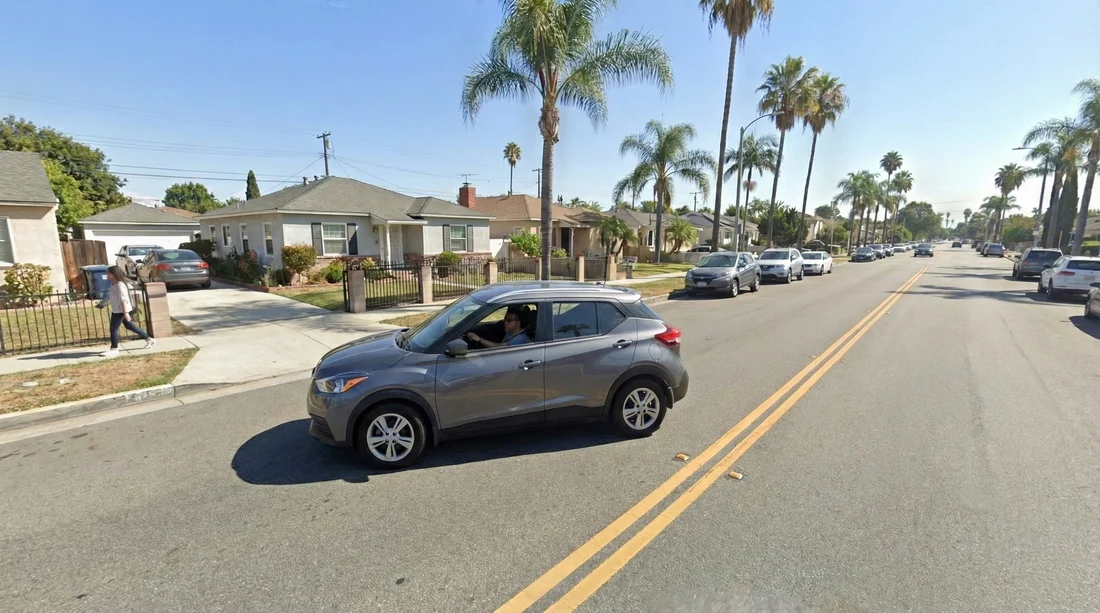
Quick Summary:
- Cross double yellow lines only to enter a driveway or private road.
- Never cross where signs forbid left turns, U-turns, or lane changes.
- Do not park next to double yellow lines, stopping is usually restricted.
- Wait until safe, yield to oncoming traffic, and complete turns promptly.
When you pick up a car hire in Los Angeles, the centreline markings can feel stricter than what many visitors are used to. Double yellow lines are one of the most common road markings you will see on city streets and canyon roads, and they exist to separate opposing traffic. The key question is not only whether you can cross them, but also which extra markings and signs turn a routine manoeuvre into a ticket-prone mistake.
In California, double solid yellow lines generally mean you must not pass traffic by crossing into the oncoming lane. However, there are limited situations where crossing is allowed, most commonly to turn left into or out of a driveway or a private road. The details matter, because enforcement in Los Angeles can be strict in busy corridors, near schools, and around intersections where visibility is limited.
If you are planning airport driving, it can help to read up on pick-up areas and local routes before you set off. Hola Car Rentals maintains location pages like Los Angeles LAX car rental and California LAX car rental which are useful starting points for understanding the general driving context around the airport and beyond.
What double yellow lines mean in Los Angeles
Think of a double solid yellow line as a strong “stay on your side” instruction. It separates two-way traffic and signals that passing is not permitted. On many Los Angeles streets, lanes are narrow and traffic flow is fast, so crossing into the opposite lane can quickly become dangerous.
Important nuance, double yellow lines restrict passing, not turning. That is why you will often see drivers cross them to reach a driveway, a car park entrance, or a side street. The manoeuvre can be legal if it is done only as necessary to complete a turn, and only where other signs and markings do not prohibit it.
Crossing double yellow lines for left turns
Common scenario, you are driving along a two-way street with a double yellow centreline and your destination is on the left. In many cases, you may legally slow, signal, and turn left across the double yellow lines to enter a driveway or a private road. You should do it without cutting the corner or lingering in the oncoming lane.
Where people with a car hire get into trouble is assuming “I can cross to turn left” always applies. It does not. You must also check for:
1) No-left-turn signs at intersections or driveways. A posted sign overrides the general expectation that a left turn is permitted. If you turn anyway, the fact that you only crossed double yellows briefly will not help.
2) Dedicated turn restrictions near intersections. Some stretches use double yellow lines plus additional markings, channelisation, or signage to keep traffic moving. If a sign says “No left turn” or “Left turn prohibited”, do not cross.
3) Safety and visibility constraints. Even if permitted, you must yield to oncoming traffic and pedestrians, and only turn when it is safe. On curving roads or hills, waiting for a large gap is essential.
If you are visiting from abroad, remember right turns on red are common in California after a complete stop unless a sign prohibits it, but that rule does not change the meaning of centreline markings. Always treat double yellow as a “do not overtake” marking, not as a general permission to weave.
Entering and exiting driveways across double yellow lines
Driveway access is the most frequent lawful reason to cross double yellow lines. This includes entrances to homes, car parks, fuel stations, and other private property. If your Los Angeles car hire route involves frequent stops, for example collecting luggage, visiting a friend, or pulling into a hotel, the safest approach is to plan for controlled turns rather than sudden braking.
When turning into a driveway across double yellows:
Signal early and slow smoothly. Sudden braking is a common cause of rear-end crashes.
Stop if you must, but avoid blocking traffic longer than necessary. It is better to miss a driveway and turn around legally than to stop abruptly in a live lane.
Yield to pedestrians on the pavement. In Los Angeles, pedestrians may appear quickly from between parked cars or bus stops.
Watch for driveways near junctions. A driveway close to a corner can be subject to extra restrictions, including signs or limited sight lines that make the manoeuvre unsafe.
When exiting a driveway and needing to cross double yellows to go the other direction, the same principles apply. You may be able to turn left, but you must yield to all traffic and only proceed when you can clear the oncoming lane promptly. If traffic is heavy, consider turning right first, then making a legal U-turn later where allowed, or using a signalised junction.
U-turn setups: when the centreline and signs change the rule
Visitors often confuse U-turn legality with double yellow rules. In California, U-turns are permitted in many places unless prohibited by signs, but Los Angeles has plenty of signed restrictions, especially near signals, in business districts, and on multi-lane roads.
Double yellow lines do not automatically ban a U-turn, but there are common situations where a U-turn becomes illegal or high-risk:
Posted “No U-turn” signs. These are frequent near traffic lights and where U-turns would disrupt flow.
Near intersections with limited visibility. Even where not signed, you must not make a U-turn unless you can do so safely without interfering with other traffic.
Across multiple lanes with a narrow median. On some roads, double yellow lines sit alongside other markings that narrow the space available. If you cannot complete the turn without mounting a kerb or swinging widely into another lane, do not attempt it.
In areas with additional channelisation. Painted islands, diagonal hatch markings, or raised medians can make the manoeuvre illegal even if the centreline alone might not.
If you are navigating with a sat nav, be cautious of prompts that suggest a U-turn on a busy arterial road. Instead, look for a signalised junction, a dedicated turning pocket, or a safer place to reverse direction.
Parking and stopping next to double yellow lines
Many drivers assume double yellow lines mainly relate to moving traffic, but in Los Angeles they often sit on roads where stopping is also restricted. As a practical rule, do not park next to double yellow centrelines. It is frequently illegal to stop on the roadway side that would force other vehicles to cross into oncoming traffic to pass you.
More importantly, parking legality in Los Angeles is often controlled by kerb paint and posted signs, not by the centreline alone. If you are looking for a quick place to pull over, check the kerb and nearby signposts first.
High-risk ticket scenarios include:
Stopping in a travel lane to load or unload where there is no designated kerb space. Even short stops can draw attention in congested areas.
Parking too close to a junction, crosswalk, or driveway. Even if you are not on the double yellows, blocking sight lines or access can earn you a citation.
Stopping where kerb paint indicates restrictions. Red kerbs, for example, are widely used to indicate no stopping. Always follow the local sign if present.
If you are driving a larger vehicle, such as a people carrier, the margin for error is smaller. Hola Car Rentals offers information on options like minivan rental in California LAX, and it is worth remembering that longer vehicles may need more space to pull in legally without clipping lane lines or blocking traffic.
Markings and signs that make crossing illegal and ticket-prone
The double yellow lines are only one part of the picture. In Los Angeles, these additional elements frequently turn a “maybe” into a clear “no”:
No-turn signs. “No left turn” and “No U-turn” are straightforward, and enforcement can be strict at high-volume junctions.
Solid white lines and lane control. While white lines separate lanes moving in the same direction, solid white lines can indicate you should not change lanes in that area. Combining an illegal lane change with a turn can increase risk.
Painted medians and hatch markings. Diagonal stripes and painted islands guide vehicles away from hazards. Do not drive over them to reach a turn unless a break and arrows clearly indicate an entry point.
Raised medians or kerbs. A physical divider is an obvious barrier. If you must mount a kerb or cross a raised separator to make your turn, the turn is not lawful.
School zones and special corridors. Even where a turn is legal, speeds are lower and enforcement is higher. Expect less tolerance for abrupt moves.
Practical guidance for car hire drivers in Los Angeles
If you want to avoid citations and stressful interactions, focus on predictability. Los Angeles traffic punishes hesitation, but it also punishes sudden moves. These habits help:
Plan turns early. If your left turn is approaching, move into an appropriate lane well in advance, then slow gradually.
Use the next safe option. If you miss a driveway, do not stop and reverse. Continue to a legal turnaround, a side street, or a signalised junction.
Prioritise sight lines. On roads with double yellow lines, assume there is a reason passing is restricted, often poor visibility. That same limitation affects turns.
Let faster traffic go. If you are waiting to turn left across double yellow lines, be mindful of vehicles behind you. Signal, position correctly, and complete the turn when safe.
Expect local patterns. Some corridors have heavy left-turn demand, and drivers may be impatient. Staying calm and strictly following signs is your best defence.
If your trip includes other Southern California airports or cities, you may encounter slightly different local signage practices while still following California rules. For nearby options, Hola also provides pages such as car hire in Santa Ana SNA and Dollar car hire at Los Angeles LAX, which can be helpful when comparing pick-up locations and typical driving routes.
Common misunderstandings to avoid
“If no one is coming, I can cross double yellows to pass.” No. Double solid yellow lines generally prohibit passing, even if the road looks clear.
“I can cross them to park quickly.” Parking rules depend on kerb paint and signs, and stopping in a travel lane can be illegal and dangerous.
“I can make a U-turn anywhere unless there is a median.” U-turns are often restricted by signs, intersection rules, and safety requirements.
“A sat nav instruction means the manoeuvre is legal.” Mapping tools do not always account for local turn bans or time-based restrictions.
FAQ
Can I cross double yellow lines in Los Angeles to turn into a driveway? Often yes, you may cross double solid yellow lines to enter or leave a driveway or private road, provided there is no sign forbidding the turn and it is safe.
Is it legal to cross double yellow lines to make a left turn at an intersection? It can be legal, but many Los Angeles intersections have “No left turn” restrictions. Always follow posted signs and lane arrows, and yield to oncoming traffic.
Can I cross double yellow lines to make a U-turn? Sometimes, but only where a U-turn is not prohibited by signs and you can complete it safely without disrupting traffic. Avoid busy multi-lane roads unless clearly permitted.
Can I park next to double yellow lines? Usually you should not. Parking legality is controlled by kerb paint and signs, and stopping near double yellow centrelines commonly creates an obstruction that can be ticketed.
What should I do if my sat nav tells me to turn across double yellow lines where signs disagree? Follow the signs and road markings, not the sat nav. Continue to the next safe, legal turning point and reroute from there.




























































































