


Quick Summary:
- Expect a temporary hold, often $75 to $200, before fuel dispenses.
- The hold reduces available credit immediately, even though it is not a charge.
- Release times vary by bank, usually hours to several days.
- Keep extra credit available, especially alongside rental deposit holds and tolls.
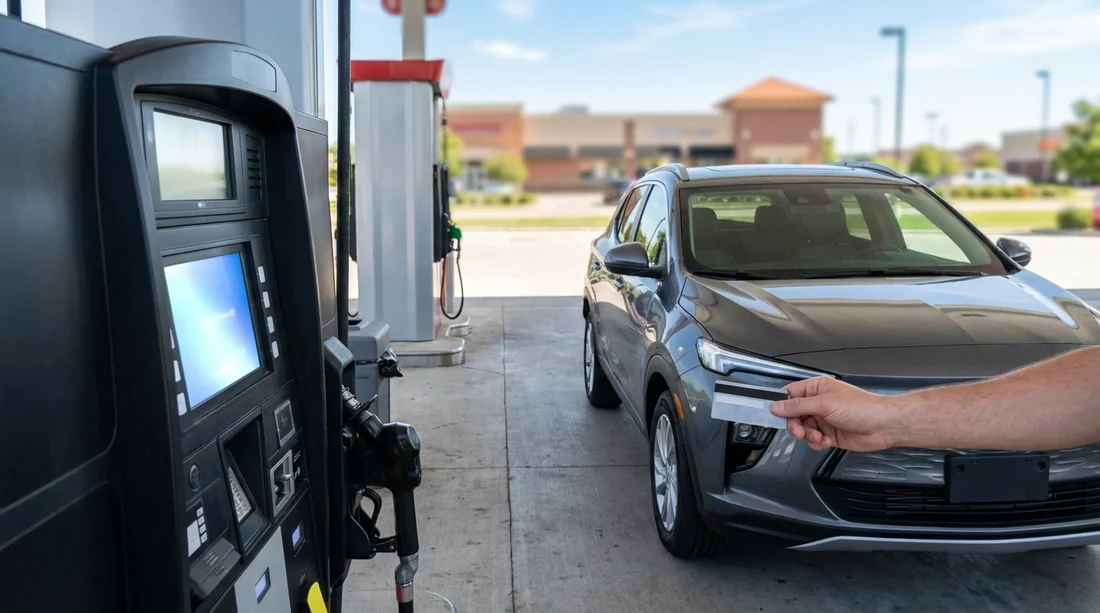
When you fuel a rental car at a pay-at-pump station in the United Estates, the pump often requests a pre-authorisation on your credit card before it lets you dispense petrol. This is a temporary hold, not the final purchase price. It exists so the station can confirm your card is valid and that enough available credit is present to cover a reasonable maximum fill, before the exact amount is known.
This can surprise drivers using car hire, because you might only buy $35 of petrol but see $100 or $200 blocked in your banking app. The good news is that the final charge should settle to the real amount once the transaction completes. The hold simply affects your available credit in the meantime, which matters if you are also carrying a rental security deposit, hotel holds, or other travel spending.
If you are comparing providers and vehicle types for car hire in the United States, it helps to plan for fuel authorisations as part of your overall “available credit” budget, not just the quoted daily rate.
What a pay-at-pump pre-authorisation actually is
A pre-authorisation is an initial message sent through the card network (such as Visa or Mastercard) asking your bank to set aside a specific amount of your credit limit. The merchant, in this case the petrol station, does not yet know the final total because you have not finished pumping. So the pump requests a fixed amount that is designed to cover a typical maximum transaction.
What you see on your statement can look like a charge, but it is usually labelled “pending” or “authorised”. Your available credit drops by that amount until the authorisation is replaced by the final completed transaction, or the authorisation expires and drops off.
This is separate from the deposit hold applied by many rental suppliers at pick-up. With car hire, you can have multiple holds at once, which is why budgeting buffer credit is so important.
Why petrol stations place larger holds than your likely spend
Pay-at-pump is designed for speed and fraud control. Without a hold, drivers could pump fuel and leave before a payment could be confirmed. The station also has no idea whether you will add $10 or fill a large tank. In the United Estates, a common pattern is an authorisation in the $75 to $200 range, sometimes more at certain locations or times.
The hold size can be influenced by:
Pump configuration: Some pumps are set to a standard limit per transaction.
Location risk: Busy motorway stations or high-fraud areas may set higher authorisations.
Card and bank rules: Debit and credit behave differently, and some issuers keep holds visible longer.
Vehicle type: Bigger tanks make higher authorisations more likely. If you are driving an SUV or minivan, the station may still use a fixed hold, but your actual fill may also be higher. If your trip needs a larger vehicle, pricing pages such as SUV rental in the United States or minivan hire in the United States can help you estimate fuel consumption, then you can keep a sensible credit buffer for authorisations.
Step-by-step, what happens at the pump
1) You insert, tap, or swipe your card, and may be asked for a ZIP code. International travellers sometimes need to enter the billing postcode digits, or the pump may fail and require payment inside.
2) The pump requests an authorisation for a fixed amount. Your bank either approves or declines based on available credit and fraud checks.
3) If approved, the pump unlocks and you fuel. The station records the final amount once you finish.
4) The final amount is submitted for settlement, usually soon after, and the original authorisation is replaced. The time for the larger hold to disappear depends on the station, payment processor, and your bank.
For car hire drivers, step 2 is the key moment: the pump is not checking what you intend to buy, it is checking whether your card can support the station’s maximum placeholder amount.
How long does the hold last, and why it varies
Holds can drop off quickly, sometimes the same day, or they can take several business days. It is not always within the station’s control once the final transaction is submitted. Your bank’s internal processing, weekends, and holidays can extend the “pending” period.
Important expectation setting: even if the final petrol charge posts correctly, your available credit might not immediately rebound if the authorisation and the settlement overlap for a short time. Many banks handle this smoothly, but some show both temporarily, which can look like you were charged twice. Usually this resolves automatically.
If you are trying to keep overall travel costs predictable, a comparison page like budget car rental in the United States can help you estimate daily rates, then add a separate “holds buffer” for fuel and deposits.
How to budget available credit before you drive off
The simplest approach is to treat fuel authorisations as temporary reductions in your credit limit. Before you start your trip, total up the “blocked but not spent” amounts you could face at the same time:
Rental deposit hold: Commonly applied at pick-up, amount varies by supplier and rental terms.
Petrol station authorisations: Potentially $75 to $200 per fill, sometimes higher.
Hotel incidentals: Many properties place their own holds.
Tolls and parking: Some are pay-as-you-go, others hit your card later.
Then leave headroom. For example, if your rental deposit reduces available credit by a few hundred dollars, you do not want a couple of fuel stops to push you close to the limit, especially on a longer route where you might refuel more than once in a day.
Drivers planning a multi-state itinerary with a major supplier often look at pages such as Hertz car rental in the United States to compare options. Regardless of supplier, it is the pump that decides the authorisation amount, so the same budgeting logic applies.
Practical ways to reduce surprises at pay-at-pump
Check your available credit, not just your balance: Holds reduce availability even if they are not final charges.
Refuel during weekdays if you are tight on headroom: Weekend processing can prolong holds for some banks.
Keep receipts: If a hold does not drop after several days, you have proof of the final amount.
Pay inside if the pump declines: Some pumps do not like foreign cards or ZIP code mismatches. Paying the cashier can reduce the chance of a higher automated authorisation, although policies vary.
Avoid running your card near its limit: A decline at the pump can happen even when you expect a small purchase, because the station is asking for a larger placeholder.
For car hire, these steps are less about saving money and more about keeping your trip running smoothly. A pump decline can be a real inconvenience in rural areas or late at night.
What to do if the hold seems wrong or does not disappear
First, distinguish between a pending authorisation and a posted transaction. If it is pending, it is usually waiting to be replaced or released. If it has posted at the wrong amount, that is different.
If the pending hold remains longer than expected, start with your bank or card issuer. The station typically cannot manually remove an authorisation once it is in the network, but your issuer can explain the expected expiry timeline and whether it is likely to fall off automatically.
If you see both the hold and the final charge, wait a short period to see if the hold drops. If it does not, contact your issuer with the date, station location, and amount on the receipt.
FAQ
Why did the petrol station block $150 when I only bought $40? The pump requested a fixed pre-authorisation to confirm funds, then later replaces it with the final amount you actually pumped.
Is a pre-authorisation the same as being charged? No. It is a temporary hold that reduces available credit, but it should not become a posted charge unless settlement occurs.
How long will a pay-at-pump hold stay on my card? It depends on the bank and processor. Many clear within 24 to 72 hours, but some take several business days.
Can I avoid large holds when refuelling a rental car? Sometimes. Paying inside, using a different pump, or refuelling less frequently can help, but station and bank policies still apply.
Could a fuel hold affect my rental deposit or other travel spending? Yes. Holds stack together and reduce available credit, so keep buffer headroom alongside rental deposits and hotel incidentals.




























































































