


Quick Summary:
- Most US rental counters use chip-and-signature, so a PIN is uncommon.
- Bring the physical credit card, matching ID, and your rental confirmation.
- Expect a deposit hold, and ensure your limit covers it.
- Call your bank pre-trip to approve US travel and larger authorisations.
If you are picking up a car hire at Miami Airport in Miami, the PIN question comes up a lot, especially for travellers used to chip-and-PIN terminals in the UK and Europe. The reassuring news is that, in the United States, rental car counters typically run cards as credit transactions, even when the card has a PIN. That means you are usually asked to insert the chip and sign, or occasionally tap and sign, rather than enter a PIN. Problems arise when travellers arrive with the wrong card type, insufficient available credit for the security deposit, or a card that is blocked for US travel or car rental merchant category transactions.
This guide explains how payment terminals generally work at the counter, what the rental agent is trying to do when they take a deposit, and the practical steps to prepare your credit card so your Miami pick-up is smooth and quick.
Do you actually need a PIN at Miami Airport car hire desks?
In most cases, no. At Miami Airport, rental desks usually process a chip card as a credit purchase with signature verification, followed by a pre-authorisation for the deposit. A PIN is more common for cash machine withdrawals or debit card payments, not for credit card payments at US rental counters.
That said, there are a few situations where a PIN might come into play.
Some cards can be routed as debit. If the terminal or the agent selects debit rather than credit, the system may request a PIN. This is more typical with debit cards than with credit cards, but it can happen with certain Visa and Mastercard products that support both routing methods.
Some self-service or unattended devices ask for PINs. Parking machines, fuel pay-at-pump terminals, or kiosks sometimes ask for a ZIP code or a PIN-like verification, and foreign cards can behave differently. This is separate from the main rental counter process.
Security verification can vary by issuer. If your card issuer flags the transaction, the payment might fail regardless of whether a PIN is required. This is why travel notifications and temporary spending limit increases matter.
For most travellers collecting a car hire at Miami International Airport, the better question is not Do I need a PIN, but whether the card will work for a deposit hold and whether there is enough available credit.
How US card terminals work at the rental counter
At the counter, the agent usually performs two card actions. First, they charge or confirm the rental amount, or a portion of it. Depending on how your booking is set up, you might pay at the counter, or you may have prepaid elsewhere and only pay extras locally.
Second, they place a pre-authorisation hold. This is not a charge in the normal sense. It temporarily reduces your available credit to protect the rental company against extra costs, such as tolls, fuel, additional days, damage excess, or admin fees.
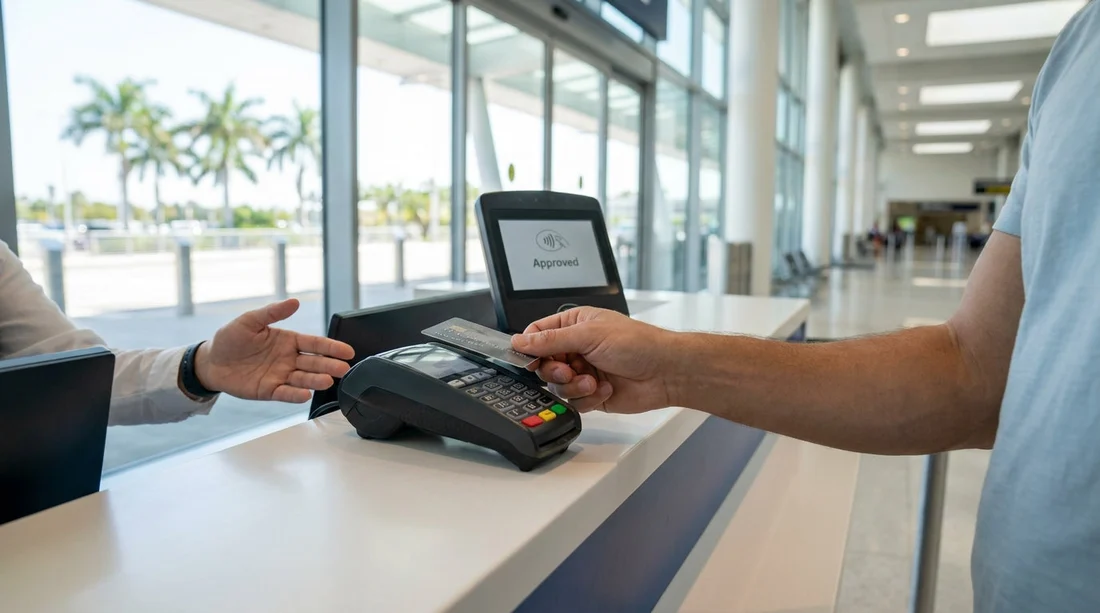
In the US, chip-and-signature is still widely used for credit transactions. The terminal may print a receipt for you to sign, or the signature may be captured electronically. A PIN prompt is not the default for credit cards at the counter.
If you want to review pick-up expectations and practical information for the airport area, see car hire at Miami Airport (MIA).
What usually causes delays at Miami pick-up, and how to prevent them
Delays are usually caused by verification and authorisation issues, not by missing PINs. Here is what helps most.
Bring the physical card, not only a digital wallet. Even if your card works in Apple Pay or Google Pay, many rental counters still require the physical card for the deposit. The agent may also need to verify the printed name and the card number.
Make sure the cardholder name matches the lead driver. The deposit is typically taken from the main driver’s credit card. If the card belongs to someone else, the counter may refuse it, even if you have permission to use it.
Check your available credit, not just your credit limit. If you have a high limit but large pending transactions, the deposit authorisation can be declined.
Tell your bank you are travelling to the US. Some issuers still block first-time US transactions, higher-value authorisations, or car rental category holds. A quick in-app travel notice can reduce the risk of declines.
Avoid mixing up credit and debit at the desk. If you have both card types, present the credit card first. Debit cards can work in some cases, but policies vary and the deposit process can differ.
PIN, ZIP code, and other prompts, what you might be asked
Travellers sometimes interpret any numeric prompt as a PIN request. At US payment terminals, you might see different prompts depending on the device.
PIN prompt. More common for debit transactions. If your card is being processed as credit, you typically will not enter a PIN.
Billing ZIP code prompt. Pay-at-pump fuel terminals often request a US ZIP code to verify the card. Foreign cards may fail this step because they do not have a US ZIP code associated with the billing address. If this happens, pay inside the station instead of at the pump.
Signature prompt. Still normal for US credit transactions, including at rental counters. Even when no signature is captured, the receipt may state Verified by PIN or No CVM, which can be confusing.
Preparing your credit card for a smooth Miami rental counter experience
Use this checklist before you fly.
Confirm your card is a true credit card. Many travellers carry cards branded as Visa or Mastercard that are actually debit or prepaid. For car hire deposits, a mainstream credit card is the safest option.
Plan for the deposit size. The hold is often more than the headline rental price.
Carry a backup card. Even when you do everything right, an issuer can decline a transaction. A second credit card can save a lot of time.
For travellers staying outside the airport zone, it can be useful to compare local collection points. For example, car hire in Coral Gables can suit those based near downtown areas, while car hire near Doral is convenient for western Miami neighbourhoods.
If you are combining cities in South Florida, planning ahead helps. If you need a larger vehicle for luggage or a group, see van hire in Fort Lauderdale as a comparison point for capacity planning.
FAQ
Do I need a PIN to pay by credit card at Miami Airport for car hire? Usually not. Most Miami Airport rental counters process credit cards via chip-and-signature, with a deposit pre-authorisation.
Why does the rental company take a deposit hold on my card? The pre-authorisation secures funds for potential extras like tolls, fuel differences, or additional days, and it reduces your available credit temporarily.
What if the card terminal asks for a ZIP code? That prompt is more common at fuel pumps than at rental counters. If your foreign card fails at the pump, pay inside the station instead.
Can I use a debit card instead of a credit card in Miami? Sometimes, but acceptance rules and deposit amounts can differ. A credit card in the main driver’s name is typically the smoothest option.
How can I avoid my card being declined at the counter? Enable US travel with your bank, ensure enough available credit for the deposit, carry the physical card, and bring a backup card.




























































































