


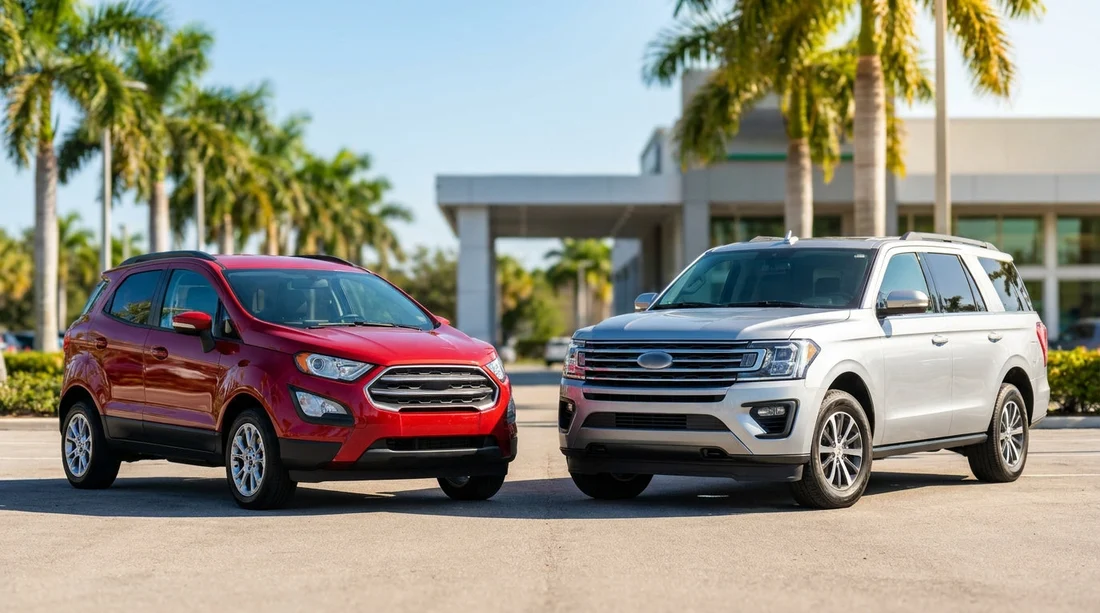
Quick Summary:
- Choose a crossover for easier parking, better economy, and lower step-in height.
- Pick an SUV class when you need more luggage volume and road presence.
- Check the quote for seats and bags, not just class names.
- For Florida family trips, prioritise boot shape for strollers and coolers.
When comparing a US car hire quote in Florida, “crossover” and “SUV” can look like near-identical categories. In practice, they usually sit in different size bands, with different boot shapes, passenger comfort, and sometimes very different fuel costs. The confusing part is that rental fleets rotate, so a class name describes a type, not a guaranteed model.
This guide breaks down what travellers typically get in each class, how to interpret “seats and bags” on a quote, and how Florida-specific driving and packing needs can push you toward one category or the other.
What rental companies usually mean by “crossover”
A crossover is generally a car-based vehicle, built on a platform closer to a hatchback or estate than a traditional off-road style SUV. On a Florida car hire quote, crossovers often appear as “Compact SUV”, “Small SUV”, or “Crossover” classes. They tend to have a slightly raised ride height, a practical tailgate, and a cabin designed for everyday use rather than maximum towing or ground clearance.
Crossovers are often a strong choice for couples, small families, and travellers doing a mix of city driving and day trips where parking convenience matters as much as luggage volume.
What rental companies usually mean by “SUV”
An SUV class on a Florida car hire quote typically signals a bigger vehicle, sometimes with a longer wheelbase, wider body, and a squarer rear for luggage. You may see “Intermediate SUV”, “Standard SUV”, “Full-size SUV”, or “Premium SUV”. These classes can include two-row and three-row vehicles, depending on how the fleet is grouped.
The key point is that “SUV” is a broad label. Two vehicles in the same SUV class can vary in boot depth and third-row practicality, so you should always cross-check what the quote says about bags.
Size and parking: why Florida makes this a real trade-off
Florida driving often mixes wide highways with tight destination parking. Miami and beach areas can have compact spaces, low ceilings, and narrow ramps. Meanwhile, Orlando-area attractions and outlet malls tend to have big open lots, where size is less of an issue.
If you are collecting around Miami, comparing categories via location pages can help you understand what fleets are common. For example, travellers looking at car hire in Downtown Miami may prioritise manoeuvrability. If you are picking up near the airport and driving straight to resorts with surface parking, an SUV class can feel effortless over longer distances. Options around Alamo car hire in Miami often span both crossover and SUV groups, so the “seats and bags” line becomes the best shorthand for real-world space.
Boot space: the shape matters more than the litres
Most travellers choose between crossover and SUV based on luggage, but “boot space” is not just capacity. It is also the shape of the opening and the floor height.
Crossovers: often have a slightly sloped tailgate and a higher boot floor. This can reduce how easily you stack rigid suitcases. They are great for soft bags, beach gear, and everyday shopping.
SUVs: more likely to have a squarer opening and taller cargo box, which is helpful for large hard-shell cases, a folded pushchair, or a cooler plus shopping.
For Florida trips, consider what you will actually carry day-to-day, not just on arrival. Beach umbrellas, chairs, a stroller, and a pram travel system can be awkward in a crossover if the boot is shallow.
Seating: five seats is not always five comfortable seats
Both crossovers and many SUV classes advertise five seats, but rear bench comfort varies widely. For adults on a longer run, such as Miami to Naples or Tampa to the Space Coast, the difference shows up in shoulder room and legroom.
For seven-seat needs, do not assume “SUV” means three rows. Look for an explicit “7 passenger” or “Large SUV” style description. If you need the third row regularly, also check what happens to the boot when the third row is up, because some vehicles leave little space behind it.
Fuel costs and toll planning
Fuel economy is a quiet budget factor in Florida. Crossovers typically use less fuel than larger SUVs, especially if you will be driving long distances on I-95, I-75, or across to the Keys. The bigger the vehicle, the more you notice it when petrol prices rise.
Tolls are also common around Miami, Orlando, and Tampa. Toll costs do not change by crossover versus SUV, but if you are trying to keep the overall trip budget tight, a crossover can help by lowering fuel spend while still offering the higher seating position many people want.
Interpreting “seats and bags” on a car hire quote
When comparing crossover and SUV classes, the most useful line on a quote is the luggage allowance, often shown as something like “2 large bags, 1 small bag”. While not perfect, it is usually a stronger indicator than marketing labels.
If you are collecting in the Doral area, browsing options for car hire at Airport Doral can be a useful way to see how categories are presented across suppliers. Fleet mix can differ by location, which influences how “crossover” or “SUV” gets grouped in practice.
Which class suits common Florida trips?
City breaks in Miami with day trips: a crossover is often the sweet spot for parking, comfort, and fuel spend, while still carrying beach gear.
Theme parks and outlets with family luggage: if you are juggling prams, backpacks, and shopping, an SUV class can make loading and unloading simpler.
Multi-centre Florida road trips: consider how often you will repack. A squarer SUV boot can reduce the daily “luggage puzzle”.
Groups of five adults: lean SUV for rear-seat comfort and shoulder room, even if the quote lists five seats for both.
If your party is larger or you have unusually bulky items, it may be worth comparing against a people carrier style option. For reference, Hola also lists larger-capacity options via van rental in Florida, which can be more straightforward than squeezing into an SUV class with limited cargo depth.
FAQ
Q: Is a crossover always smaller than an SUV on a Florida car hire quote?
A: Usually, yes, but not always. Some “compact SUV” crossovers can be close in size to a smaller “intermediate SUV”, so check the seats and bags line.
Q: Will an SUV class in Florida guarantee seven seats?
A: No. Many SUV classes are five-seat, two-row vehicles. Look for wording that clearly states seven passengers or a large SUV category.
Q: Which has the bigger boot, crossover or SUV?
A: SUVs often have a squarer, taller boot that fits bulky items better. Crossovers can still be roomy, but the boot may be shallower with a sloped tailgate.
Q: Are crossovers easier to drive in Miami and other Florida cities?
A: Many drivers find crossovers easier for tight parking and narrow garages. They also tend to have a smaller turning circle than larger SUV classes.
Q: Does choosing an SUV mean better safety for Florida driving?
A: Not automatically. Safety depends on the specific vehicle, tyres, and how you drive. SUVs may offer higher seating and visibility, while crossovers can feel more nimble in traffic.




























































































