


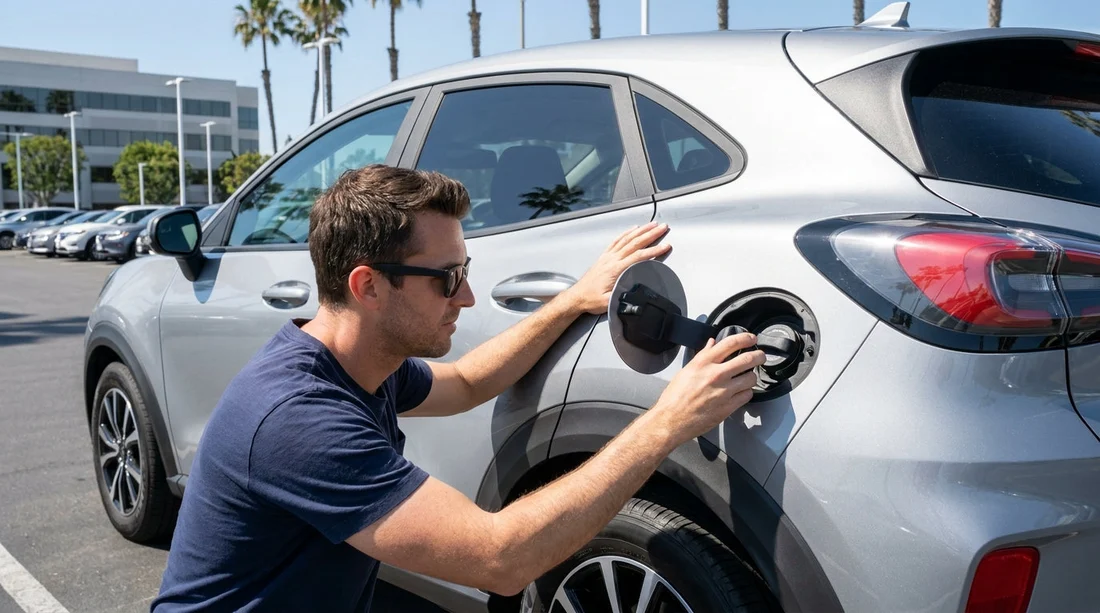
Quick Summary:
- Find the fuel door release and confirm it opens easily.
- Check the fuel type label and match it to the pump nozzle.
- Locate the EV charge port and test opening and closing.
- Confirm you have any required key, card, or adapter access.
Fuel and charging mistakes are among the quickest ways for a smooth pickup to turn into a delay. On a busy California forecourt, it is easy to assume every car opens the same way, or that a label is obvious. A practical two minute check at the bay can prevent misfuelling, avoid a jammed flap, and save you a second trip back to the desk.
This checklist focuses on what to confirm about the fuel cap and, if applicable, the EV charge port before you drive away with your car hire. It is designed for real pickup conditions, bright sun, tight parking spaces, and the pressure of a queue behind you.
1) Confirm how the fuel door opens, without guessing
Start by locating the fuel door, then work out the correct opening method. Different models use different systems, and forcing the wrong one can bend the flap or break the hinge.
Cabin lever or button: Often near the driver’s footwell or on the dashboard. Pull or press it once, then listen for the flap to pop. If nothing happens, do not keep yanking, ask staff to confirm the control.
Press-to-open flap: Many newer cars unlock the fuel door with central locking. With the car unlocked, you press a corner of the flap to release it. Test this while you are still next to the bay, because if it only opens when the car is unlocked, you need to know that before arriving at a pump.
Capless fuel system: Some vehicles have no screw cap. Instead, you push the nozzle through a spring loaded seal. If you see a capless insert, look for a warning about using the correct nozzle size, and keep the area clean to avoid dirt getting inside.
Locking cap: Less common, but still possible on some vehicles. If the cap requires a key, verify you have the right key and that it turns smoothly.
If you are collecting at a major airport, staff are used to questions like this. At pickups such as car hire at LAX or car hire at San Francisco SFO, it is worth confirming the release method before you join exit traffic, because returning to the pickup area can be awkward.
2) Check the fuel type label, then cross-check it twice
Misfuelling is expensive and can immobilise the vehicle. Do not rely on assumptions about the car’s size or brand. Instead, confirm the fuel type in two places.
Inside the fuel door or on the cap: Look for “Unleaded”, “Gasoline only”, “Diesel”, or similar. Some cars show the minimum octane rating, commonly 87 in California. That does not mean you must buy premium, it tells you the lowest safe grade.
On the instrument cluster or in the infotainment: Many vehicles show “Diesel” or “Gasoline” in vehicle information menus. If you see conflicting information, stop and ask for clarification before leaving the lot.
Also check whether the car is a hybrid, plug-in hybrid, or fully electric. A plug-in hybrid can have both a fuel door and a charge port, which is exactly why a quick walk-around matters. If it is a diesel model, be extra cautious at the pump because misfuelling often happens the other way around, petrol into a diesel vehicle.
3) Inspect the fuel cap or capless seal for damage and correct fit
Once you have the flap open, take a close look. You are not doing a mechanical inspection, just confirming nothing is obviously loose, missing, or difficult to operate.
If there is a screw cap: Unscrew and re-screw it once. It should thread smoothly, tighten with light resistance, and click if it is a ratcheting cap. A cap that spins without tightening, or one that cross-threads, can trigger an emissions warning light and may cause vapour leaks.
If the car is capless: Check the spring loaded inner flap moves freely. Do not poke it with fingers, just confirm it is not stuck open and there is no debris around the seal.
Finally, close the fuel flap. It should latch flush. If it bounces open, the latch may be misaligned, which can become a problem later at speed or when parked.
5) For EVs and plug-in hybrids, locate the charge port and practise opening it
Charging issues often come down to one simple obstacle, you cannot open the charge port when you need it. Before you drive off, find the port and confirm how it opens and closes.
Press-to-open door: Similar to a fuel flap, but sometimes only works when unlocked.
Cabin button: A dashboard or door panel release that pops the charge door.
Touchscreen control: Some EVs require a menu action to unlock the port.
Key fob command: Less common, but possible on certain models.
Open it once, then close it once. Check that it sits flush and does not require force. If there is a separate connector latch area, confirm it is not damaged. A charge door that will not close properly can affect aerodynamics, weather sealing, and in some cases prevent the car from locking.
6) Verify the connector type and any included accessories
California has excellent public charging coverage, but you still need the right connector. Before leaving, confirm what the car uses and what, if anything, is included with your hire.
Connector type: Many EVs use CCS for DC fast charging and J1772 for AC charging. Some vehicles use NACS. Look at the port shape and any label inside the door. If you do not recognise it, ask staff to confirm the standard so you do not arrive at a fast charger that cannot connect.
Adapters and cables: If the rental includes an adapter, check that it is in the car and that you know where it is stored. If there is a portable charging cable for mains outlets, confirm it is present and undamaged, and understand that it charges slowly.
Charge port locking: Many EVs lock the connector during charging. Find out whether you must unlock the car to release the plug, or whether there is a button on the connector. This prevents you from getting stuck at a charger, especially in a crowded station.
If your trip starts in Southern California and you need extra passenger space, a larger vehicle might be part of the plan. Even if you pick up something like minivan rental at Los Angeles LAX, the same logic applies for fuel door access and clear labels, just with a bigger body panel and sometimes a different flap position.
8) Photograph labels and any existing issues before you depart
The fuel label inside the flap: Useful if there is later confusion about diesel versus petrol.
The charge port area: Capture any scuffs, cracks, or missing covers.
The fuel cap condition: If the tether is broken or the cap looks worn, a time-stamped photo helps.
Photos are quick evidence, and they also help you remember how the flap opens, especially if you are switching between vehicles on different trips.
This is particularly useful if you are leaving a smaller airport and heading straight onto open roads, such as after pickup from car hire at Sacramento SMF, where you may have longer gaps between familiar services than you expect.
If you are collecting from a city airport with a busy returns loop, such as Avis car rental at San Jose SJC, take photos while you still have space around the vehicle and support nearby.
FAQ
Q: Should I open the fuel flap at the pickup bay even if I will not refuel soon? A: Yes. It confirms the release method, checks the cap or seal, and verifies labels while staff are nearby to help.
Q: What if the fuel cap is missing or the flap will not close properly? A: Report it before leaving the lot. A missing cap can trigger warning lights and vapour leaks, and an unlatched flap can be damaged while driving.
Q: How can I avoid misfuelling if I am tired after a flight? A: Read the fuel label inside the flap and cross-check the vehicle information on the dashboard. If anything is unclear, ask staff to confirm petrol or diesel.
Q: For an EV rental, what is the one charging check that saves the most hassle? A: Practise opening and closing the charge port, and confirm whether it requires the car to be unlocked. This prevents getting stuck at a charger.
Q: Do I need to check for adapters with an electric or plug-in hybrid rental? A: Yes. If an adapter or cable is supplied, verify it is present and stored securely, and understand which connector types the car supports.




























































































