


Quick Summary:
- Assume deposit holds can temporarily reduce your available credit at pick-up.
- Leave an extra $150 to $300 buffer for fuel and incidentals.
- Use a credit card, debit cards often fail pre-authorisation checks.
- Plan extra headroom for tolls, upgrades, additional drivers, and one-way fees.
When you pick up a car hire vehicle in California, the amount you can actually spend on your credit card is often less than your card’s headline limit. The reason is the deposit hold, also called a credit card pre-authorisation. It is not a charge, but it does reduce your available credit until the hold is released. If your card is close to its limit, the transaction can be declined even if you have enough money in your bank account.
This article explains how pre-authorisations work, why they can feel like an unexpected charge, and how much spare credit to leave for fuel and typical pre-trip extras in California. The numbers below are practical planning ranges, since the exact hold varies by supplier, vehicle group, location, and sometimes your insurance choices.
What a credit-card-only pre-authorisation really does
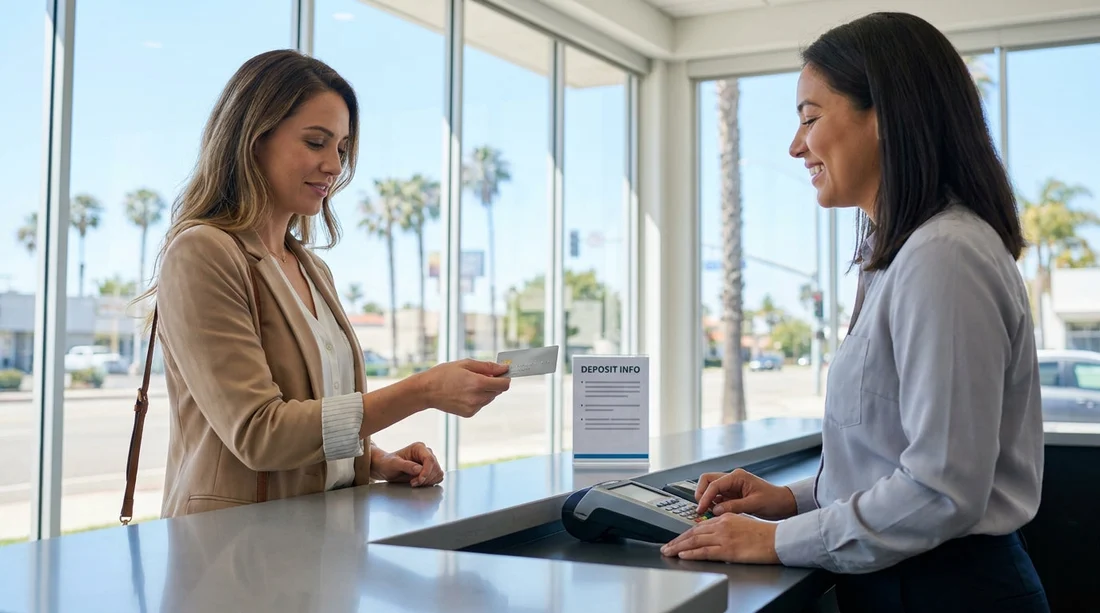
A pre-authorisation is a temporary hold placed on your credit card at the counter. The supplier requests a set amount, your card issuer ring-fences that amount, and your available credit drops by the same figure. You can still use the card, but only up to what remains available.
Two points catch travellers out:
First, the hold can be applied in addition to the cost of the rental, especially if you pay at the counter. Even if you prepaid the rental, a separate security hold is still common.
Second, the release timing is controlled by the card issuer after the supplier submits the release. It can bounce back quickly, or it can take several business days. If you are travelling on a tight card limit, that delay matters.
How much credit should you allow for the deposit hold?
For car hire in California, a sensible planning approach is to assume you will need enough available credit for (1) the remaining rental charges due at pick-up and (2) the deposit hold, plus a separate buffer for fuel and extras. Because vehicle class and location affect the hold, plan using ranges rather than a single number.
Typical planning ranges many travellers find workable are:
Economy to standard cars: allow an additional $200 to $500 available credit beyond the rental total.
SUVs, premium, people carriers: allow $500 to $1,000 additional available credit.
Vans or higher value categories: allow $750 to $1,500 additional available credit, sometimes more at busy locations.
These ranges are not promises, they are buffers designed to stop an avoidable decline at the desk. If your trip includes a one-way rental, you add drivers, or you are arriving at peak times, leaning toward the top end is safer.
If you are collecting near major hubs, you can also check location details and typical supplier expectations on Hola Car Rentals pages such as car hire at LAX, Alamo car hire at San Francisco SFO, or car hire at Sacramento SMF. Understanding the airport context helps you anticipate higher demand and counter add-ons.
Why you should budget separate headroom for fuel
Fuel is usually the first extra you will buy after pick-up, and in California it can be a bigger swing than people expect, especially if you drive long distances between cities or national parks. The cleanest way to avoid fuel surprises is to return the vehicle with the tank at the same level as collection, typically full. That keeps your fuel cost under your control, rather than paying a supplier refuelling rate.
As a credit buffer, set aside $80 to $150 for a small to midsize car’s first tank and $120 to $220 for larger SUVs or vans, depending on driving plan and local prices. If you are arriving late and filling up near the airport, prices can be higher, so leaving a little extra headroom is sensible.
Also remember that your first fuel purchase is often a pay-at-pump transaction. Some petrol stations place their own temporary authorisation, which can briefly hold more than the actual amount you pump. That is another reason to avoid running your card close to its limit on pick-up day.
Pre-trip extras that can reduce available credit
Deposit holds are only one part of the credit story. The other part is the extras you may choose, or be required, to add at the counter. Each one can raise the final amount due and, in some cases, the size of the hold.
Additional drivers can add a per-day charge. If you plan to share driving, include room for this from the start rather than relying on remaining credit.
Upgrades are common when inventory is tight. Even if you do not intend to upgrade, be prepared for a higher category being offered or required to meet luggage or seating needs. A higher category can mean a higher deposit hold.
One-way fees can be material in California if you pick up in one city and drop off in another. It is not unusual for this to be added at the counter depending on the deal structure.
Tolls are easy to overlook around major metro areas. Depending on where you drive, toll programmes can apply fees per toll plus a daily service charge. If you are likely to use tolled bridges or express lanes, keep $50 to $150 of credit headroom for a week-long trip, more if you will be commuting in tolled corridors.
Child seats and equipment are paid extras. Even if you bring your own, factor in the possibility that you decide to rent one for convenience.
For travellers starting in Southern California, the car hire at Santa Ana SNA page can be useful for planning, because Orange County pick-ups often involve motorway driving, fuel, and toll decisions quickly after leaving the airport.
Credit card versus debit card, and why it matters
Many suppliers in California strongly prefer, or require, a credit card for the security deposit. A debit card might be declined, or it might come with stricter conditions. Even when a debit card is accepted, it can lead to larger holds or slower releases because it can interact differently with your bank’s authorisation rules.
To reduce friction, use a mainstream credit card in the main driver’s name, with enough available credit to cover your buffers. Also check that your card allows foreign or out-of-state transactions if you are visiting from abroad.
How to avoid unnecessary holds and keep your credit usable
Pay attention to name matching. The driving licence and the credit card name should match, otherwise additional checks can trigger delays or declines.
Avoid splitting costs across too many cards. Many desks need one card to cover the deposit hold even if you want to pay the rental on a different card.
Keep screenshots or emails of your inclusions. If a dispute arises about what is included, you can resolve it faster and avoid last-minute add-ons you did not budget for.
Top up your card limit before you travel if possible. A modest temporary limit increase can be easier than reorganising spending mid-trip.
If your trip requires a larger vehicle, planning is even more important because holds and fuel usage tend to be higher. The van hire at San Jose SJC page is a helpful reference point when comparing vehicle size needs with realistic credit headroom.
FAQ
How long does a car hire deposit hold take to release in California? It varies by card issuer. Some releases appear within 24 to 72 hours, others take 5 to 10 business days after return and final billing.
Will the deposit hold be taken even if I prepaid my car hire? Often, yes. Prepaying can reduce the amount due at pick-up, but many suppliers still place a separate security pre-authorisation for potential incidentals.
How much extra credit should I keep for fuel? Budget $80 to $150 for a smaller car, and $120 to $220 for SUVs or vans. Add extra headroom if you will fill up near airports or do long-distance driving.
Can I use two credit cards, one for the deposit and one for extras? Usually the deposit must be on one card in the main driver’s name. Extras might be payable on the same card only, depending on the supplier’s rules.
What if my available credit is too low at the counter? The desk may decline the rental, require a different card, or restrict vehicle options. The simplest fix is arriving with enough free credit to cover rental charges, the hold, and a fuel and extras buffer.




























































































