


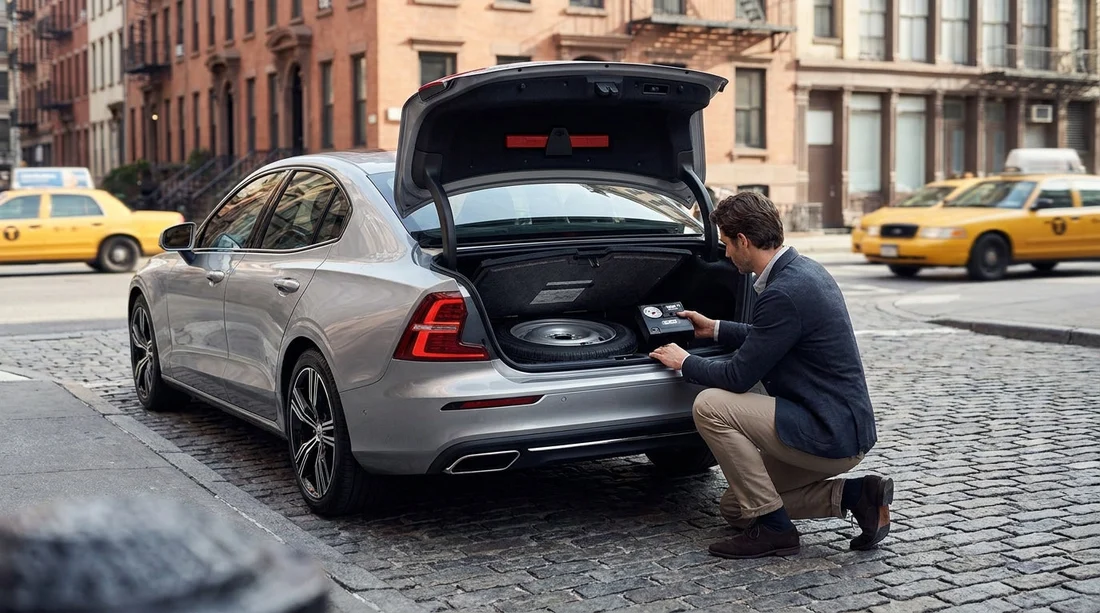
Quick Summary:
- Check the boot for a spare wheel, jack, and wheel brace.
- Look for an inflator and sealant kit in the side compartments.
- Confirm the roadside assistance number and puncture procedure before leaving.
- Photograph tyre equipment and any dashboard warnings at pick-up.
When you pick up a car hire in New York, it is sensible to assume the vehicle may not have a full-size spare wheel. Many modern fleets prioritise space and fuel efficiency, so a temporary spare, run-flat tyres, or a tyre inflator and sealant kit is common. The key is not what is “typical” in general, but what is supplied with your specific vehicle on the day, and what your rental agreement says about punctures, roadside assistance, and tyre damage.
Pick-up locations around New York can be busy and time-pressured, especially at major hubs. If you are collecting at car hire at JFK you may be leaving a multi-storey garage with limited space to stop and check. At Newark, where many New York trips actually begin, car rental at EWR facilities can also be fast-moving. A two-minute check before you drive out can save you a long delay later on the shoulder of a parkway.
What is usually supplied with a New York rental car?
In New York, most mainstream rental categories fall into three patterns:
1) Tyre inflator and sealant kit: This is increasingly common in compact, midsize, and some SUV models. The kit usually includes a small 12V compressor and a bottle of sealant designed to temporarily plug small tread punctures. It is not a permanent repair, and it may not work for sidewall damage or larger holes.
2) Temporary “space saver” spare: Some cars still include a smaller spare wheel plus a jack and wheel brace. Space savers have speed and distance limits, and they can handle short trips to a tyre shop, but they are not built for long motorway driving.
3) No spare, run-flat tyres fitted: Some vehicles use run-flat tyres that allow limited driving after a puncture. If so, it is vital to know the distance and speed guidance and the process for reporting the issue to the rental company.
Which of these you get is influenced by the specific make and model, not just the class you booked. If you are collecting a larger vehicle, such as a family mover, you might assume there is more room for a spare. In practice, even people carriers and larger SUVs can be supplied with an inflator kit. If you are hiring a bigger model from Newark, it still pays to do the same checks at minivan rental at EWR pick-up before loading luggage and setting off.
Why spares are less common than you might expect
Drivers from the UK are often surprised that a spare wheel is not standard. Rental fleets rotate vehicles quickly, and manufacturers increasingly ship cars without a spare to reduce weight and increase boot space. For rental companies, fewer spares also mean fewer missing parts to replace after one-way rentals and vehicle swaps.
There is also a practical New York factor. Many puncture incidents happen in dense areas where pulling over safely is difficult, or on bridges and parkways where stopping can be risky. Because of that, rental operators often rely on roadside assistance procedures rather than expecting customers to change a wheel themselves.
What to check before leaving the lot
Use this quick, systematic approach at pick-up. Do it before you exit the garage or pull into traffic.
Step 1: Find the tyre support equipment. Open the boot and lift the floor panel. Check side cubbies and the rear quarter storage. You are looking for a spare wheel or a compressor and sealant bottle. If you see an inflator, confirm it has its power plug and hose.
Step 2: If there is a spare, confirm the tools are complete. You should see a jack, wheel brace or lug wrench, and often a tow hook. Some cars have locking wheel nuts, so check for the key adaptor too. Missing the key can make a spare useless.
Step 3: Check the tyre condition and warning lights. Walk around the vehicle and look at all four tyres for bulges, cuts, or very low tread. Turn the ignition on and confirm there is no tyre pressure warning illuminated. If there is, report it before you drive away.
Step 4: Confirm how punctures are handled. Ask what to do if you get a puncture, whether you are expected to fit the spare, whether you must call roadside assistance first, and what happens if sealant is used. Sealant can trigger cleaning fees if it is not authorised, so it is worth clarifying.
Step 5: Photograph what you found. Take quick photos of the spare or inflator kit, the boot area, and the tyres. This is useful if there is a later dispute about missing equipment or pre-existing tyre issues.
If the car has an inflator and sealant kit, what should you know?
Inflator kits are designed for temporary mobility. They are most effective for small punctures in the tread area, for example, a nail. They are not intended for damage to the sidewall, a torn tyre, or a blowout. In those cases, you should not attempt to drive far, and you should follow the rental company’s roadside process.
Before you need the kit, locate the instructions in the glovebox or on the compressor. Ensure the sealant bottle is in-date and unopened. If the kit is missing parts, ask the desk to swap the vehicle or supply the missing items. If you are picking up from a branded counter at Newark, such as Enterprise at EWR via Hola Car Rentals, the staff can usually advise what is standard for that model and whether an alternative vehicle is available.
How to set the right expectations for New York car hire
The most accurate expectation is this: your New York car hire may include a spare wheel, but it is not guaranteed, and an inflator kit is increasingly common. Your job at pick-up is to confirm what you have, confirm what you are allowed to do in a puncture situation, and document the vehicle’s condition.
If you want an easier collection experience, consider choosing a pick-up point that suits your arrival and driving direction. For example, some travellers compare options at JFK such as Dollar at JFK or Alamo at JFK, then focus on the same equipment checks regardless of supplier. The brand matters less than verifying the actual vehicle in front of you.
FAQ
Does a New York rental car always come with a spare wheel? No. Many vehicles in New York fleets do not carry a spare wheel, and instead provide a tyre inflator and sealant kit or use run-flat tyres.
Where should I look for the spare wheel or inflator kit at pick-up? Start in the boot under the floor panel, then check side compartments. Some models store the compressor in a foam insert near the spare well.
Can I use the sealant kit myself if I get a puncture? Often yes, but you should confirm the rental company’s procedure first. Sealant is usually a temporary measure and may not be suitable for sidewall damage.
What should I do if the kit is missing or incomplete? Report it before leaving the lot. Ask for the missing parts, a vehicle swap, or a note on your agreement confirming what was not supplied.
Will roadside assistance handle a puncture in New York? In many cases, yes, but coverage and response times vary. Save the assistance number at pick-up and clarify whether towing, tyre replacement, or call-outs are included.




























































































