


Quick Summary:
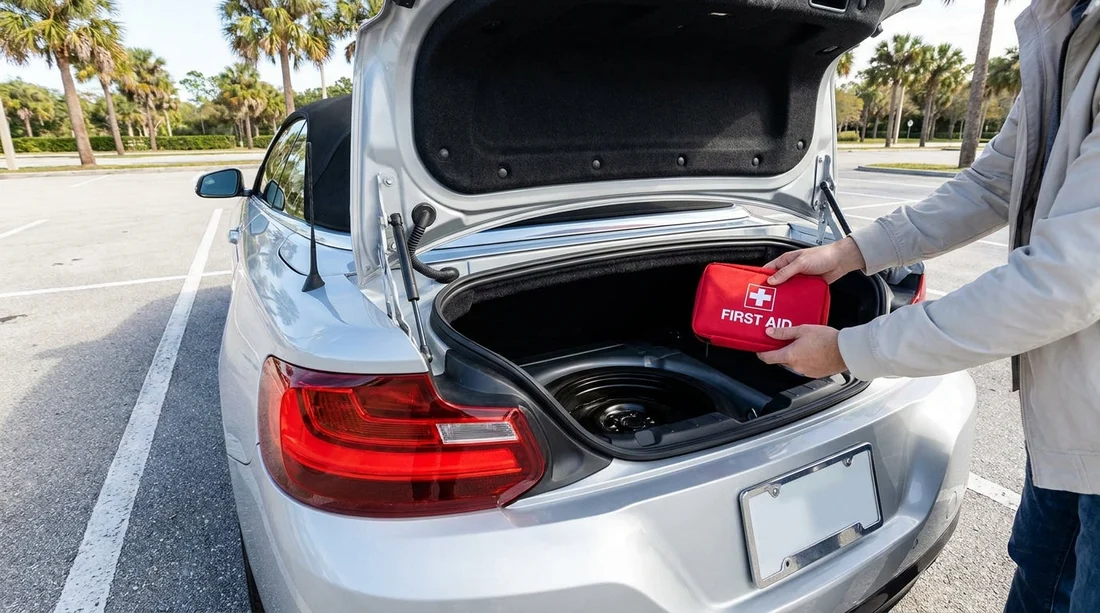
- Most Florida rental cars do not include warning triangles or first-aid kits.
- Expect core basics like hazard lights, seatbelts, and working exterior lights.
- Check the boot and glovebox at pickup, report missing items immediately.
- Pack a compact first-aid kit and reflective vest for added roadside visibility.
If you are arranging car hire in Florida and wondering whether your rental will come with a warning triangle or a first-aid kit, set your expectations early. In the US, these items are not standard inclusions in most rental fleets, especially compared with what some travellers are used to in parts of Europe. You should plan for the likelihood that neither item will be in the vehicle, and decide what you want to bring yourself for comfort and preparedness.
This matters because Florida driving often involves long interstate stretches, fast-moving multi-lane roads, and sudden weather changes. Even if you only plan short city hops, a simple breakdown or tyre issue can leave you waiting on a shoulder, and having the right small items can make that wait safer and less stressful.
Are warning triangles included with rental cars in Florida?
In most cases, no. A warning triangle is not routinely provided with passenger rental cars in Florida. Some commercial vehicles and company fleets may carry extra reflective devices, but typical holiday and business rentals do not include triangles as a default “safety kit” item.
Instead, US rentals generally rely on the car’s built-in hazard warning lights. Hazard flashers are expected to be functional, and they are the primary signalling method for a stopped vehicle. For many renters, this is the first surprise, because a triangle feels like an obvious addition, but it is simply not a standard part of the rental handover.
Are first-aid kits included with car hire in Florida?
Also usually no. A first-aid kit is not commonly supplied with Florida car hire vehicles. Some premium vehicles, concierge-style services, or specific corporate programmes may offer one, but you should assume it will not be present unless it is explicitly listed in your booking inclusions or confirmed by the supplier.
Even when a kit is present, it may be small, incomplete, or out of date. For that reason, travellers who care about having medical basics close to hand tend to pack their own compact kit, tailored to their group’s needs.
What safety items are normally provided in US rental cars?
Although triangles and first-aid kits are uncommon, you can still expect core safety features that are part of the vehicle itself. These are the basics worth checking during pickup:
Seatbelts for all seating positions. Make sure they latch, retract properly, and are not twisted.
Hazard lights, headlights, and brake lights. Confirm they work. If you are collecting the vehicle in daylight, turn lights on and walk around the car.
Spare tyre or tyre mobility kit, depending on model. Many newer vehicles have no full-size spare. Some have a temporary spare, others have an inflator and sealant. Check what you have, and where it is stored.
Jack and tyre iron if a spare is provided. If they are missing, changing a wheel becomes impossible even with a spare.
Owner information and emergency contact details. Rental documents usually list roadside assistance numbers and incident steps. Keep them accessible.
If you are flying in, you might collect your vehicle at a major hub such as Miami Airport car rental or Orlando Airport car hire. Busy locations move quickly, so building a two-minute safety check into your pickup routine is worthwhile.
Why these items are not standard in Florida car hire
There is no universal US requirement that passenger cars must carry warning triangles or first-aid kits. Rental companies also manage thousands of vehicles, and small removable items are easy to lose, damage, or forget to replace between rentals. Because hazard lights are already on every car, suppliers tend to treat additional roadside warning devices as optional rather than essential.
First-aid kits raise similar practical issues. Contents vary, regulations differ by country, and liability concerns mean suppliers often prefer not to provide medical supplies unless it is part of a defined programme.
Pickup checklist: what to inspect before driving away
Whether you pick up near the beaches or inland, do a brief check in the lot before you leave. This avoids awkward returns and makes sure you understand what is in the vehicle.
1) Open the boot and locate tyre equipment. Confirm whether there is a spare tyre or a mobility kit, and check it looks complete.
2) Look in the glovebox and side pockets. Do not expect a triangle or first-aid kit, but verify what is there. Some cars have a small roadside pack, most do not.
3) Confirm hazard lights work. Turn them on, then walk around to see all indicators flashing.
4) Check windscreen wipers and screenwash. Florida downpours can be intense, and worn blades reduce visibility quickly.
5) Save key numbers. Store the rental location and roadside assistance contact in your phone before you drive. If you are collecting around South Florida, you may also be comparing options like Fort Lauderdale Airport car rental.
Roadside safety basics in Florida if you have a problem
If something goes wrong, prioritise safety over fixing the issue quickly. If possible, move the vehicle out of traffic, use hazard lights, and stay alert to surrounding cars. On fast roads, standing behind the vehicle can be dangerous. If you are unsure, it is often safer to remain inside with your seatbelt fastened until help arrives, as long as the car is well clear of moving traffic.
Many travellers choose an SUV for luggage space and higher driving position, especially for longer routes across the state. If that sounds familiar, you might be looking at options such as SUV rental in Doral. Whatever you drive, know where the hazard switch is and how to open the bonnet and fuel door before you need to.
Does it differ by supplier, vehicle type, or pick-up location?
It can vary, but not reliably. One branch may have a few cars with extra items left by previous renters, while another has none. Vehicle segment also does not guarantee anything. A larger vehicle does not automatically include a first-aid kit or warning triangle, and you should not assume premium equals fully stocked.
The only dependable approach is to treat these items as “not included unless stated”, and prepare accordingly. If you are collecting in a busy airport environment such as Orlando, you may see choices like National car rental at Orlando Airport, but the expectation on safety kit extras remains broadly similar.
FAQ
Do Florida car hire vehicles legally need to carry a warning triangle?
Typically no for passenger cars. Most rentals rely on hazard lights, and triangles are not commonly supplied unless specifically included.
Will my rental include a first-aid kit if I request one?
Sometimes a branch may help, but it is not guaranteed. If it is essential, bring a compact kit in your luggage.
What should I check in the car before leaving the rental lot?
Confirm hazard lights work, locate the spare tyre or inflator kit, and make sure you have roadside assistance contact details.
If there is no spare tyre, what happens with a puncture?
Many cars have an inflator and sealant, or require roadside assistance. Check your boot for a mobility kit and read the instructions.
Is it worth packing a reflective vest for driving in Florida?
Yes. It is lightweight, improves visibility in rain or darkness, and is useful if you must exit the car near traffic.




























































































