


Quick Summary:
- EV bookings usually guarantee a class, not a specific make or model.
- ‘EV or similar’ may still allow a comparable hybrid or petrol alternative.
- Check the category description and fuel type before confirming the reservation.
- Ask about charging access, range expectations, and included cables at pickup.
When you arrange car hire in California, it is common to see listings labelled “EV or similar”. That wording can feel frustrating if you are counting on an electric vehicle for charging discounts, HOV access rules, or simply to avoid petrol. The key is understanding what rental companies typically guarantee: a category (also called a class), not a specific vehicle, and sometimes not even a specific fuel type unless the category is explicitly defined as electric-only.
California has a high proportion of EVs compared with many other regions, but fleet availability changes daily. Vehicles move between airports, go out of service for repairs, or return late. Because of that, many suppliers protect themselves by promising an “or similar” alternative that meets the same broad criteria, such as size, doors, and luggage capacity.
If you are collecting near a major airport, the range of fleet options can be broader, but the guarantee language is often the same. For example, travellers comparing options around San Francisco Airport may see both standard categories and electrified options on car rental airport San Francisco SFO and car rental San Francisco SFO, yet the specific model can still vary at the counter.
What does “EV or similar” actually mean?
In rental terms, “or similar” means the supplier can provide a vehicle that is comparable within the booked category, particularly for passenger capacity and luggage. It does not automatically mean the replacement will match the badge, trim level, colour, or even the same powertrain, unless the listing or category explicitly locks fuel type to electric.
With EV categories, there are two common scenarios:
1) Electric category with substitutions allowed. The listing may show an EV example model, but the terms allow the supplier to substitute another vehicle that is “similar”, which might include a hybrid or efficient petrol model if the EV fleet is constrained.
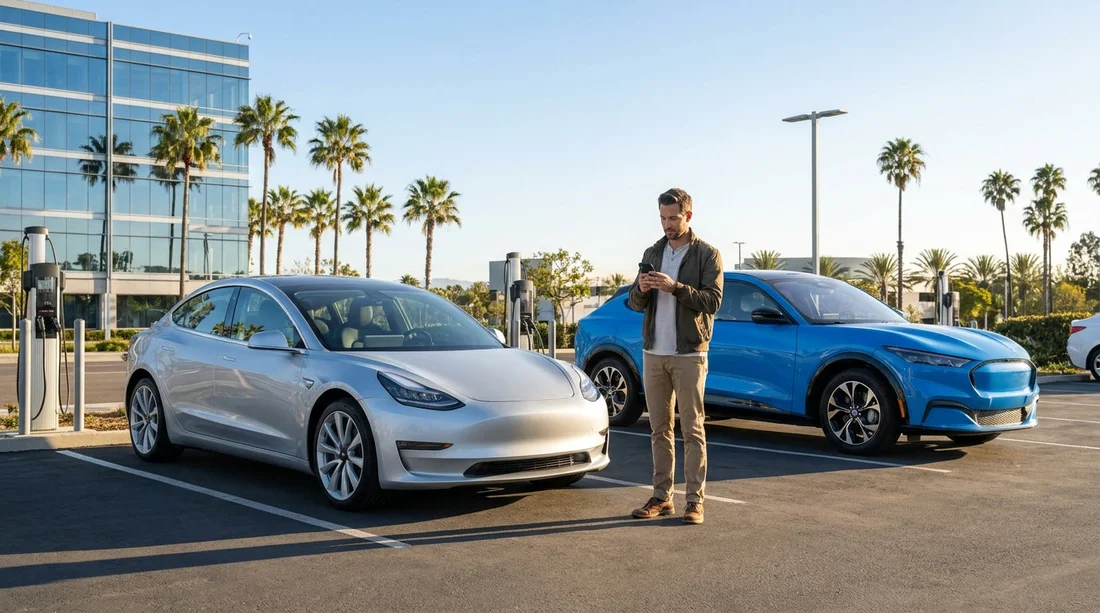
2) General category with EV as an example. Sometimes a standard compact or intermediate class shows an EV in the photos, but the class itself is not electric-only. In that case, the EV is simply an illustration, and the delivered car can be any vehicle in that class.
The practical takeaway for car hire is this: “EV or similar” rarely guarantees the exact outcome you want unless the booking flow clearly identifies the fuel type as electric in the confirmed category description.
How EV availability works by car class in California
Rental fleets are organised by classes such as economy, compact, intermediate, standard, full-size, premium, SUV categories, and specialty options. EVs are increasingly present across multiple classes, but they are still a smaller and more volatile pool than petrol cars. Availability tends to depend on:
Airport size and fleet depth. Large hubs such as Los Angeles and San Diego often have more EVs in rotation, but they also have heavier demand. If you are collecting in Los Angeles, you might compare supplier pages like National car rental Los Angeles LAX or Budget car hire Los Angeles LAX to see how categories are presented, then verify the fuel-type wording in the final confirmation.
Turnaround and charging logistics. EVs need time to charge between hires. If a car comes back low, it may not be ready for the next driver even if it is physically on site. Some locations prioritise keeping EVs at a certain state of charge, while others treat them like any other return and manage readiness based on staffing and charger access.
Seasonality. Holiday weekends, conference periods, and summer travel peaks can squeeze inventory. In those windows, substitutions become more common across all classes, including EV requests.
One-way rentals. If you are returning in a different city, EV availability can be more limited depending on how the fleet is balanced between locations.
Can an electric rental car be guaranteed?
Sometimes, yes, but it depends on how the supplier defines the category and what the confirmation states. A genuine guarantee usually comes from one of these signals:
The category name explicitly states “Electric”. The confirmation should show “Electric” in the class name or fuel type, not just in example photos.
Fuel type is listed as Electric on the confirmation. Look for a line item that calls out “Electric” as fuel or powertrain. If it only shows “Automatic, air conditioning” and seats, that is not a guarantee.
Terms specify no fuel-type substitution. Some suppliers treat EVs as a distinct fleet category. If substitutions are mentioned, see whether they are limited to other EVs or allow any similar vehicle.
Even with these indicators, there is a real-world constraint: if an EV is not available due to an operational issue, the desk may still offer an alternative, a wait, or a different location pickup. The best way to reduce surprises is to confirm the EV requirement before travel and arrive with a backup plan if an EV is non-negotiable.
What to check before booking EV car hire
Use this checklist to understand what you are actually reserving, and whether “EV or similar” could become petrol on the day.
1) Check the vehicle category code and description. Many systems use standard category codes that indicate size and features. While codes vary, your confirmation should clearly match the class you intended. If the code does not specify electric, treat the EV as a preference rather than a promise.
2) Look for fuel type in writing. You want “Electric” stated explicitly. If it is missing, assume “or similar” could include non-EV vehicles.
3) Confirm charging expectations and equipment. Ask whether the vehicle comes with any necessary adapters, whether it uses CCS, Tesla (NACS), or another standard, and whether a portable cable is included. Not all rentals include the same charging accessories, and the difference matters if you plan to use slower AC chargers at hotels.
4) Understand range and charging speed variability. Two “similar” EVs can have very different real-world range and fast-charging performance. If your itinerary includes long drives, you may care more about battery size and charging curve than the badge.
5) Ask about the return charge policy. Some suppliers require you to return at a certain battery percentage, others allow a lower return with a fee. Knowing this helps you plan the final charge stop near the airport.
If you arrive and the EV is not available
If the desk cannot provide an EV, stay focused on outcomes and documentation. Ask what alternatives exist within the same price bracket, whether waiting for an EV return is realistic, and whether another nearby branch has EV inventory. If you accept a petrol substitute, ensure the contract reflects the vehicle you are actually taking, and ask how pricing is handled when a lower-cost category is provided.
If you specifically need an EV for charging access at your accommodation or for a planned route, communicate that clearly. Staff can sometimes locate an incoming EV or suggest the closest equivalent that still meets your luggage and passenger needs.
How to set expectations: the simplest rule
For car hire in California, treat “EV or similar” as “I am reserving a class, and an EV is preferred” unless your confirmation explicitly states Electric as the fuel type or class. If you need certainty, prioritise suppliers and listings where the electric designation is unambiguous, and keep a charging plan that works even if your delivered EV has different range or connector requirements.
FAQ
Q: Does “EV or similar” mean I might get a petrol car?
A: Yes. Unless the confirmed class explicitly states Electric as the fuel type, “or similar” can include hybrids or petrol models in the same size category.
Q: Can I pay extra to guarantee an electric vehicle?
A: Sometimes. The most reliable route is selecting an electric-only category where Electric appears on the confirmation, rather than relying on photos or example models.
Q: Are EVs easier to get at big airports in California?
A: Often there is more EV inventory at major airports, but demand is higher too. Operational factors like charging time can still cause substitutions.
Q: Will my rental EV come with charging cables or adapters?
A: It varies by supplier and model. Check the rental terms and ask at pickup what connectors are supported and what equipment is included.
Q: What happens if I return the EV with a low battery?
A: Many suppliers charge a fee if the battery is below a required level. Review the return-charge policy on your agreement to avoid surprises.




























































































