


Quick Summary:
- Ask if the car has a spare wheel, donut, or inflator kit.
- Locate the jack, wheel key, and tow hook before leaving.
- Confirm tyre damage cover, roadside help, and towing rules in writing.
- Photograph tyres and note pressures, tread, and sidewall marks.
Yes, you should check for a spare tyre or puncture kit before leaving in a rental car in California. Many US rentals no longer include a full size spare. Some provide a compact “donut” spare, and many provide only a sealant and inflator kit, or nothing at all on certain models with run flat tyres. If you find out after you have left the counter, you may be stuck on the roadside working out what support you actually have, especially in remote stretches of California where mobile reception can be patchy.
This is particularly relevant for car hire in California because distances can be long and driving conditions vary, from urban freeways to desert heat and mountain passes. If you are collecting at a major hub such as Los Angeles Airport (LAX) or San Francisco Airport (SFO), the lot is busy, so it helps to follow a short checklist rather than assuming the boot contains a spare.
Why many California rentals do not carry a full spare
There are a few practical reasons rental fleets increasingly move away from full size spares. A spare wheel and tyre adds weight, which affects fuel economy, and it takes up luggage space. Some newer vehicles also prioritise storage for hybrid batteries or additional equipment. As a result, you may get a car with a tyre mobility kit, typically a small compressor and a sealant bottle, or a compact spare designed for temporary low speed use. Some models use run flat tyres, which can be driven for limited distance after a puncture, but you still need to know the limits.
Because different makes and trims are mixed within the same vehicle category, you cannot rely on the class name. An SUV may have a full spare, a donut, or just a kit. That is why it is worth checking regardless of whether you are picking up a compact car or something larger, for example via an SUV rental in San Diego.
What to check before you drive out of the lot
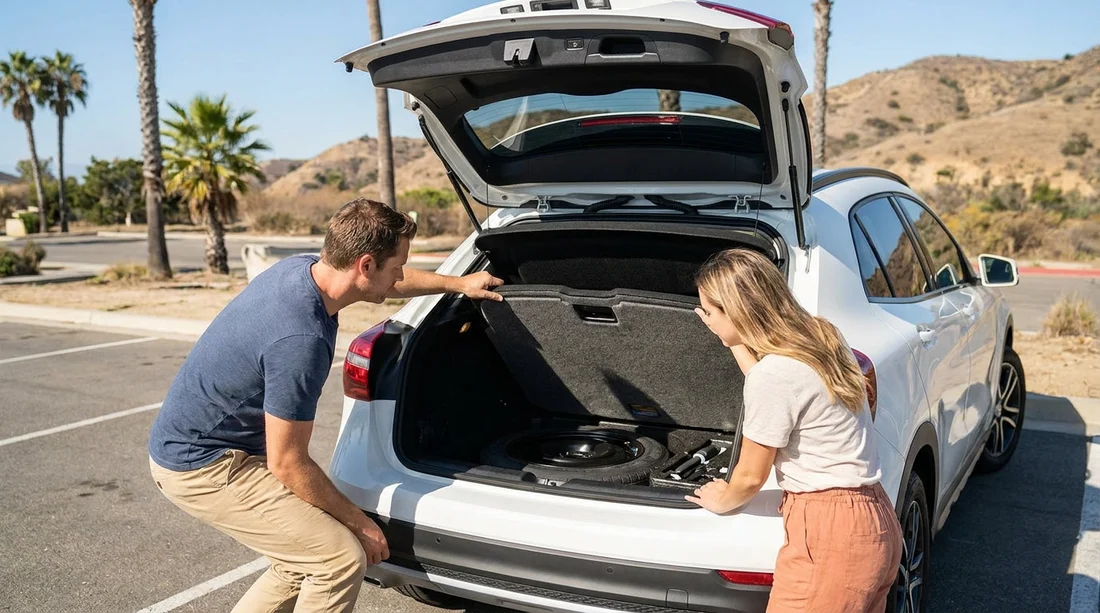
1) Identify what puncture solution the car actually has. Open the boot and look under the floor panel. You are looking for one of these: a full size spare wheel, a compact spare (donut), a tyre inflator and sealant kit, or a note that the vehicle uses run flat tyres and has no spare. If there is a kit, check that the sealant bottle is present and not past its expiry date, and that the compressor power lead fits the 12V socket.
2) Find the tools, not just the wheel. A spare is not useful without the jack and wrench. Confirm the jack, wrench, and locking wheel nut key are all present. Some cars also have a tow hook stored with the tools, which can be useful if roadside assistance needs to pull the car onto a flatbed. If the car has a donut spare, confirm the tyre is inflated.
3) Understand the limits of a donut spare or run flats. A compact spare is typically intended for short distances at reduced speed. If your California itinerary includes long highway stretches, you may prefer a vehicle with a full size spare or at least a complete, in date inflator kit. Run flat tyres can allow limited driving to reach safety, but they may not be repairable after use, and replacement can take time.
4) Check the tyres for existing issues. Walk around and photograph each tyre. Look for sidewall bubbles, cuts, exposed cords, or very low tread. Take a photo of the dashboard tyre pressure warning light if it is on. This is not just for safety, it helps avoid disputes about whether damage was pre existing.
5) Confirm what your agreement says about tyres and roadside assistance. Tyre punctures are commonly excluded from basic roadside support, or support may be limited to changing a spare if you have one. Ask how to get assistance, whether towing is covered if there is no spare, and whether you must stay with the vehicle. Get clarity on whether you are expected to pay up front and claim later, and whether there is a cap on towing distance.
6) Note where the locking wheel nut key is stored. On some cars it is in the glovebox, on others with the jack, and sometimes it is missing. If you have alloy wheels, this is a quick check that can prevent a major delay if a tyre shop cannot remove a wheel.
7) Make sure you have safe stopping options. In cities, a puncture can be managed in a well lit car park. On mountain routes, desert roads, or busy freeways, it is often safer to call for help rather than attempt a roadside wheel change. Know where the hazard lights are, and check that a reflective triangle or vest is not assumed, since these are not standard in US rentals.
How to ask the right questions at the counter
Time at the desk is limited, so be direct. Ask: “Does this vehicle have a full size spare, a donut, or only an inflator kit?” Then ask: “If I get a puncture and there is no spare, what is the exact process and cost for assistance or towing?”
If you are arriving after a long flight, it can be helpful to choose a pick up location where you can take a moment to check the car properly. Whether you are collecting at San Jose Airport (SJC) or another major airport, do not feel rushed out of the bay before you have opened the boot and located the tools.
What to do if there is no spare and no kit
If you open the boot and find neither a spare nor an inflator kit, do not assume it is normal. First, check the sidewalls of the tyres for “run flat” markings. If they are not run flats, go back to the counter or kiosk and request a car with a puncture solution appropriate for your trip. In California, you may drive through areas where a tow could take a long time, and a simple kit can make the difference between a quick fix and an extended wait.
If the car is supposed to have a kit but the sealant is missing or expired, ask for a replacement kit or a different vehicle. Sealant is single use, and an incomplete kit is effectively useless. If you are travelling with a lot of luggage, also consider that a full size spare may reduce boot space, which matters for airport pickups and multi stop road trips.
How this affects your route planning and time
If your itinerary includes remote areas, you should treat the spare or kit check as essential, not optional. A day trip on urban freeways is one thing. A drive that crosses long rural stretches is another. Even if you are staying near the coast, a puncture can still mean time lost, and availability of the correct replacement tyre size can vary. Having a spare, even a donut, can keep you moving to a safe location where you can resolve the issue properly.
For travellers comparing providers for car hire, it can also be useful to note what brand policies tend to be at your pick up point. Vehicle equipment can vary by fleet and model year, so the most reliable approach is still to check the specific car you are assigned. If you are picking up via a brand page such as Dollar Car Rental in San Jose, the same pre drive check applies once you have the keys.
FAQ
Do rental cars in California usually have a spare tyre? Many do not have a full size spare. You may find a compact spare, a sealant and inflator kit, or run flat tyres instead, so check the specific vehicle.
Is a puncture kit as good as a spare wheel? It depends on the damage. Sealant kits can help with small tread punctures, but they usually cannot fix sidewall damage, and they are often single use.
What should I photograph during pickup regarding tyres? Take clear photos of all four tyres, including sidewalls and tread, plus any warning lights on the dash. This supports your notes if an issue was pre existing.
If there is no spare, will roadside assistance tow me for free? Not always. Coverage depends on your rental agreement and any roadside add ons. Confirm whether towing is included, any distance limits, and any out of pocket payment rules.
Can I swap cars if the kit is missing or the spare is flat? Typically yes if you raise it before leaving the lot. Ask staff to provide the missing equipment or assign another vehicle that meets your needs.





























































































