


Quick Summary:
- Plan for a $200 to $500 hold, plus your rental charges.
- Keep $300 to $800 extra credit for insurance, tolls, fuel, upgrades.
- Bring the cardholder and matching ID, or the counter may refuse.
- Ensure your credit limit covers holds, as debit cards often fail.
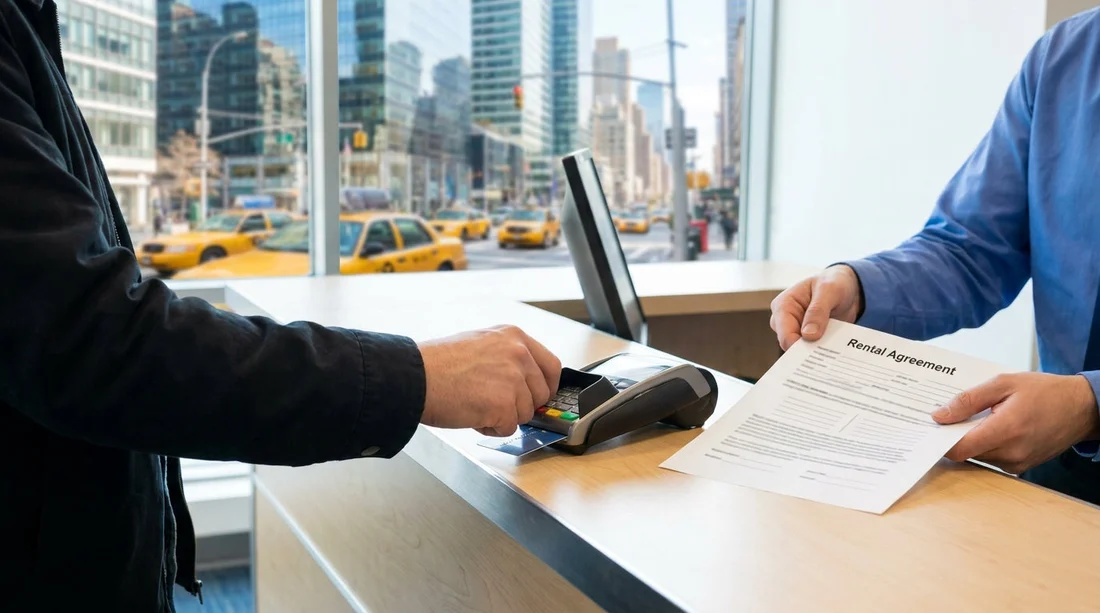
When you collect a car hire in New York, the most common cause of pick-up delays is not the paperwork, it is available credit. Rental companies usually place a security deposit hold on a credit card, then add any estimated extras. If your card does not have enough unused credit to cover both, the counter may reduce vehicle options, remove add-ons, or decline the rental entirely.
This guide sets realistic expectations for how much available credit you should have before arriving, why the amount varies between suppliers, and how to avoid surprises at busy locations such as JFK and Newark.
What “available credit” means at pick-up
Available credit is the unused portion of your credit limit at the moment the rental company runs the pre-authorisation. Even if you have a high credit limit, recent spending, pending transactions, or other pre-authorisations can reduce what is available. The rental desk does not look at your balance, they look at the amount their terminal can authorise.
A pre-authorisation is a temporary hold rather than a charge, but it still reduces your available credit until it drops off. How long it takes to release depends on the supplier and your card issuer, commonly several business days after the car is returned.
Typical credit-card holds for car hire in New York
In New York, a common deposit hold range is roughly $200 to $500 for standard cars. Some suppliers may hold more for premium vehicles, larger people carriers, or if you add certain services at the counter. The hold is separate from your rental price, so you should treat it as an extra amount of credit you need to keep free.
Your estimated rental charges (the full amount the supplier expects to take), plus a deposit hold, plus a buffer for extras that can be added or estimated at pick-up.
A realistic “safe minimum” available credit
For most travellers, a sensible target is to have at least $700 to $1,500 of available credit on the card you will present. That typically covers a mid-range deposit hold plus several common extras, and it gives you room if the desk needs to adjust the authorisation.
If you plan to pick up at a major airport location, you can review location-specific car hire options such as car hire at New York JFK to compare vehicle categories and plan your likely extras in advance.
Extras that can increase the pre-authorisation
The quickest way to underestimate required credit is to focus only on the base rental cost. In New York and nearby New Jersey airports, the following items often increase what must be authorised:
Insurance and protection products. If you do not have acceptable cover already, taking collision damage coverage or supplemental liability options at the counter can materially increase the total the supplier expects. Even if you decline, the desk may ask for proof of cover in some cases.
Tolls and toll programmes. New York area driving involves bridges, tunnels, parkways, and toll roads. Many suppliers offer toll products, or they may bill tolls after return via plate-reading systems. Some will take an additional authorisation to cover estimated toll exposure, particularly for longer rentals.
Additional drivers and young driver fees. Extra driver charges are common, and young driver surcharges can be significant. These fees increase the total rental charges and therefore the amount that must be authorised.
One-way rentals and cross-state travel. Collecting in one state and returning in another can involve fees, and some suppliers adjust deposits for one-way hires. This is particularly relevant around Newark and New Jersey locations. You can check alternative pick-up options like car hire at New Jersey EWR when planning routes around New York.
Why airport locations may feel stricter
Airport counters in the New York area often process high volumes of customers with tight schedules. Staff may follow deposit and card rules more strictly because they need clear authorisations before handing over keys. It also means any issue, such as insufficient available credit, can result in a long wait while you contact your bank or switch cards.
If you are flying into Newark, you may also see inventory and supplier differences between listings such as car rental at Newark EWR and specific supplier pages. Planning your likely vehicle size and extras ahead of time reduces the risk of the desk needing to re-run a higher authorisation than you expected.
Card requirements that can trigger delays
Even with enough available credit, the transaction can fail if the rental desk cannot validate the payment method or the renter’s identity. Common issues include:
Cardholder mismatch. The main driver usually must present a credit card in their own name. If the card belongs to someone else, the desk may decline the rental, even if that person is present.
Debit cards and prepaid cards. Many New York car hire desks prefer or require a credit card for the deposit hold. Debit acceptance rules vary and may involve larger holds or additional documents. Prepaid cards are commonly not accepted for deposits.
Insufficient limit due to pending transactions. Hotels, airlines, and even other car parks may place their own holds. Clearing some headroom before you arrive can prevent awkward declines at the counter.
How to calculate what you should bring
1) Start with your expected rental total. Include taxes and any pre-selected options you intend to keep.
2) Add a deposit hold estimate. For many standard hires, add $200 to $500. For larger or premium vehicles, add more headroom.
3) Add an extras buffer. A practical buffer is $300 to $800 depending on your driving plans. Choose the higher end if you expect tolls, extra drivers, or insurance add-ons.
4) Check current available credit, not just the limit. If your card app shows “available to spend”, rely on that figure. Aim to keep the calculated total free.
For instance, if your rental charges are roughly $450 and you assume a $300 hold, you are already at $750. Add a $400 buffer for tolls, fuel, and contingencies, and you would want around $1,150 of available credit.
Practical tips to avoid pick-up problems
Carry a second credit card. If one authorisation fails, a backup card can save significant time. Make sure both are in the main driver’s name where possible.
Reduce other holds before travel. If you have hotel deposits or large pending card transactions, consider using a different card for those so your car hire card stays clear.
Decide on insurance before you land. Uncertainty at the counter often leads to rushed decisions and higher authorisations. If you are comparing suppliers, looking at a brand page such as Hertz car rental in New Jersey EWR can help you anticipate how you want to handle cover and vehicle category.
Choose the right vehicle size. Bigger vehicles can mean bigger holds. If you genuinely need space for passengers and luggage, a dedicated listing like minivan rental at New York JFK helps set expectations for category and cost before you reach the counter.
What happens to the hold after return?
After you return the car, the supplier finalises the rental charges and releases the remaining hold. Your bank may take additional time to reflect that release in your available credit. If you are planning another car hire, a hotel stay, or a large purchase soon after your trip, keep in mind that the hold might still temporarily reduce your available credit.
If you notice the hold has not dropped off after a reasonable period, check your final receipt and then contact your card issuer first, as they control the timing of when released funds appear.
FAQ
How much available credit do I need for car hire in New York? Many travellers are safe with $700 to $1,500 available on the card used at pick-up, covering rental charges, a typical deposit hold, and a buffer for extras.
Is the deposit hold taken in addition to the rental price? Yes. The supplier usually pre-authorises a deposit hold and also authorises or charges expected rental costs, so you need enough unused credit for both.
Can I use a debit card instead of a credit card? Often, New York area suppliers prefer or require a credit card for the deposit. Debit acceptance varies, may require extra documentation, and can involve higher holds.
Why did my card get declined even though I have a high credit limit? The terminal checks available credit, not the overall limit. Pending hotel or travel holds, daily card limits, or bank fraud controls can reduce what can be authorised.
How long does it take for the pre-authorisation to be released? It depends on the supplier and your bank, but it commonly takes several business days after return for the available credit to update.





























































































