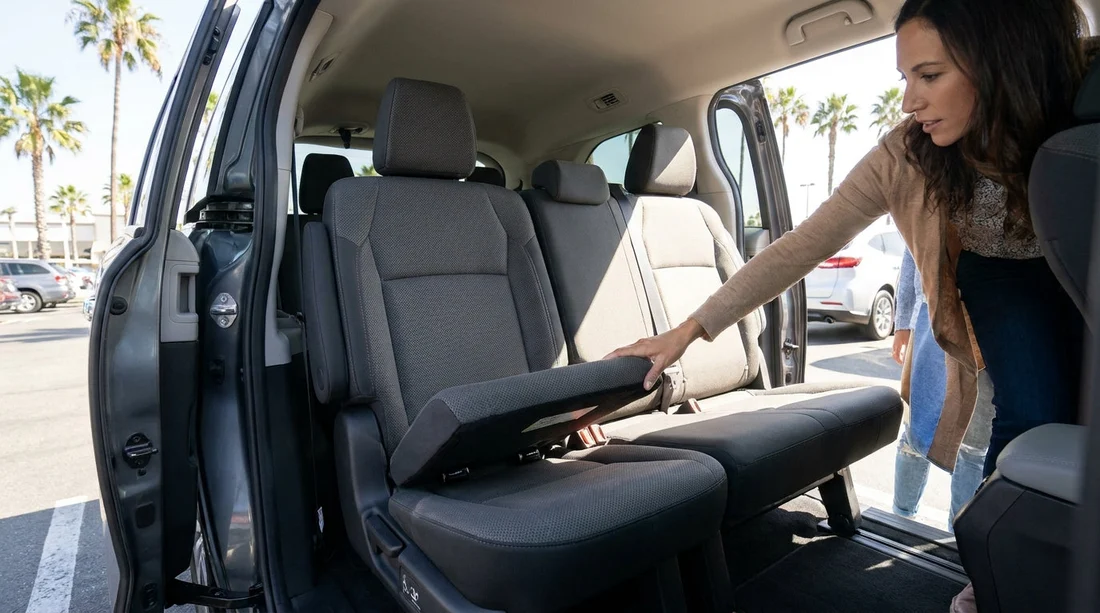
Quick Summary:
- Check the rear-seat label or manual for LATCH positions first.
- Locate lower anchors by feeling between seat back and cushion.
- Find the top tether point behind the seat, then confirm routing.
- Install your child seat and test for less than one inch movement.
When you pick up a car hire in California, it is easy to focus on fuel level, damage photos, and navigation. If you are travelling with children, your most important pre-drive check is whether the vehicle works with your child restraint, and whether you can locate and use the ISOFIX or LATCH anchor points correctly. In the US you will usually see the term LATCH, which stands for Lower Anchors and Tethers for Children. In practice it is the same concept as ISOFIX, a pair of lower anchors plus a top tether anchor for forward-facing seats.
The goal before you leave the rental car park is simple, confirm that the rear seat position you plan to use has the right anchor points, that you can reach them without twisting straps, and that your installed seat is tight and level. If anything is unclear, switch seating positions or request another vehicle type before you drive off.
Know what you are looking for: lower anchors and top tethers
LATCH has two parts. Lower anchors are a pair of metal bars fixed to the vehicle seat frame, normally in the crack where the seat back meets the seat cushion. Your child seat either clips to these anchors using push-on connectors, or uses ISOFIX-style rigid connectors. Top tethers are separate anchor points used with many forward-facing seats to reduce forward head movement in a crash. The tether anchor is not in the seat bight. It is usually on the rear shelf, the back of the seat, the boot area, or the ceiling or floor depending on vehicle design.
California follows US federal motor vehicle safety standards, so vehicles sold in the US generally have LATCH in at least two rear seating positions. However, not every position has lower anchors, and not every centre seat allows borrowing anchors from the left and right. That is why you must verify the exact position and rules in that specific car.
Step 1: confirm the correct rear-seat position for LATCH
Start by opening the rear doors and scanning for LATCH markings. Many vehicles have small round buttons, stitched tags, or embossed icons on the seat upholstery that indicate the lower anchors. The marking is often at the seat bight, slightly above the crack. If you see markings only on the outboard seats, do not assume the centre also has anchors.
Next, check the car’s information sources. Some rentals keep a printed quick guide in the glovebox, and most have the full owner’s manual. Look for a section titled “Child Restraints”, “LATCH”, or “Lower Anchors”. It will show which seating positions have lower anchors and where the top tether anchors are located. This matters because the centre seat can be safer in some crashes, but only if you can install the seat correctly there using the permitted method.
If you are collecting at a major hub such as Los Angeles Airport (LAX) or San Francisco (SFO), you may have several vehicle options within the same class. It can be worth checking LATCH layout before you load luggage, especially if you need three child seats across.
Step 2: physically locate the lower anchor bars
Even with labels, it helps to confirm the exact anchor location by feel. Slide your fingers into the seat crack where the backrest meets the cushion. You should feel a solid horizontal metal bar on each side of the seating position, about shoulder width apart for a child seat. In some cars the anchors sit behind fabric flaps, plastic guides, or deep upholstery that makes them hard to find at first touch.
As you locate each bar, check for obstructions. A seat belt buckle that sits directly over the anchor path can complicate installation. Also look for rigid plastic trim that may force the connector to twist. Twisted connectors can reduce strength and make tightening difficult.
If you cannot find the anchor bars quickly, do not force hooks into unknown gaps. Re-check the labels and manual, then try the other outboard seat. If anchors seem missing entirely, you may be in a vehicle configuration that requires seat-belt installation instead.
Step 3: find and verify the top tether anchor points
For forward-facing seats that use a tether, locate the tether anchor before you install anything. In many sedans, the tether anchor is on the rear parcel shelf behind the head restraints. In SUVs and hatchbacks, it may be on the back of the seat, inside the boot area. In minivans and some three-row vehicles, anchors can be on the floor behind the seat or on the seat track.
Once you find the tether anchor, confirm the correct routing path. Some vehicles require the tether strap to go over the head restraint, some under, and some around a specific guide. The owner’s manual diagrams are important because incorrect routing can create slack or cut across sharp edges. If the head restraint is removable, confirm whether it must be removed for a flat tether path.
If you are using a larger vehicle, such as those commonly compared on California van rental options at LAX, pay extra attention to third-row tether anchors. Not all third-row seats have them, which can affect where a forward-facing harness seat can go.
Step 4: check rear-seat compatibility and practical fit
Even when anchors exist, the rear seat shape can affect how safely and easily a child restraint fits. Before installing, consider these compatibility checks.
Seat angle and contour: Deeply contoured seats can tilt the child seat or create gaps. Your child seat manual will specify allowed recline range and how to measure level indicators.
Head restraints: Some head restraints push the top of a forward-facing seat away from the vehicle seat back. If the vehicle head restraint is adjustable, lower or remove it only if the manual allows.
At busy pick-up locations such as Santa Ana (SNA), allow a few extra minutes to test-fit. A correct install is worth the time, and it is easier to swap cars before you exit the facility.
Step 5: install and perform the one-inch movement test
Install the seat using either the lower anchors or the vehicle seat belt, following your child seat manual. Most child seats require you to choose one method, not both, unless the manufacturer explicitly permits combined use. After tightening, perform the standard movement test, grip the seat at the belt path and try to move it side-to-side and front-to-back. If it moves more than one inch (about 2.5 cm) at the belt path, it is not tight enough.
Finally, if you are using a top tether, tighten it last. The tether should remove slack without lifting the child seat off the vehicle seat cushion. Confirm the hook is clipped to the correct anchor, not a luggage tie-down loop or cargo hook that looks similar.
Common rental-car pitfalls and quick fixes
Hidden anchors: Some vehicles have recessed anchors with plastic covers. Use your fingertips to locate the bar, then attach straight on.
Confusing centre seat: Many centre seats do not have dedicated lower anchors. If the manual does not explicitly allow it, do not “borrow” inner anchors from adjacent seats.
Time pressure: If the queue behind you is building, pull into a safe adjacent bay to finish the install checks. The one-inch test and tether routing are not steps to rush.
FAQ
Is ISOFIX the same as LATCH in a California car hire? They are functionally equivalent systems. In the US, the anchors are referred to as LATCH, with lower anchors and a top tether, while ISOFIX is the common term in many other countries.
Can I use the centre rear seat LATCH anchors in any car? No. Some vehicles have centre lower anchors, many do not. Do not borrow anchors from the left and right seats unless the vehicle manual explicitly allows that seating position for LATCH.
Where is the top tether anchor usually located? It depends on body style. Sedans often place it on the rear parcel shelf, SUVs and hatchbacks commonly place it behind the seat in the boot area, and some vans mount it on the seat back or floor.
How tight should the child seat be before I drive off? When tested at the belt path, it should move less than one inch side-to-side and front-to-back. If it slides more than that, re-tighten or reinstall.
What if I cannot find LATCH anchors or they seem damaged? Use a seat-belt installation if your child seat allows it, or request a different vehicle before leaving. Do not attach to cargo hooks or unmarked metal loops.