


Quick Summary:
- Ask the counter what puncture kit is supplied for your vehicle.
- Open the boot, lift the floor panel, and confirm equipment is present.
- Check the jack, wheel wrench, locking key, and tow-eye location.
- Photograph the kit and save the roadside assistance number.
Texas roads can be brilliant for long drives, but they can also be hard on tyres. Construction debris near city interstates, rough shoulders on rural highways, and sudden temperature swings can all turn a minor puncture into a stressful stop. Before you pull away from the rental location, it is worth taking two minutes to confirm whether your car hire comes with a spare tyre, an inflator kit, or neither, and what you are expected to do if a tyre loses pressure.
The key point is that different vehicles, and different rental fleets, are set up differently. Many modern cars ship from the manufacturer without a full-size spare, and some have no spare at all. That does not automatically mean you are stuck, but it does change the safest and quickest response when you get a puncture in Texas.
Why you should check before leaving the lot
If you discover missing puncture equipment after you have left, you may have to return to the depot, wait for roadside support, or accept a vehicle swap later. Spotting the situation while you are still at the pickup location keeps it simple. It also lets you confirm the correct procedure for that particular provider and vehicle class, because rules vary on whether customers are allowed to change a wheel themselves.
If you are collecting near Austin-Bergstrom, the pickup flow can be quick and you may feel rushed. Build the check into your routine, especially if you are arranging car hire through Hola Car Rentals for a busy travel day. For airport pickups, see car rental at Austin Airport (AUS).
What equipment you might be given in Texas
1) Full-size spare tyre. This is the most convenient option for longer drives, but it is less common in standard cars. If provided, you still need the matching jack and wheel tools.
2) Space-saver spare (temporary spare). This is common. It is usually narrower, with speed and distance limits printed on the tyre. It can get you to a tyre shop safely, but it is not intended for extended highway driving.
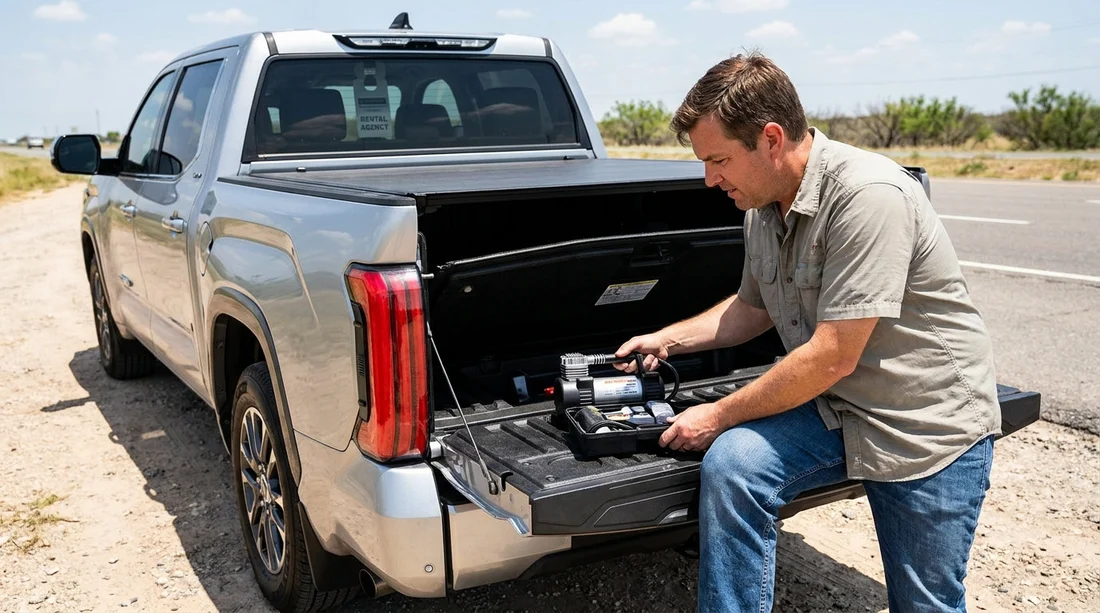
3) Tyre inflator kit with sealant. Often a 12V compressor plus a sealant bottle. It can fix small tread punctures temporarily, but it cannot help with sidewall damage, larger cuts, or a tyre that has come off the rim.
4) Run-flat tyres. Some vehicles are fitted with run-flats, which can be driven a limited distance at reduced speed after losing pressure. The car may still carry an inflator, but not always. The sidewall normally has markings indicating run-flat capability.
5) No spare and no sealant kit. This can happen. In that case, the correct plan is to use roadside assistance. Confirm the number, and understand whether towing is included, and where the car can be taken.
The counter check, three questions that prevent surprises
Before you head to the car, ask the desk agent three specific questions, and listen for clear, practical answers.
Question 1: “Does this exact vehicle have a spare tyre or an inflator kit?” If they answer by vehicle class, ask them to confirm for your registration plate or bay assignment, because fleet variations happen.
Question 2: “Am I permitted to change the wheel myself if there is a spare?” Some providers prefer you to call roadside even if the tools are present. You do not want a policy breach while you are on the shoulder of I-10.
Question 3: “What number do I call for tyre trouble, and is towing included?” Save it in your phone while you are standing there.
If you are collecting from a major hub like Houston, counters can be busy, so keep it short and direct. For location specifics, check car hire at Houston IAH.
The boot check, what to look for in under two minutes
Once you reach the vehicle, do this quick physical check before you load luggage. It is easier when the boot is empty.
Step 1: Open the boot and lift the floor panel. Many spares or kits are under the boot floor. If there is no floor panel handle, look for a fabric loop or a small recess at the edge.
Step 2: Confirm the spare or kit is actually present. Do not assume. If it is a spare, check it is seated and strapped down. If it is an inflator kit, check the compressor and sealant bottle are both there.
Step 3: Find the tools. For a spare tyre, you normally need: jack, wheel-nut wrench, and often a locking wheel-nut key. Some cars also have a tow eye and a small tool for removing wheel covers.
Step 4: Check the spare’s condition. If there is a spare, look for obvious cracking, damage, or extreme underinflation. You do not need a gauge on the lot, but a visibly flat spare is a problem to solve before leaving.
Step 5: Locate the tyre pressure label. This is usually on the driver door jamb. It will list cold pressures for the front and rear tyres, and sometimes a temporary spare pressure.
Step 6: Photograph what you found. Take a quick photo of the kit or spare in place. It is useful if you need to explain what is missing later, and it helps you remember where the tools were stored.
Space-saver spares, small tyre, big implications on Texas highways
If you have a temporary spare, read the sidewall. Typical limits are around 50 mph and a short distance, but follow the printed guidance. On fast roads around Dallas-Fort Worth or on open stretches between cities, a temporary spare changes your driving plan. You may need to take slower routes and prioritise getting the main tyre repaired or replaced.
If your trip involves long motorway distances, choosing a larger vehicle class can sometimes improve your chances of getting a spare, although it is never guaranteed. For family travel options, minivan rental in Austin may be relevant when boot space and practical equipment matter.
If you find no spare and no kit, what to do before you drive away
If the boot check shows no puncture solution at all, do not panic, but do clarify the plan immediately. Return to the counter or call the pickup desk from the lot. Ask them to confirm that roadside assistance is the correct route for punctures and what response time you should expect in the area you are travelling.
For cross-state style drives within Texas, consider where you will be overnight, and how mobile reception might be in remote areas. If you are heading west, pickup procedures can differ by airport operator, so it helps to know your local support contacts. See car hire in El Paso (ELP) for another major Texas pickup point.
A simple checklist for your phone notes
When you are finished, you should be able to write a quick note that reads: spare tyre or inflator kit present, tools present, roadside number saved, photo taken. If you cannot truthfully write that, fix the gap at the pickup location. It is much easier there than on a hard shoulder with traffic passing.
FAQ
Do all car hire vehicles in Texas come with a spare tyre? No. Many cars come with a space-saver spare, an inflator kit, run-flat tyres, or no spare at all. Always confirm for your exact vehicle at pickup.
Where is the spare tyre or inflator kit usually stored? Most commonly under the boot floor panel. Some vehicles store tools in side compartments, and a few keep the spare under the vehicle, depending on model.
What should I do if the inflator kit sealant is missing or looks expired? Report it before you leave and ask for a replacement kit or a different vehicle. A compressor alone may not help if you need sealant.
Can I change the wheel myself if there is a spare? It depends on the rental provider’s policy and the roadside terms on your agreement. Ask at the counter so you follow the approved procedure.
What if I get a puncture and there is no spare in the car? Move to a safe place, switch on hazard lights, and call the roadside assistance number provided with your rental paperwork. They will advise on repair, recovery, or replacement.





























































































