


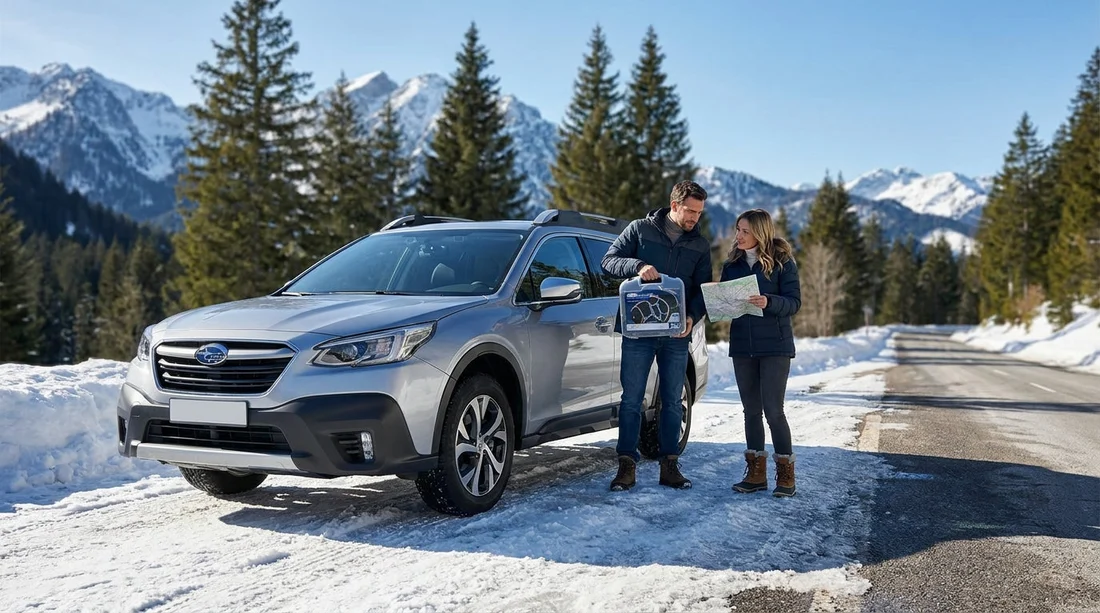
Quick Summary:
- Most California car hire vehicles do not include snow chains as standard.
- Carry approved chains when travelling to mountains during winter storm periods.
- Follow Caltrans R1, R2, R3 chain-control signs, and checkpoints.
- Confirm tyre size, drivetrain, and chain policy before collecting your rental.
Planning a winter road trip in California often raises one practical question, do rental cars come with snow chains, and do you actually need them? The short, useful answer is that you may need chains depending on where and when you drive, but they are not typically provided automatically with car hire. Chain-control rules are enforced by Caltrans on mountain highways, and they can apply even when roads look clear at lower elevations.
This guide explains how California chain controls work, what most rental agreements allow, and the exact checks to make before you set off towards Lake Tahoe, Yosemite high country, Big Bear, or any route that crosses snowy passes.
Do rental cars in California come with snow chains?
In most cases, no. Standard car hire in California is usually delivered without snow chains in the boot. Some suppliers sell chains as an optional extra, some may offer them seasonally at selected locations, and many do not stock them at all. Even when chains are available, availability can be limited during storms, and the chains must match your exact tyre size and clearance.
If you are collecting near the mountains, it can help to compare options by pickup point because policies vary by location and fleet. For example, travellers flying into Los Angeles might start with car hire at LAX, while Bay Area arrivals may review San Francisco SFO rental options before heading towards Tahoe or Yosemite routes.
When do you need chains for car hire in California?
You need chains when chain controls are in effect on the roads you are using and your vehicle is not exempt. In California, chain controls are most common on mountain highways after snowfall, during active storms, or when packed snow and ice remain on the road surface. Caltrans sets chain requirements dynamically, and they are enforced at roadside checkpoints.
Even if you have an AWD or 4WD vehicle, you can still be required to carry chains. In practice, chain controls may be lifted quickly after conditions improve, but you should plan as if you will encounter them if your route involves higher elevations in winter.
Common areas where chain controls are likely include routes to Lake Tahoe via I-80 or US-50, access roads around Yosemite and Sequoia National Park at higher elevations, and mountain routes around Big Bear and Mammoth Lakes. Drivers collecting in Southern California may head inland from Orange County using Santa Ana SNA car rental as a starting point for mountain trips, where chain checks can happen quickly as you gain altitude.
California chain-control levels explained (R1, R2, R3)
Caltrans uses three primary levels of chain control. Understanding them helps you decide whether your car hire is suitable for the day’s conditions.
R1, Chains required except for AWD/4WD with snow tyres. Under R1, most two wheel drive vehicles must fit chains on the drive wheels. AWD or 4WD vehicles are typically allowed through if they have snow tyres. Even so, you should still carry chains, because conditions can escalate.
R2, Chains required on all vehicles except AWD/4WD with snow tyres and chains carried. This is the most common “serious winter” condition. Two wheel drive vehicles must chain up. AWD or 4WD can proceed if they have snow tyres, and they must carry chains. If you have a standard rental on all season tyres, you should assume you will need to carry and possibly fit chains under R2.
R3, Chains required on all vehicles, no exceptions. Under R3, every vehicle must use chains or approved traction devices. This level is less common, but it does happen in severe storms. Some roads may close rather than remain open at R3 for long periods.
At any level, you must follow posted signs and instructions at checkpoints. If you do not have chains when required, you may be turned around or cited, and you can create a safety risk for yourself and others.
What to confirm before booking and at the counter
Before you finalise car hire for winter driving in California, confirm these details so you are not caught out at the base of a pass.
1) Chain policy in the rental terms. Ask whether chains are allowed, whether cables are required, and whether fitting them voids any cover. If chains are not permitted on the vehicle category you want, consider a different category with more clearance, or plan a route that avoids chain-control zones during storms.
2) Tyre size and clearance. Chains must match the exact tyre size (for example 215/60R17). You will only know this for certain once you see the assigned vehicle. If you are bringing your own chains, wait until you confirm the size at collection, or buy from a shop with an exchange policy for unopened boxes.
3) Drivetrain and tyre type. AWD/4WD can help, but it does not replace chains under many conditions. Also, most rentals are on all season tyres, not true winter tyres, which affects exemptions during R1 and R2.
4) Where chains would be fitted. For most front wheel drive cars, chains go on the front wheels. For rear wheel drive, they go on the rear. Some AWD systems require specific guidance. Check the vehicle manual or the rental provider’s instructions.
5) Your route and timing. If you can travel mid day, after ploughing, you may reduce the chance of chaining up. If you are driving overnight or during a storm front, assume controls will be active and closures are possible.
Pick-up location can influence these conversations, as staff at certain airports field winter questions often. Travellers starting in the state capital region may look at Sacramento SMF car rental before heading to Tahoe, where chain controls are frequent in peak winter months.
What happens if you reach a chain checkpoint without chains?
If chain controls are active and your vehicle is not exempt, you may be instructed to turn around. In busy periods, this can mean a long detour, losing accommodation bookings, or being stuck until conditions improve.
If you are unsure whether your planned route will be affected, consider building flexibility into your itinerary and keeping an alternative lower elevation route. If you are driving a larger group vehicle, note that fitting chains can be more involved. For people travelling with more luggage or passengers, exploring vehicle types like van rental from Santa Ana SNA is common, but you still need to confirm chain compatibility and the supplier’s rules.
FAQ
Do all rental companies in California provide snow chains? No. Most car hire vehicles do not come with chains included. Some suppliers may offer them as an optional purchase or seasonal add-on, but you should confirm availability and compatibility in advance.
Do I need chains if I rent an AWD or 4WD vehicle? Sometimes, yes. Under R2 controls, AWD/4WD vehicles can be allowed through only if they have suitable tyres and carry chains. Under R3, all vehicles must use chains or approved traction devices.
Are all-season tyres enough to avoid chains? Usually not. All-season tyres are common on rentals, but they are not the same as winter tyres. Chain-control exemptions often reference snow tyres, and conditions can still require chains even with good tyres.
Can I be fined for not having chains in my rental car? You can be cited or turned around if you enter a chain-control area without required equipment. Enforcement is handled at checkpoints, and the safest plan is to carry approved chains when mountain travel is possible.
What should I check at the rental counter before driving to the mountains? Confirm the chain policy, tyre size, drivetrain, and any restrictions on chain types. Also ask where chains would be fitted on that vehicle and whether any damage exclusions apply.





























































































