


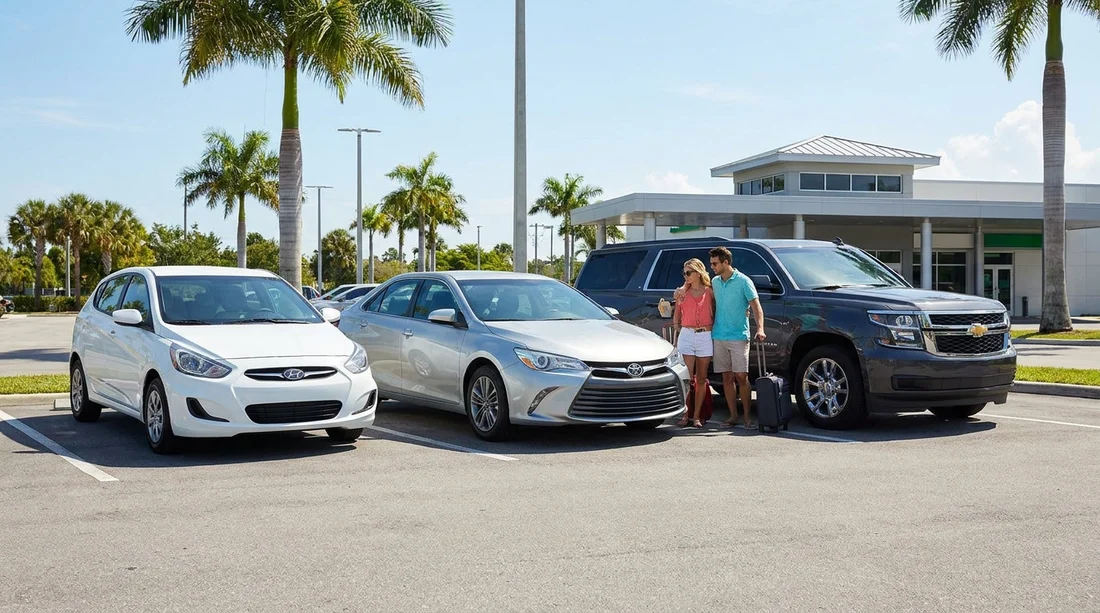
Quick Summary:
- Pick compact for easy city parking, light luggage, and lower fuel costs.
- Choose intermediate for two suitcases, smoother motorways, and mixed driving days.
- Go full-size for long distances, wider seats, and bigger boot capacity.
- Check hotel parking bay widths and toll-road mileage before selecting class.
Choosing between compact, intermediate and full-size car hire in Florida is mostly about matching the car to your daily reality: how many suitcases you are carrying, how many motorway miles you will do, and where you expect to park. Florida roads are generally easy to drive, but the state mixes dense urban areas like Miami with long, fast stretches across Central Florida, plus beach towns where parking can be tight.
Instead of picking a class by habit, plan around four constraints: luggage volume, comfort at speed, fuel use over your total mileage, and the parking situations you will face. The right match can make airport pick-up smoother, keep the cabin calmer on Interstate runs, and reduce the stress of squeezing into hotel or garage spaces.
If you are collecting near Fort Lauderdale, see what local driving patterns look like around car hire at Fort Lauderdale Airport (FLL), where many travellers head straight to highways and beach parking areas. For Miami-based stays, neighbourhood conditions vary, from busy downtown streets to planned retail zones, so it can also help to compare options around car hire in Doral.
What “compact”, “intermediate” and “full-size” usually mean in Florida
Rental classes vary by supplier, but in Florida the differences tend to be consistent in three areas: exterior footprint, rear-seat space, and boot volume. Compacts are typically easier to place in tight spaces and tend to have the best fuel economy. Intermediates sit in the middle, often giving noticeably more rear-legroom and a more settled feel at 70 mph. Full-size models prioritise cabin width, seat comfort and boot capacity, which can matter when you are carrying larger cases or doing long days on the road.
One important detail: you are reserving a class, not a specific model. So use classes as a planning tool, then prioritise the factors that affect your trip most. If you are staying in a high-rise area with structured parking, such as around car rental in Brickell, a smaller footprint can reduce daily friction.
Luggage space: match boot volume to real suitcases
Luggage is the quickest way to end up regretting a smaller class. Florida trips often include beach gear, shopping bags, prams, or golf clubs, so think beyond the number of people.
Compact: Works best for one to two travellers with cabin bags, or one medium suitcase plus soft items. The boot opening can be narrower, and a bulky case may force you to use part of the rear seat. If you will be doing airport to hotel with minimal kit, it is often fine.
Intermediate: A safer choice for two adults with two medium suitcases, plus day bags. Many intermediates handle a couple of larger cases if they are not rigid, but it depends on shape and boot design. If you are doing a fly-drive with a few stops, intermediate reduces the need to play luggage Tetris each morning.
Full-size: Better when you have bigger hard-shell suitcases, extra gear, or you want everything hidden in the boot rather than on the rear seats. It can also be more comfortable if you are travelling with three adults, because shoulder room in the back matters on longer drives.
If your party includes beach chairs, a pushchair, or multiple large suitcases, a larger vehicle category may suit better than any saloon class. In that situation, browsing something like SUV rental in Florida can give you a clearer benchmark for cargo practicality, even if you later decide a full-size saloon is enough.
Motorway comfort: the hidden difference on long days
Florida driving often means sustained motorway speeds, especially on I-95, I-75, I-4, and the turnpike network. A car that feels fine for 20 minutes can feel noisy, busy, or under-supported after two hours.
Compact: Usually lighter, sometimes a bit louder at speed, and may feel more affected by crosswinds when passing large trucks. It is still perfectly workable for motorways, but fatigue can creep in on repeated long days. If you mostly drive short hops, the trade-off is minor.
Intermediate: Often the sweet spot for Florida. You typically get more stable cruising, better rear comfort, and a more relaxed feel in the cabin. If you are splitting time between city exploring and longer drives to theme parks or beaches, intermediate can keep everyone happier without being hard to park.
Full-size: Best when you prioritise comfort for three or four adults, or you expect long point-to-point legs. The ride can be calmer, seats are often broader, and cabin noise can be lower. If you are doing multi-city driving or returning late after a long day out, reduced fatigue is a real benefit.
Fuel use and total mileage: do the maths for your itinerary
Fuel costs are not only about miles per gallon, they are about how many miles you will actually cover. Many Florida itineraries include long motorway distances that add up quickly across a week.
Compact: Typically the most fuel-efficient option. If your trip involves lots of daily driving, compact can keep fuel spend lower, especially in mixed traffic. If you are price-sensitive and travelling light, it is the efficient choice.
Intermediate: Often only slightly less efficient than compact, depending on engine and hybrid availability. For many travellers, the small increase in fuel use is offset by better comfort and easier luggage loading.
Full-size: Usually uses more fuel, particularly in stop-start traffic. However, if it prevents you from needing a larger vehicle category, or keeps the cabin comfortable for long days, it can still be the best value for your trip experience.
Parking constraints: where you will feel the size difference
Florida has plenty of open-air parking, but tight spots still appear in specific places: downtown garages, hotel valet ramps, beachfront lots at peak hours, and busy shopping zones. Choosing the smallest class that meets your needs can make arriving and departing easier.
Compact: Easiest to park in dense areas, and more forgiving when bays are narrow. If you are staying central, eating out in busy districts, or relying on garages, compact reduces hassle.
Intermediate: Still manageable in most Florida lots and garages, but you may notice tighter margins in older multi-storey car parks. It remains a good compromise if you want comfort without parking stress.
Full-size: Usually fine in standard retail and hotel lots, but can feel wide in structured parking, especially when adjacent cars are also large. If you expect nightly garage parking in a busy district, check whether the property uses compact bays or narrow ramps.
If your stay includes areas like Brickell or other high-rise neighbourhoods, you may want to prioritise manoeuvrability. Travellers visiting Orlando attractions can compare local considerations around Enterprise car hire near Disney Orlando (MCO), where driving is often a mix of highways and large, busy car parks.
Simple checklist before you choose your Florida car hire class
1) Count suitcases by size, not just by number. A single large hard-shell case can dominate a compact boot.
2) Map your longest driving day. If you have two or more long motorway legs, comfort matters.
3) Think about where you will park overnight. Street, open lot, or multi-storey garage changes the experience.
4) Plan for extras. Child seats, cooler boxes, and shopping bags add bulk quickly.
5) Choose the smallest class that meets all needs. It is usually the easiest to live with day to day.
FAQ
Is intermediate car hire in Florida big enough for two large suitcases? Often yes, but it depends on suitcase shape and the boot opening. If both cases are large and rigid, a full-size class is the safer choice for keeping luggage in the boot.
Will a compact feel unsafe on Florida motorways? No, Florida motorways are well maintained and compacts handle them fine. The main difference is comfort, with more cabin noise and a lighter feel at speed on longer drives.
Does a full-size car make parking difficult in Florida? Not usually in open-air lots, but it can feel tight in structured garages and busy beach areas. If you expect frequent garage parking, intermediate may be easier day to day.
Which class is best for fuel economy on a Florida road trip? Compact is typically the most fuel efficient, especially with lots of miles. Intermediate can be close depending on the model, and may be worth it for added comfort.





























































































