


Quick Summary:
- A $1 test charge confirms your card works before authorisation.
- It is separate from the larger pre-authorisation deposit hold.
- Use a credit card in the main driver’s name at pick-up.
- Keep enough available credit for deposits, extras, and fuel policies.
Seeing a $1 charge on your credit card after arranging car hire in Miami can feel odd, especially if you were expecting a much larger deposit hold. In most cases, that small amount is not the deposit at all. It is a short card verification transaction used by payment networks and rental partners to confirm the card is real, active, and able to accept a larger authorisation later.
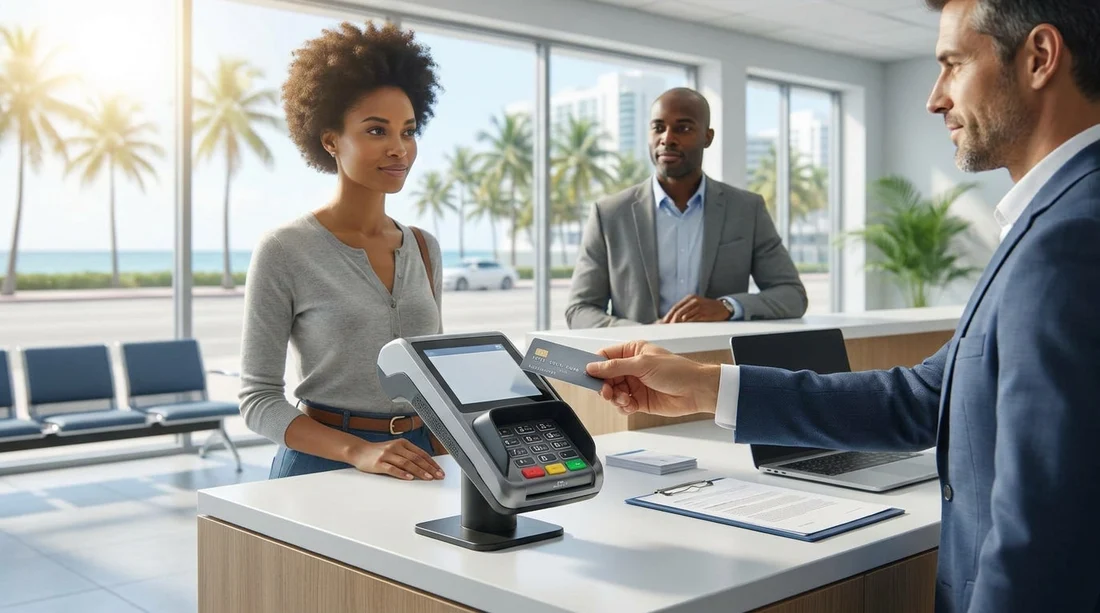
This matters in Miami because many rentals at airports and city locations rely on fast, automated payment checks at the counter. If the quick verification fails, staff may not be able to place the actual pre-authorisation, which can lead to delays while you change payment method, contact your bank, or update details.
What a $1 test charge actually is
A $1 test charge, sometimes shown as $0 or a small local-currency amount, is a “card verification” transaction. It is commonly used to confirm basic things that are not guaranteed until a live transaction is attempted, including whether the card number is valid, the card is open, the expiry date and security checks match, and the card can accept an authorisation request.
In many cases, the $1 does not remain as a final charge. It may appear as pending, then disappear, or it may be reversed shortly after. Some banks display it for a few days depending on how quickly they process reversals. The key point is that it is separate from the deposit hold and does not represent the full amount that may be temporarily reserved for the rental.
How a verification charge differs from a pre-authorisation
For car hire in Miami, there are usually two different payment moments that customers confuse:
1) Card verification test transaction: A small value such as $1 is used to verify the card. It is a technical check, not a security deposit. It often appears quickly, sometimes before you even collect the car.
2) Pre-authorisation (deposit hold): This is the larger amount the supplier temporarily reserves on your credit limit at pick-up. The hold is used to cover potential charges such as excess, fuel differences, tolls, late returns, damage, cleaning, or contract changes, depending on the rental terms and options selected.
A pre-authorisation is not a purchase either. It reduces your available credit while it is held, and then it is released after the vehicle is returned and final checks are completed. Release timing varies by bank, and can be a few business days or longer.
If you are arranging Miami pick-up, it helps to review the local rental information in advance, including where you will collect and which supplier rules apply. For example, Hola provides information for car rental in Miami and also for car rental in Florida, which is useful if you plan to drive beyond the city.
Common reasons the verification succeeds but the deposit fails
It is possible to see the $1 verification succeed, then still run into trouble when the pre-authorisation is requested at pick-up. Typical reasons include insufficient available credit, cardholder and driver mismatch, unsupported card type, or bank fraud controls.
If your goal is a smooth collection for car hire in Miami, the simplest approach is to plan for both the small verification and the larger pre-authorisation. Use a standard credit card issued in the main driver’s name, make sure you have enough spare credit for the deposit plus any expected extras, and avoid switching cards at the counter.
If you are collecting near the airport, plan a little extra time for payment and deposit processing during peak hours. Hola also provides location-specific pages such as car rental at Fort Lauderdale Airport, which can be helpful if your flight arrives into FLL but you still want to drive in the Miami area.
Will the $1 test charge be refunded or reversed?
In most cases, yes. A verification transaction is typically reversed automatically and should not settle as a final charge. However, what you see depends on your bank’s app and processing speed. Some banks show the pending item until it drops off, others show it as a completed charge and then add a reversal entry later.
If the $1 remains for more than a week, check whether it is still pending or has fully posted. A posted amount can still be reversed afterwards, but if it persists, it is reasonable to contact your card issuer with the merchant details shown on your statement.
Why the deposit amount can feel unexpectedly high in Miami
Miami deposits can be higher than travellers expect because rental pricing and risk assumptions vary by market, vehicle category, and season. The deposit can also depend on whether you choose cover at the counter, and whether optional items are added. Even small add-ons can increase the pre-authorisation because the supplier is reserving funds to cover potential additional charges.
To reduce surprises, it helps to review the terms that apply to your chosen supplier and location. If you are comparing options, pages such as Budget car hire in Florida and Alamo car hire in Downtown Miami can guide your expectations around pick-up process and requirements.
FAQ
Why do I see a $1 charge for car hire in Miami? It is typically a card verification test to confirm your credit card is active and can accept an authorisation before the deposit hold is requested.
Is the $1 the same as the security deposit? No. The $1 is a small verification transaction, while the pre-authorisation is the larger temporary hold placed at pick-up.
How long does the $1 test charge stay on my statement? It is usually pending and then disappears, but some banks show it for several days before reversing or dropping it.
Can I use a debit card instead of a credit card to avoid this? Many rentals require a credit card for the main driver, and a debit card may be refused for the deposit. Using the correct credit card helps prevent delays.
What is the best way to prevent pick-up delays? Bring a credit card in the main driver’s name, ensure enough available credit for the deposit, and consider notifying your bank about travel to Miami.

























































































