


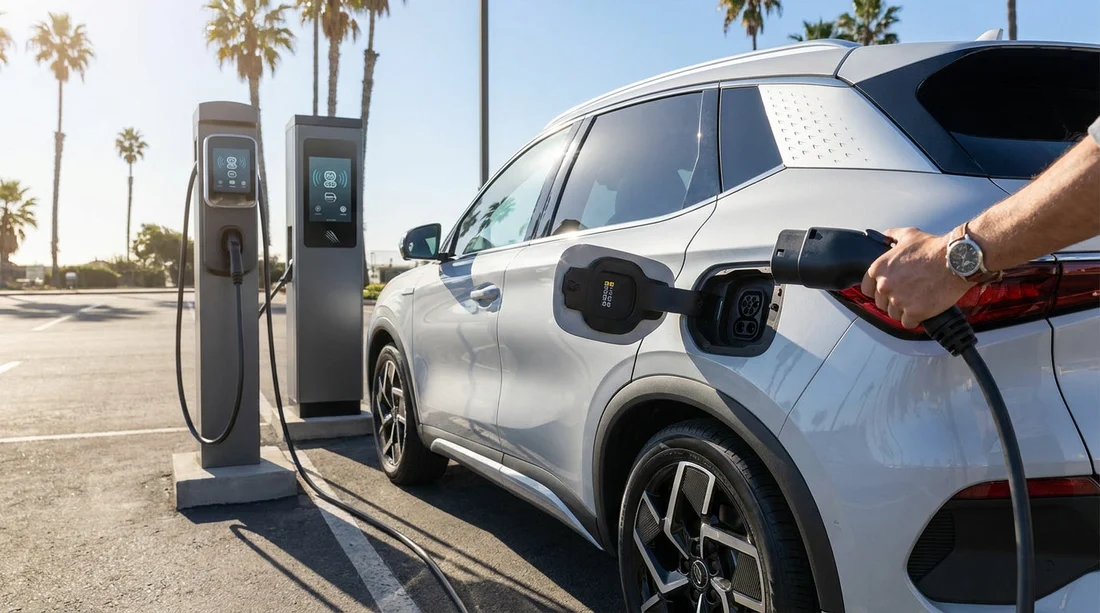
Quick Summary:
- Ask whether the car uses CCS1 or NACS, and confirm in writing.
- Check if the rental includes a NACS or CCS adaptor, plus cables.
- Match your route to chargers, Tesla-only sites may need NACS.
- Confirm DC fast-charging and Level 2 compatibility before you collect.
When you arrange car hire in California with an electric vehicle, the biggest practical question is often not range, it is the connector. The right plug determines which fast chargers you can use, whether you need an adaptor, and how easy it is to charge near airports, cities, and national parks. Because California has a dense mix of public networks and Tesla sites, understanding the connector on your rental car saves time and prevents arriving at a charger you cannot use.
This guide explains the two connector families you will see in the US market, CCS1 and NACS (often called Tesla), plus where adaptors come into play and what to confirm before you commit.
Two main connector types you will encounter in California
CCS1 (Combined Charging System) is the most common plug on many non-Tesla EVs in the US, especially models from earlier years. CCS1 is typically used for DC fast charging on networks such as Electrify America, EVgo, and many independent stations. The same car will usually have a separate port for Level 2 charging (J1772), or it may be integrated as part of the CCS inlet depending on model.
NACS (North American Charging Standard) is the connector used by Tesla vehicles and increasingly adopted by other brands for newer model years. NACS supports both Level 2 and DC fast charging using the same compact connector. In California, NACS is particularly important because of the large number of Tesla Superchargers along major routes.
In short, CCS1 is common across many public fast chargers, while NACS is strongly associated with Tesla and many Superchargers. The key for your car hire decision is which infrastructure you expect to rely on.
Why the connector matters for fast charging
Most holiday itineraries depend on DC fast charging to keep journey time reasonable. If your EV uses CCS1, you can typically plug straight into many public fast chargers without extra equipment. If your EV uses NACS, you may find Tesla Superchargers easiest, but access can vary by vehicle brand and site rules.
California’s reality is mixed. In the Los Angeles area and around major airports you will see many CCS fast chargers and many Tesla Superchargers, often near the same retail centres. On longer drives, for example Los Angeles to the Central Coast or down towards San Diego, charger density is good but not uniform, so your connector can affect which stops are practical.
If you are collecting near Los Angeles International Airport, it can help to consider where you will likely top up first. You can compare location options on pages like car hire Los Angeles LAX and car hire California LAX, then map nearby chargers that match the connector type you expect.
When adaptors matter, and what they can and cannot do
Adaptors can bridge the gap between the plug on the charger and the port on your car, but not every combination works, and not every adaptor supports fast charging. This is where many renters get caught out.
DC fast charging adaptors are more sensitive. Some vehicles can use an adaptor to access another network’s fast chargers, but only if the vehicle software and the charging network support it. A physical adaptor alone is not a guarantee of compatibility, especially at Tesla Superchargers. In practice, you should treat fast-charging access as a capability that must be confirmed for that exact vehicle, not assumed from the connector shape.
For your car hire planning, the safest approach is to confirm three things: the connector on the car, whether an adaptor is provided, and whether DC fast charging is enabled for the networks you plan to use.
What to confirm before you book, and again before you collect
Connector details can change because rental fleets rotate vehicles. Even within the same “EV” category, you might receive different models on different days. Before committing, ask for specifics that reduce uncertainty:
1) The vehicle model and model year, if possible. Connector type often correlates with model year and manufacturer changes. If you cannot get a guaranteed model, ask what connectors are typical for that category at that location.
2) The port type on the car, explicitly “CCS1” or “NACS”. Avoid vague wording like “Tesla compatible” because it can mean different things.
3) Whether the car can use Tesla Superchargers. This is not the same as having a NACS port. Access can depend on the vehicle and the site, and some brands require activating access in an app.
4) Which adaptors are included. Ask whether the car comes with any Level 2 adaptor, and whether any DC fast charging adaptor is included if relevant. Also check whether the adaptor is in the boot at pickup or must be requested.
5) How payment works. Many public chargers require an app, RFID card, or contactless payment. Clarify whether the rental has any in-car account integration, and plan to set up at least one charging app on your phone.
If you are flying into other California airports, it is also worth thinking about where you will first charge. For Orange County, see car rental airport Santa Ana SNA. For Northern California, consider routes around San Jose via minivan hire San Jose SJC.
How to avoid the most common charging surprises
Do not assume “EV” means “Tesla connector”. Many rentals will be CCS1 vehicles, and some will be NACS, depending on fleet. Always confirm the port.
Do not assume an adaptor is included. Even when a model usually ships with one, rental procedures vary. Getting confirmation helps avoid a last-minute scramble.
Plan for a backup network. Apps, maintenance, and queues can make a single network risky. Set up at least one alternative option compatible with your connector type.
Check charging speed expectations. Even with the correct connector, the car’s maximum charging rate affects stop length. This matters on multi-stop drives and can influence whether you prefer fewer fast charges or more frequent top-ups.
Connector checklist for California car hire
Before finalising, use this quick checklist:
Connector on the car: CCS1 or NACS.
Fast charging: DC fast charging enabled, and which networks are supported.
Adaptor kit: what is included for Level 2 and any relevant DC use.
Your route: at least two compatible fast-charge options per travel day.
Doing this upfront makes EV car hire feel as straightforward as petrol, while still benefiting from California’s excellent charging coverage.
FAQ
How can I tell if my rental EV is CCS1 or NACS before I arrive? Ask the provider to confirm “CCS1” or “NACS” in writing for your booking, ideally with the intended model. If the model is not guaranteed, ask what connector is most common in that category at your pickup location.
If the car has NACS, can I use any Tesla Supercharger in California? Not always. Access depends on the vehicle and the Supercharger site rules. Confirm whether that exact rental vehicle is enabled for Supercharging, and what app or payment setup is required.
Will a CCS car be able to use Tesla chargers with an adaptor? Sometimes, but do not assume it. A physical adaptor may not be enough for DC fast charging, and compatibility can depend on vehicle software and network support. Confirm capability for Tesla fast charging specifically.
Do I need to bring my own adaptor from the UK? Usually not, and it may not be compatible with US connector standards. It is better to confirm which adaptors, if any, are supplied with your rental, and plan charging stops around what you will definitely have.
Is Level 2 charging enough for a California road trip? Level 2 works well for overnight charging at hotels or long stays, but it is usually too slow as the only option on travel days. Most road trips are easier when you can use DC fast chargers that match your connector.

























































































