


Quick Summary:
- Drive on the right, keep right, and overtake mainly on the left.
- Right turn on red is often allowed after a complete stop.
- At four-way stops, the first vehicle to stop goes first.
- Stop for any school bus showing red lights and a stop arm.
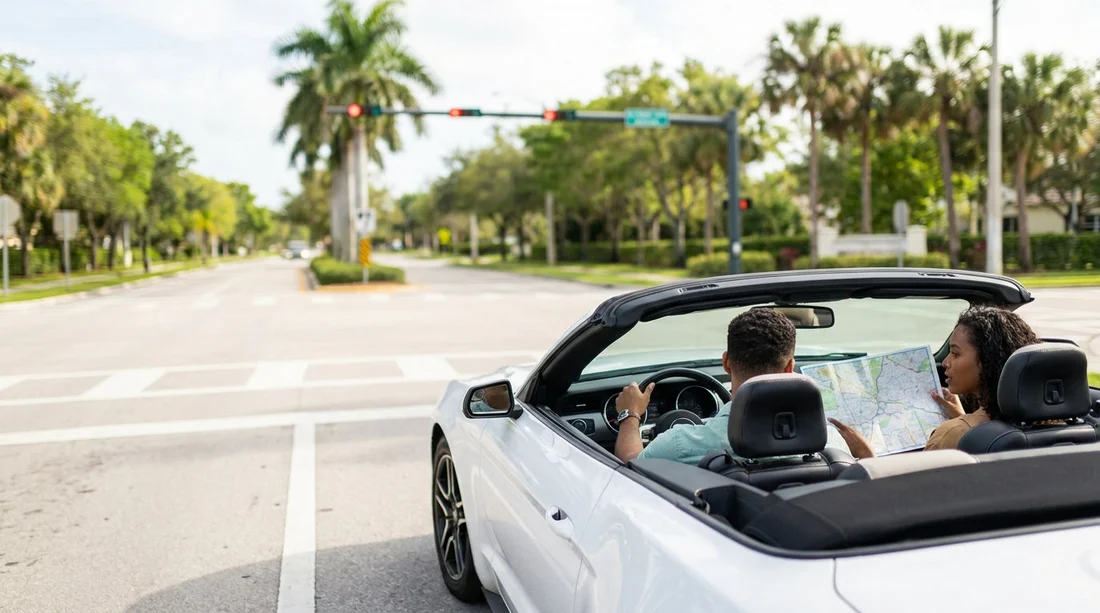
Picking up car hire in Florida can feel familiar at first, wide roads, big junctions, clear signage. The biggest challenge for most UK visitors is not confidence, it is habit. A few US-specific rules, plus some Florida enforcement hotspots, can catch out even careful drivers.
If you are collecting near Miami, Fort Lauderdale, or the surrounding areas, it helps to plan your first 20 minutes. Choose a simple route out of the airport, set your sat-nav before moving, and give yourself time to settle into right-side driving. For location planning, these Hola Car Rentals pages are useful references: car hire Florida (Miami) and car hire at Fort Lauderdale Airport.
1) Right-side driving, lane discipline, and turning habits
In Florida you drive on the right and the driver sits on the left. The mental shift is biggest at junctions and when pulling out after a stop. A good rule is to say, quietly, “keep right” whenever you start moving, especially after leaving a car park, petrol station, or hotel driveway.
Lane discipline differs slightly from the UK. On motorways, slower traffic should generally stay right, while passing happens to the left. You will still see some drivers overtaking on the right, but you should avoid making it your default. Also expect multi-lane junctions where your turning lane choice matters early. In many places you can turn right from a dedicated right-turn lane, often protected by an arrow signal.
2) Turns on red, when it is allowed and when it is not
One of the biggest surprises for UK drivers is turning right on a red light. In Florida, a right turn on red is often permitted after coming to a complete stop, but only if it is safe and there is no sign banning it.
Stop fully behind the line, just as you would at a STOP sign. Then check for pedestrians in the crosswalk, cyclists, and traffic coming from your left. If a sign says “No Turn on Red”, you must wait for green. If there are multiple right-turn lanes, read the signs carefully, sometimes only one lane is permitted to turn on red.
Left turn on red is generally not allowed, except from a one-way street onto another one-way street, where signs permit it. If you are unsure, wait.
3) Four-way stops, who goes first, and how to avoid confusion
Four-way stops are common in residential areas and smaller towns. All approaches have a STOP sign, and everyone must stop. The basic rule is simple: first to stop is first to go.
If two vehicles stop at the same time, the vehicle on the right typically has priority. If you are turning left, you should yield to oncoming traffic going straight. Make eye contact where possible and commit decisively when it is your turn.
A common UK mistake is rolling through because the road looks empty. In Florida, a “rolling stop” can attract a ticket. Come to a full stop, count a beat, then proceed.
4) School buses, lights, stop arms, and why Florida takes it seriously
Florida enforces school bus rules strictly. When a school bus stops and extends its red stop sign arm while flashing red lights, traffic in both directions must stop. You must remain stopped until the lights stop flashing and the arm retracts.
There are exceptions on divided highways. If there is a raised median or physical barrier separating directions, the opposing traffic may not need to stop. Painted lines alone can be tricky to interpret quickly, so treat any bus stop situation cautiously and stop unless you are certain a divided carriageway rule applies.
Be extra alert in mornings and mid-afternoons. Speed limits around schools can drop sharply and enforcement can be active. If you are travelling with family or lots of luggage, consider the extra space of a people carrier. This page can help when comparing options: minivan rental in Florida.
5) Speed limits, units, and Florida driving pace
US speed limits are in miles per hour, like the UK, but the numbers and road feel differ. Typical limits are about 25 to 35 mph in residential areas, 45 to 55 mph on larger surface roads, and 65 to 75 mph on interstates.
Florida drivers may appear faster and more assertive, particularly in South Florida. The safest approach is to match the flow while staying within the posted limit, and keep a larger following distance than you think you need. Heavy rain can arrive suddenly, so increase space and reduce speed early rather than braking sharply.
If you are collecting in a busy urban area, reading the pick-up location guidance can help you anticipate exits and lane choices, for example car hire in Brickell.
6) Lane markings, signs, and common junction layouts
US road markings are consistent but different. White lines typically separate lanes going the same direction, yellow lines separate opposing directions. Double yellow lines mean do not cross. A flashing yellow signal often means proceed with caution, while flashing red is treated like a STOP sign.
At traffic lights, you may see a “protected” left turn indicated by a green arrow. When the arrow is green, oncoming traffic is stopped and you can turn. When you have a solid green circle (no arrow), you may turn left only after yielding to oncoming traffic and pedestrians, similar to turning right across traffic in the UK.
7) Motorways (interstates), tolls, and what to do at ramps
Interstates are generally straightforward. Entry and exit ramps can be longer than in the UK, giving you time to accelerate to match traffic. Use your indicators, check mirrors, and do a shoulder check before changing lanes.
Florida has many toll roads, especially around Orlando, Miami, and Fort Lauderdale. Your rental may use an electronic toll system. Before you drive off, understand how tolls will be handled, whether by a transponder, number plate billing, or a pay-as-you-go option.
8) Practical tips before you leave the car hire lot
Before you set off, adjust mirrors, seat, and steering wheel. Set your sat-nav and phone mount while stationary. Confirm where the handbrake or parking brake control is, many US cars use a foot pedal or electronic switch rather than a lever. Check the fuel type and where the fuel flap release is.
If you are choosing between providers, you may also want to compare what is included, such as additional driver options or toll handling. This neutral overview can help with brand expectations: Avis car rental in Florida.
Finally, give yourself a low-pressure first drive. A short loop to a nearby petrol station to practise right-side lane positioning can make the rest of the trip feel much easier.
FAQ
Do I need an International Driving Permit to drive in Florida with a UK licence? Many visitors drive using a valid UK photocard licence, but requirements can vary by rental company and circumstances. Check your car hire terms and carry your passport and licence.
Can I turn right on a red light in Florida? Often yes, but only after a complete stop and only if there is no “No Turn on Red” sign. You must yield to pedestrians and cross traffic before turning.
How do four-way stops work if everyone arrives together? Everyone must stop. If arrival is simultaneous, the vehicle on the right usually goes first, and left-turning vehicles yield to oncoming traffic going straight.
What should I do when a school bus stops with red lights flashing? Stop and stay stopped while the red lights flash and the stop arm is extended. Only proceed once the bus signals are off and it is moving again.
Are Florida speed limits in miles per hour, and are they strictly enforced? Speed limits are in mph. Enforcement varies by area, but school zones, busy urban roads, and major highways can be monitored, so follow posted limits and drive to conditions.

























































































