


Quick Summary:
- Bring your insurance ID card and a current declarations page.
- Ensure your policy shows liability limits, dates, and your name clearly.
- Request an insurer letter confirming rental or non-owned vehicle coverage.
- Carry printed and saved PDFs, some desks will not accept screenshots.
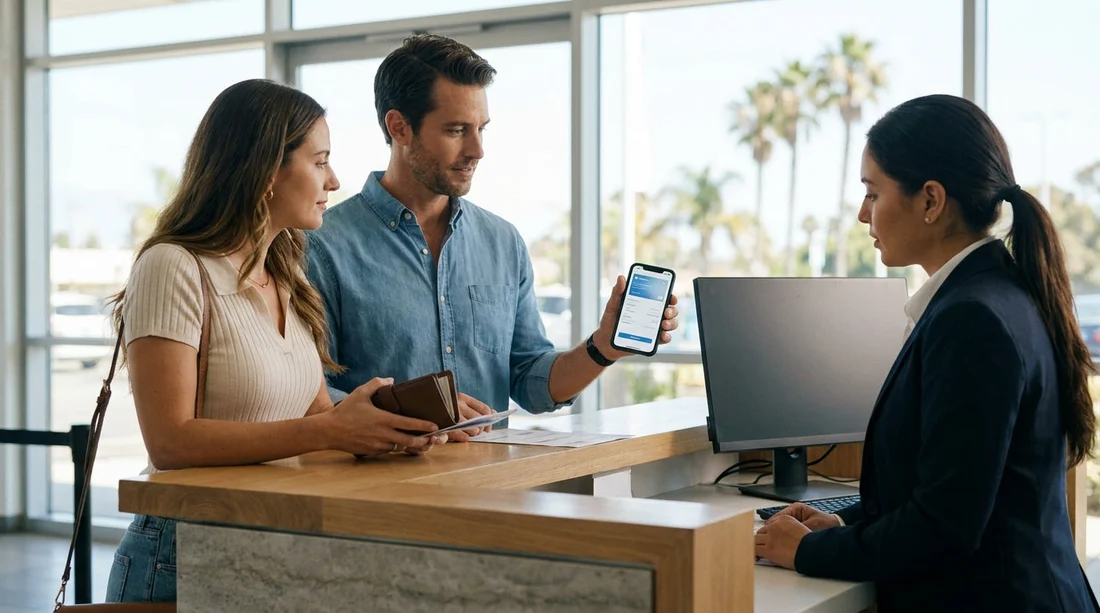
When you collect a rental car in California and plan to rely on your own US auto insurance, the rental counter may ask you to prove that your policy is active and that it covers you while driving a rental vehicle. Requirements vary by rental company and location, but having the right paperwork ready can prevent delays, unexpected charges, or being required to take the desk’s insurance products.
This guide explains the most commonly accepted proof at pick-up, how to make it easy for staff to verify, and what to do if you cannot access your insurer documents on the day. If you are arranging car hire at a major airport desk, such as Los Angeles LAX or San Francisco SFO, these checks are more likely simply because counters handle high volumes and follow standard scripts.
Why the rental desk may ask for proof
In California, rental companies must ensure vehicles leave their lot with at least the legally required liability protection and that the renter meets contract conditions. If you decline optional cover and say you have your own insurance, counter staff may need to confirm two things: that you are insured today, and that the policy applies to you driving a rented vehicle. They may also need to record details for their file, such as the insurer name and policy period.
It is important to note that “having insurance” is not the same as “having coverage for this rental”. Some policies only cover specific named vehicles, some limit cover to personal use, and some exclude certain vehicle types. Because a rental agreement is a contract, the desk may refuse to accept unclear documentation even if you believe you are covered.
Documents you should have ready at pick-up
Bring more than one form of proof. Most issues happen when a single document is missing key information, such as effective dates or confirmation that rental vehicles are included.
1) Proof of insurance card (insurance ID card)
This is the simplest starting point and is often requested first. A proof of insurance card generally shows the insurer, policy number, named insured, and policy effective dates. Some cards list the covered vehicle(s) as well. If the dates are expired or the name does not match the driving licence, staff may not accept it.
If you only have a digital card in an app, make sure it is accessible offline. Airport terminals and car parks can have patchy signal. A PDF is usually better than relying on logging into an insurer portal.
2) Declarations page (dec page)
A declarations page is one of the strongest documents because it summarises the policy, who is insured, what vehicles are listed, and the coverage limits. For counter verification, it helps if your dec page clearly shows your full name, policy number, effective and expiry dates, and liability limits.
If your insurer provides multi-page declarations, download the complete file. A single screenshot may omit the section that confirms cover types or policy dates.
3) Insurer letter confirming rental, or non-owned auto, coverage
If your policy wording is complex or you know the desk often challenges “personal policy covers rentals”, request a short letter from your insurer. It can be emailed as a PDF and should be on insurer letterhead or include a verification line.
Useful language in the letter includes confirmation that your personal auto policy extends to a private passenger vehicle rented in the United States, and whether physical damage cover applies. Some insurers call this “coverage for temporary substitute vehicles” or “non-owned auto coverage”. The key is that it is explicit about rental vehicles and dates.
This letter is especially helpful if you are renting in busy locations such as Sacramento SMF, where staff may be strict about documentation for renters who decline optional products.
4) Full policy booklet or key endorsements (as backup)
A full policy document can be long, but having it available helps if the desk questions a specific point, such as whether collision coverage transfers to a rental car, whether other drivers are covered, or whether certain vehicle classes are excluded. If you can, save the policy PDF and key endorsements that mention rental vehicles, “temporary substitute auto”, or “newly acquired vehicle”.
You usually will not need to show the entire booklet, but it is useful if a supervisor needs to verify a term quickly.
What the rental company is really checking
Most counters do not analyse your policy in detail, but they look for clear proof of validity and a reasonable match to the rental situation. Expect questions on name match, active dates, geography, and whether your cover extends to rentals.
If you are hiring a larger vehicle, confirm whether the policy restricts vehicle weight or class. This matters for certain SUV or people carrier rentals, including options like SUV hire in San Diego.
Also remember that liability coverage is different from collision or comprehensive. Even if your policy covers liability, the desk may still offer a damage waiver. If you plan to rely on your own collision and comprehensive, your declarations page and any endorsements should show those coverages and deductibles.
Printed vs digital proof, what is safest?
Carry both. Many rental desks accept digital insurance cards, but practical issues can arise: a dead phone battery, poor reception, app login failures, or a staff member who cannot accept a screenshot because it does not show the full policy period.
A printed declarations page and insurance card can save time. If you prefer paperless, store PDFs in your phone’s files and email them to yourself for quick retrieval.
If you are not the named insured
If you are driving under someone else’s policy, you may have trouble using that policy as “your” proof unless you are listed as a driver. Some rental companies only accept insurance in the renter’s name. If you are an additional driver or spouse, bring documentation showing you are listed. An insurer letter can help if the declarations page is unclear.
Also be aware that if you are not the renter on the agreement, your insurance may not apply the way you expect. Align the rental contract name with the insured driver whenever possible.
What if you cannot provide acceptable proof at pick-up?
If you cannot show proof, the counter may treat you as uninsured for their purposes. Outcomes vary, but you may be required to purchase the rental company’s liability product, add coverage through the desk, or in rare cases have the rental refused.
If you run into this issue at a high-traffic counter, such as car rental at LAX, asking your insurer to email a letter while you wait can resolve it quickly. Use insurer customer service chat or phone support, and request a PDF that confirms active cover and rental extension.
Tips to avoid surprises before you travel
Check your policy a few days before your trip, not at the counter. Confirm whether your policy extends to rental vehicles, whether it covers loss of use or administrative fees charged by rental firms, and whether your deductibles are acceptable to you.
If you will be picking up at an airport desk that handles international travellers, you may see slightly different terminology like “car hire” rather than “car rental”, such as on car hire at Los Angeles LAX. The proof you need is the same: clarity and current dates.
Finally, confirm the payment card requirements separately. Even with perfect insurance proof, the desk may still require a credit card and a deposit, depending on supplier rules.
FAQ
Q: Is an insurance ID card alone enough for a rental car in California?
A: Sometimes, but not always. Many counters accept an active insurance ID card, but a declarations page is better because it shows coverage types and limits more clearly.
Q: What should an insurer letter say to support using my own insurance?
A: It should confirm the policy is active, name the insured driver, and state that coverage extends to a private passenger rental or non-owned vehicle in the US.
Q: Will my liability coverage automatically cover the rental car itself?
A: No. Liability covers damage or injury you cause to others. Damage to the rental vehicle is handled by collision and comprehensive cover, or a damage waiver from the rental company.
Q: Can I show proof on my phone at the counter?
A: Often yes, but bring PDFs or printed copies. Some desks will not accept screenshots, and apps can fail without signal or a login.
Q: What happens if I cannot prove I am insured at pick-up?
A: The rental company may require you to purchase their cover or may refuse the rental. Calling your insurer for an emailed letter can sometimes fix the issue quickly.

























































































