


Quick Summary:
- A TPMS warning often means low pressure in one tyre.
- Ask staff to measure and inflate all tyres before leaving.
- Inspect tyres for damage, bulges, nails, and uneven tread wear.
- Request a different vehicle if the light stays on.
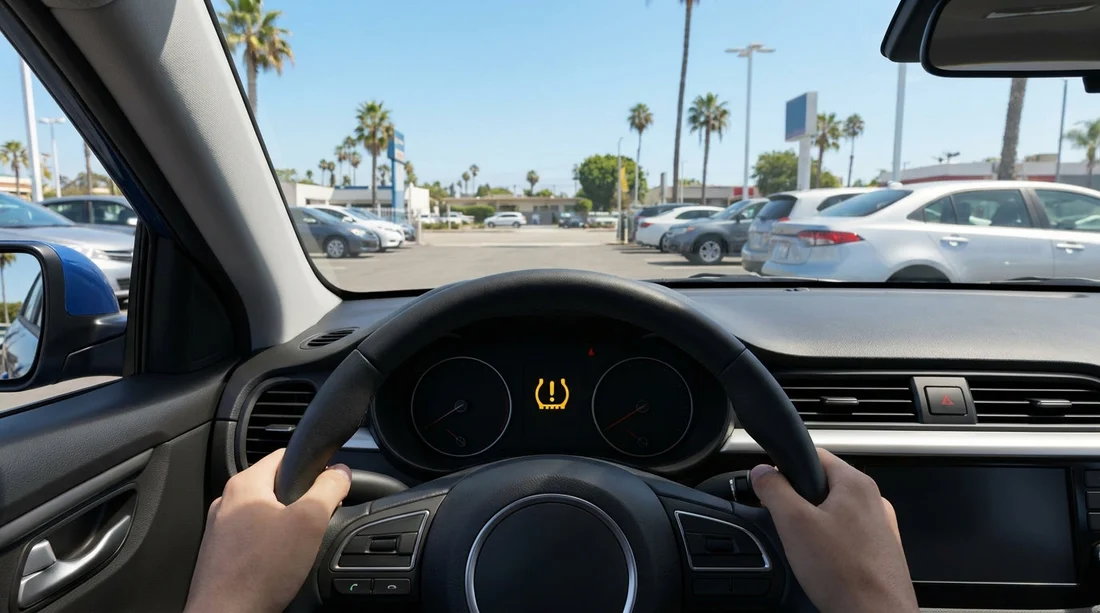
Seeing a tyre-pressure monitoring system (TPMS) warning when you collect a rental car in California can be unsettling, especially if you are about to join a fast freeway. The good news is that a TPMS light is often a simple maintenance issue, not an immediate breakdown, but it is also a safety signal you should not ignore. At pick-up, you have the best leverage to get it resolved properly, either by inflating the tyres, confirming there is no damage, or switching vehicles if anything seems off.
This guide explains what the warning typically means, what you should check before leaving the rental lot, and how to decide whether it is acceptable to drive. It is written for travellers arranging car hire in California, where temperature swings, long highway distances, and heavy traffic make correct tyre pressure especially important.
What the TPMS light is actually telling you
TPMS is designed to warn when one or more tyres are significantly below the recommended pressure. In many cars, the system triggers when a tyre drops roughly 25 percent below the target. Some vehicles show an individual tyre reading on the dash, others only show a general warning symbol.
At pick-up, a TPMS warning usually falls into one of these categories:
1) A tyre is genuinely low. This is the most common reason. It can happen from natural air loss, a puncture, a slow leak at the valve, or simply the car sitting between rentals.
2) The tyres were adjusted but the system was not reset. Some cars need a reset procedure after inflation. If this was missed during cleaning or servicing, the light can remain on even if pressures are correct.
3) A sensor or battery fault. TPMS sensors can fail. If the dashboard message says “TPMS system fault” rather than a low-pressure warning, it may not be reading correctly. That is a stronger reason to request another vehicle.
4) Temperature-related pressure change. In California, an early morning collection near the coast can be cool, while inland afternoon heat can be much higher. Tyre pressure typically changes about 1 psi for every 10°F. A drop overnight can trigger the light even if the tyre is not damaged.
Why you should deal with it before leaving the lot
Driving with underinflated tyres can increase stopping distance, reduce grip, and raise the risk of a blowout as tyres heat up at freeway speeds. Underinflation also hurts fuel economy, which matters if you are covering long distances between cities or parks.
From a practical standpoint, addressing it immediately avoids wasting travel time searching for an air pump and wondering whether you will be charged for a tyre issue later. Rental companies expect tyres to be roadworthy at handover. You are well within your rights to ask for a pressure check and written acknowledgement of any warning light at pick-up.
If you are collecting at major hubs, such as when arranging car rental at San Francisco Airport, service desks and maintenance staff are typically nearby, so it is sensible to resolve it on the spot.
Checks to request before you drive away
Do not rely on a quick glance at the tyres alone. Many tyres can look “fine” while being significantly underinflated. Here is what to request from staff, in order:
1) Measure and set tyre pressures with a gauge. Ask them to check all four tyres, not just the one indicated. The correct pressures are on a sticker in the driver’s door jamb. The number on the tyre sidewall is not the target pressure, it is the maximum rating.
2) Check the spare tyre if the vehicle has one. Many modern rentals have an inflator kit rather than a spare. If there is a spare, it is often neglected and can be flat. Knowing what you have avoids surprises on a road trip.
3) Inspect for visible damage. Ask staff to look for sidewall bulges, cuts, or embedded objects. If you spot a nail or screw, do not accept “it’s probably fine”. A slow leak can become a rapid failure after heating up on the freeway.
4) Confirm tread depth looks even. Uneven wear can suggest alignment issues. That is not your problem to diagnose, but it is a reason to prefer a different car, because it can affect handling and tyre life.
5) Ask for a TPMS reset if needed. If pressures are corrected, the warning should usually clear after a short drive. Some models require a menu reset or a button press. Ask them to perform it and confirm the light is off, or at least confirm their process in writing.
If you are picking up in Southern California traffic, for example when using Payless car hire at Los Angeles LAX, it is worth spending an extra few minutes to get this right, because pulling over safely soon after leaving the airport can be difficult.
When it is OK to accept the car, and when it is not
Acceptable to leave with the car if all of the following are true: pressures were measured and set to the door-jamb specification, tyres show no damage, and staff confirm the TPMS will clear after driving or have reset it. If the light remains on but the car displays live pressure readings that match the sticker, that strongly suggests a reset is needed rather than a safety issue. Even then, ask for the check to be noted on your paperwork or rental record.
Do not leave in the car if any of the following apply: the TPMS light is flashing, the message indicates a system fault, a tyre is losing pressure again after inflation, there is any sidewall damage or bulge, or staff cannot or will not measure pressures with a gauge. Also be cautious if the vehicle pulls to one side, the steering wheel sits off-centre, or you feel vibration at low speed in the lot, as these can hint at tyre or wheel issues.
In those cases, it is reasonable to ask for a different vehicle. If you are organising car hire in busy locations like Silicon Valley, such as Alamo car hire in San Jose, swaps are often straightforward when you raise the issue before you exit.
How to document the issue at pick-up
Even when the fix is simple, take two minutes to protect yourself. Photograph the dashboard showing the TPMS warning, and photograph each tyre, including the wheel area where you might see a puncture. If the car displays tyre pressures on-screen, photograph those too after inflation. Then ask the desk or lot attendant to note that the warning was present at handover and that pressures were checked.
What to do if the TPMS light comes on shortly after leaving
If the warning appears within the first few miles, do not ignore it and “see how it goes”. Instead, find a safe place to stop, visually inspect all tyres, and inflate to the door-jamb specification. If pressure will not hold, contact the rental provider and request a swap rather than continuing to drive on a leaking tyre.
If you are travelling between cities, for example from the Bay Area after arranging car hire at San Francisco SFO, handle it early rather than hoping it resolves itself later on the highway.
FAQ
Does a TPMS light mean I have a puncture? Not always. It means one or more tyres are below the threshold, which could be a puncture, slow leak, temperature change, or missed reset after servicing.
Can I drive a short distance with the TPMS warning on? You can usually drive carefully to a nearby safe place to stop, but avoid freeway speeds until pressures are checked. If a tyre looks visibly low, do not keep driving.
What should I ask the rental staff to do at pick-up? Ask them to measure and set all tyres to the door-jamb specification, inspect for damage, and reset the TPMS if required. Request that the check is noted on your rental record.
What does it mean if the TPMS light is flashing? A flashing TPMS light often indicates a system malfunction rather than low pressure. Treat that as a reason to request a different vehicle, because you may not get reliable warnings.
Could I be charged if the TPMS light was on when I collected the car? You should not be charged for a pre-existing warning, but protect yourself by photographing the dashboard and asking staff to document the issue and the pressure check at pick-up.

























































































