


Quick Summary:
- Use a federally approved seat matched to your child’s age and size.
- Florida generally requires restraints for children aged five and under.
- Pick rear-facing, forward-facing, booster, or belt-only based on belt fit.
- Request the correct seat early and confirm installation expectations at collection.
Planning car hire in Florida with children onboard means thinking about more than luggage space and fuel policy. Florida law sets minimum requirements for young passengers, but best practice often goes beyond the legal baseline. The goal is simple, keep every child properly restrained for their age, height and weight, and make sure the seat is installed and used correctly for every trip, including short airport runs.
In this guide, you will find the key Florida rules, how they translate into practical seat choices, and a checklist to use before you finalise your car hire. If you are collecting near major gateways, you may also want to compare pick-up locations such as car hire in Miami (MIA) or Orlando (MCO) car rental options, as seat availability and vehicle types can vary.
Florida child restraint law, what it covers and what it does not
Florida’s child restraint requirement is often summarised as, children aged five and under must be in a federally approved child restraint device. More specifically, Florida law expects:
Children aged 0 to 3: secured in a child restraint device (commonly a rear-facing infant seat at first, then a rear-facing convertible seat as they grow).
Children aged 4 to 5: secured in a child restraint device, or in a booster seat using a vehicle safety belt.
Once a child is older than five, Florida law generally allows the adult seat belt alone. However, that does not automatically mean the belt fits properly. Many children still need a booster for correct belt positioning well beyond age five, and the safest approach is to choose restraint type by fit rather than birthday.
Also note that Florida law is a minimum standard. Your home country guidance, your child’s seat manual, and your vehicle’s safety information may recommend stricter use, such as rear-facing for longer.
Age and height guidelines that help you pick the right seat
Because legal rules use ages, but car seats are designed around size, it helps to keep both in mind. Use the child seat label and instruction manual for exact limits, then apply these practical guidelines:
Rear-facing seats: best for babies and toddlers until they reach the rear-facing height or weight limit of the seat. Rear-facing supports the head, neck and spine in a crash. Many children can remain rear-facing beyond age two, depending on the seat’s limits.
Forward-facing seats with a harness: used once a child outgrows rear-facing limits. A five-point harness spreads crash forces and reduces movement. Keep children harnessed until they reach the harness height or weight maximum.
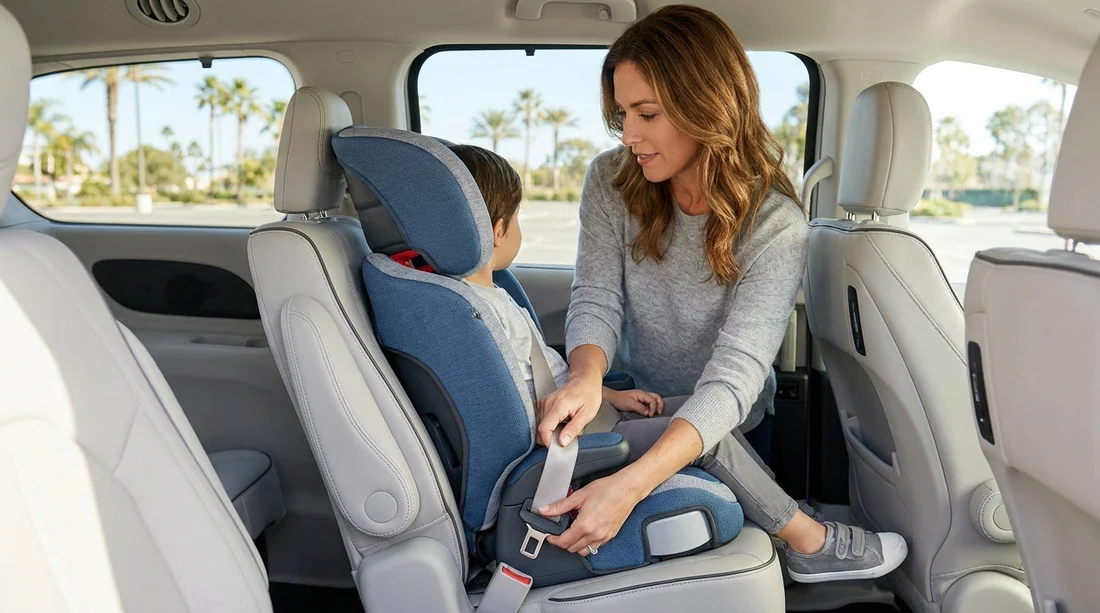
Booster seats: used when the child is too big for a harnessed seat but too small for the vehicle belt to fit correctly. A booster positions the lap belt low across the hips and upper thighs, and keeps the shoulder belt across the centre of the chest and shoulder.
Seat belt only: suitable when the belt fits without a booster. A practical fit check is that the child can sit back with knees bending naturally at the seat edge, the lap belt stays low on the hips, and the shoulder belt sits on the shoulder, not the neck or face. Many children reach this stage around 10 to 12, but it varies.
If you are unsure which category your child is in, treat height and belt fit as the deciding factor, not just age. This matters particularly when you are planning theme park days or long highway drives, where comfort can tempt children to wriggle out of position.
Choosing a car hire seat option, what to check before you confirm
When arranging car hire, you may be offered infant seats, child seats, or booster seats. The labels differ by provider, so focus on the child’s current weight, height and age, and ask how the seat is specified. Before you finalise, check these points:
1) Seat type and limits: confirm whether the offered “child seat” is rear-facing capable, forward-facing only, or convertible. For boosters, clarify high-back versus backless if you have a preference, especially for children who nap and need head support.
2) Installation responsibility: many rental providers supply the seat but expect you to install it. You should be comfortable fitting it using either the vehicle belt or LATCH anchors, then tightening it so it moves less than an inch side-to-side at the belt path.
3) Vehicle compatibility: if you have three children, or need two seats plus an adult in the back, the car class matters. Larger vehicles can make correct installation easier. If you expect extra space needs, it can help to compare options like SUV hire in Florida (MIA) for wider rear seating and luggage capacity.
4) Pick-up location and stock: airports and city branches can differ in seat availability. If you are landing on the Atlantic coast, you might compare Fort Lauderdale airport car rental (FLL) with other nearby branches based on timing and convenience.
5) Condition and cleanliness: check the seat for visible damage, missing parts, frayed straps, and that the buckle clicks securely. Straps should lay flat without twists, and the chest clip should slide correctly.
6) Expiry and labels: child seats have expiry dates and required labels, including compliance wording. If anything looks unclear, request a different seat.
Common mistakes travellers make, and how to avoid them
Using a booster too early: moving a child from a harnessed seat into a booster before they are ready can reduce protection. A booster only works if the child stays seated correctly for the whole journey. If they slump, lean, or unbuckle, they likely need a harnessed seat.
Shoulder belt behind the back: children sometimes do this for comfort, but it removes upper-body restraint. A booster that positions the belt better, or a higher-back booster, can help.
Bulky coats under harness straps: thick clothing can compress in a crash and leave slack. Use thinner layers, then place a blanket over the harness if needed.
Loose installation: a seat that shifts easily is not tight enough. Before you drive away, do a firm tug at the belt path to confirm it is secure.
Incorrect chest clip position: the clip should sit at armpit level. Too low can allow straps to slip off shoulders.
Practical checklist for collection day in Florida
Use this quick routine at the car park before you set off:
Check the back seat: locate LATCH anchors if you plan to use them, and confirm the seat belt locks as required for child seat installation in that vehicle.
Fit the seat tightly: install rear-facing at the correct recline angle for your child’s age. For forward-facing, use the top tether if available and required by your seat instructions.
Do a fit test on the child: harness straps at or below shoulders for rear-facing, at or above shoulders for forward-facing. Pinch test at the collarbone to confirm snugness.
Plan seating positions: the centre rear seat can be a good option if you can achieve a correct install, but many vehicles make outboard positions easier. Never put a rear-facing seat in front of an active airbag.
Recheck after the first stop: straps can settle, and children can loosen things. A fast check after 10 minutes helps catch issues early.
FAQ
What are the legal child seat requirements in Florida? Florida generally requires children aged five and under to use a federally approved child restraint. Ages 0 to 3 must be in a child restraint device, and ages 4 to 5 must be in a child restraint device or a booster using a seat belt.
Does my child need a booster seat after age five in Florida? The law may allow a seat belt after five, but many children still need a booster until the belt fits correctly. Use belt fit, not age alone, to decide.
Can I install a rental child seat myself? Yes, and you should expect to. Before driving away, confirm the seat is tightly installed, the harness is snug, and you understand how to adjust it for your child.
Is a high-back booster better than a backless booster? High-back boosters can help position the shoulder belt and provide head support, which is useful for sleeping children or cars without supportive headrests. Backless boosters can work well when belt fit and head support are already good.
Should children sit in the front seat in Florida? It is safest for children to ride in the back seat. Never place a rear-facing child seat in front of an active front airbag.

























































































