


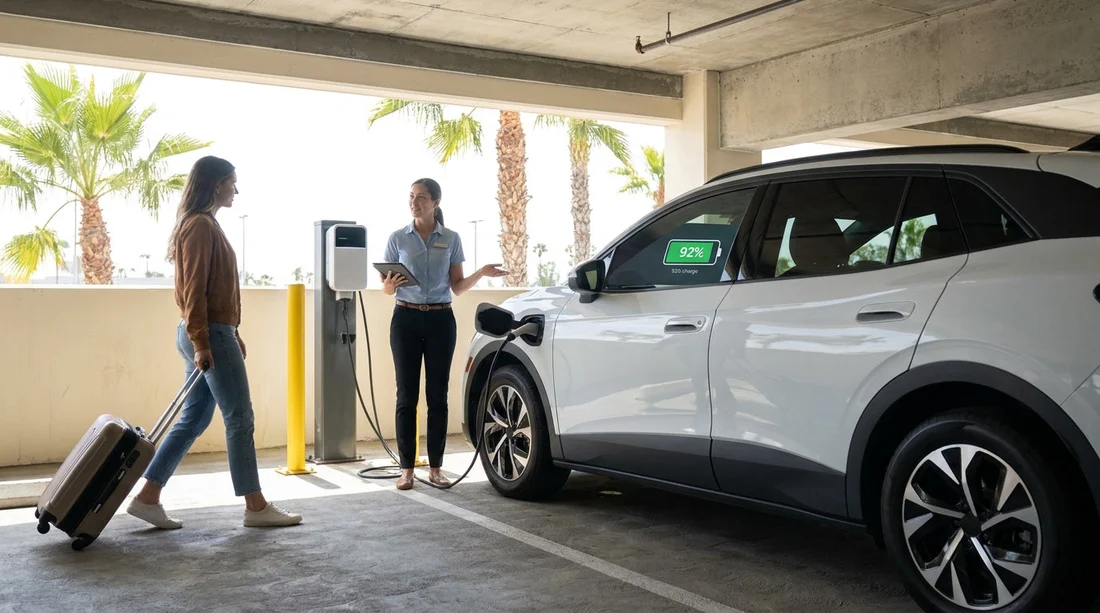
Quick Summary:
- Expect 60–90% charge, but policies vary by location and fleet.
- Confirm start charge and return rule before accepting the EV keys.
- Plan a first charging stop nearby, not at your final destination.
- Photograph battery percentage and range estimate at the vehicle bay.
Electric car hire in California is straightforward once you know one key detail, the battery level you will receive at pick-up. Unlike petrol cars that are often supplied “full to full”, EVs are commonly supplied with a practical, not always full, state of charge. The reason is simple, rapid turnaround. A vehicle can be cleaned and checked quickly, but charging to 100% can take longer than the time available between rentals.
That said, California is one of the easiest places in the world to drive an EV, thanks to dense charging networks, familiar EV models, and staff who see electric rentals every day. Your job at the counter is to confirm the starting percentage, the return rule, and any charging payment method, then plan your first stop so you are never learning the ropes while low on range.
If you are collecting near the Bay Area, the process is similar whether you are picking up at San Francisco Airport car rental desks or elsewhere. The policy is set by the rental brand and location, and the fleet can include Tesla and non-Tesla models with different connectors and route planning tools.
Typical EV pick-up charge level in California
In California, a common real-world pick-up range is roughly 60% to 90% battery. Some locations aim for a consistent minimum, for example “at least 70%”, while others simply deliver “as available” above a stated floor. A fully charged 100% vehicle does happen, but you should treat it as a bonus rather than an expectation, especially during peak travel days.
Airports often operate on speed. High turnover at major airports can mean the vehicle is cleaned and returned to circulation as soon as it meets the minimum charge requirement.
Urban stations may have tighter control. City locations with overnight dwell time sometimes deliver higher states of charge, because vehicles can sit on Level 2 chargers longer.
Model and battery size matter. A smaller-battery EV at 80% might show less range than a larger-battery EV at 70%. Ask for both the percentage and the estimated miles, then remember that the range estimate can change quickly with speed, temperature, and elevation.
If you are collecting around Silicon Valley through car hire at San Jose SJC, expect the same general norms. What matters is not the city, but the specific station policy and how long the car has been off rent.
What to confirm at the counter before you drive away
To avoid surprises, confirm these items before accepting the contract and heading to the bay. A few minutes here can save a stressful detour later.
1) Starting battery percentage and any guaranteed minimum. Ask the agent to state the battery charge level on the paperwork or point you to where it is recorded. If they cannot guarantee an exact percentage, ask what minimum the location uses.
2) Return requirement and fees. EV return policies vary. Some are “return at or above the level you received”, others are “return above a stated minimum”, and some offer optional charging products where you can return lower and pay for energy and service. Make sure you understand which applies to your car hire agreement.
3) Connector type and adapters. Confirm whether the car uses NACS (common on Tesla and increasingly on newer EVs) or CCS (common on many non-Tesla EVs). If an adapter is provided, confirm it is in the vehicle, and check the condition before leaving.
If you are starting in Southern California, for example from San Diego car rental locations, these checks are especially useful because traffic and short hops can lead to lots of stop-start driving, which changes energy use in ways that surprise first-time EV renters.
How to plan your first charging stop before you leave
The smartest approach is to plan your first charge while you still have time and flexibility. Even if you pick up at 80%, make your first fast-charge a deliberate, low-stress stop rather than an emergency.
Choose a charger close to your pick-up point. Aim for a fast charger within 5 to 15 miles of the rental station. This gives you a safety buffer, and if something unexpected happens, such as a queue or an out-of-service stall, you are still near lots of alternatives.
Know what “good enough” charging looks like. For most trips, charging from about 20% to 80% is time-efficient on many EVs, because charging speed often slows after 80%. You do not usually need 100% unless you are heading into areas with fewer chargers or doing a long uninterrupted drive.
Account for California elevation and speed. Coastal cruising can be efficient, but mountain routes can use more energy on the climb and return some on the descent. High motorway speeds also reduce range. If your route includes steep grades or sustained fast driving, keep a bigger buffer before your next stop.
Drivers collecting near large hubs such as Budget car hire at Los Angeles LAX will often find plenty of charging options nearby, but the same is true of traffic. A nearby first stop can keep your plan resilient if you get rerouted or delayed.
What to check at the vehicle bay, before you exit
Once you reach the car, do a quick “EV-specific” walkaround in addition to the usual inspection for marks and wheels.
Photograph the dashboard. Take clear photos of the battery percentage, estimated range, and any warning messages. Do this before you drive, ideally with the time and location recorded automatically by your phone.
Confirm charging equipment is present. If the vehicle should include a mobile charging cable, adapter, or key card, confirm it is there. Missing equipment can turn a simple overnight top-up into an inconvenience.
Set up your phone and navigation safely. Pair Bluetooth, set your destination, and locate the charging search function while still parked. That way, you are not learning menus while merging into busy roads.
How return rules affect what you should accept at pick-up
Return policies shape what is reasonable to expect at the start. If the agreement says “return with the same charge”, then a higher starting percentage gives you more flexibility, but it also means you should plan to return it at a similar level. If the policy is instead “return above a minimum”, you may not need to match the exact percentage.
If you are handed an EV with a low battery that would force an immediate, lengthy charge, ask whether another vehicle is available. Whether the station can swap it depends on fleet availability, but it is reasonable to raise the concern before you leave the premises. The key is to keep the conversation factual, based on the stated policy and your ability to reach your first destination comfortably.
Finally, remember that an EV’s displayed range is an estimate. For planning, treat the battery percentage as the more stable reference point, then use the car’s navigation and your planned charging stops to manage the journey.
FAQ
Q: Should I expect an electric rental car to be 100% charged at pick-up in California?
A: Usually not. Many locations aim to provide a practical level such as 70% to 90%, because charging to 100% can take longer than quick turnaround allows.
Q: What is the most important thing to confirm at the counter for EV car hire?
A: Confirm the starting battery percentage and the return requirement. Those two details determine whether you need an early charge and how to avoid end-of-rental fees.
Q: How soon should I plan my first charging stop after leaving the rental location?
A: Ideally within 5 to 15 miles as a low-stress option, even if you do not need it immediately. It gives you a buffer if your route or charging plan changes.
Q: Is it better to charge to 100% on the first stop?
A: Not usually. Charging slows down after about 80% on many EVs, so 80% is often the best balance of time and range unless you need maximum distance.
Q: What should I do if the battery level at pick-up seems too low?
A: Raise it before leaving the bay. Ask whether it meets the location’s minimum policy or if a different vehicle is available, and photograph the starting percentage for your records.

























































































