


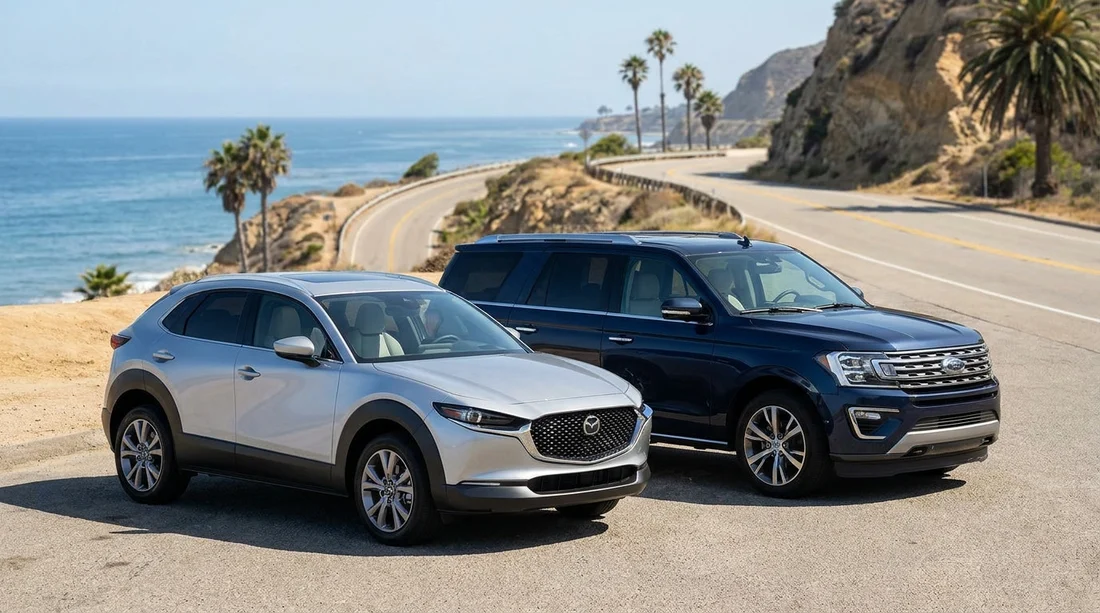
Quick Summary:
- Choose a crossover for easier city parking and smoother, car-like handling.
- Pick an SUV when you need extra boot height and more clearance.
- For four adults plus bags, compare boot shape, not just seats.
- In busy California traffic, crossovers often save fuel without losing comfort.
When you are choosing car hire in California, the crossover versus SUV question is less about labels and more about how the vehicle will live in your trip. Both can seat five, both can take a couple of suitcases, and both feel “taller” than a standard saloon. The real differences show up when you start thinking about boot shape, passenger comfort over long distances, how the car feels on freeways and canyon roads, and how stressful it will be to park near beaches, downtown areas, and busy airport hotels.
In general, a crossover is built on a car-like platform, sits a little higher than a hatchback, and aims for everyday comfort. A traditional SUV is usually taller and heavier, may have more usable ride height, and can offer a more upright cabin with a squarer boot. In rental fleets, the line can blur, so it helps to focus on outcomes: how many people, how many bags, and what kinds of roads and parking you expect.
Space and seating, what you really get
Both categories can advertise five seats, but that does not mean five adults will be comfortable for a multi-hour drive. Crossovers typically prioritise front seat comfort and overall refinement, with a rear bench that suits two adults best. Many mid-size SUVs provide a slightly wider rear bench and a more upright seating position, which can feel less tiring on long freeway runs.
For families, pay attention to rear door opening size and second-row headroom. The higher roofline in many SUVs can make child seats easier to lift in and out, and it can also reduce the “bumping heads” problem when passengers climb aboard. If you are collecting a vehicle at a major airport location such as Los Angeles LAX, think about how quickly you can load everyone and move on, because kerbside areas can be busy and time-limited.
Luggage capacity, volume matters more than litres on paper
Luggage capacity is where renters most often misjudge the crossover versus SUV decision. Many crossovers have decent boot volume, but the boot can be more sloped at the rear, reducing the usable height for stacked suitcases. SUVs often have a squarer tailgate and more vertical space, which helps with prams, cooler boxes, hiking backpacks, and bulky soft bags.
Instead of picturing “two large cases,” imagine your real packing: hard-shell suitcases, cabin cases, shopping bags, sports gear, and snacks. A helpful rule is to allow one large suitcase per adult plus one extra “odd-shaped item” for the group. If your trip includes beach chairs, a folded pushchair, or multiple backpacks, the extra boot height of an SUV can reduce the need to pack above the luggage cover, which is preferable when parking.
If you already know you will have seven passengers or a lot of bulky kit, neither a typical crossover nor a standard five-seat SUV may be ideal. In that situation, it can be useful to compare with a people carrier option such as minivan hire in California, because sliding doors and a boxier cargo area can be more practical than forcing luggage into a tight boot.
Driving feel on California roads
California driving can swing from stop-start urban traffic to long, steady freeway cruising, then on to winding coastal or canyon roads. Crossovers usually feel closer to a regular car: lighter steering, less body roll, and a smoother response when merging and changing lanes. That can make them less tiring in dense traffic and easier to place within narrow lanes and multi-storey car parks.
SUVs can feel more substantial, which some drivers prefer on long drives. You may notice a higher seating position and a more upright view over traffic, but also a bit more movement in corners and a slightly larger turning circle. If you are planning long stints between cities, either category can be comfortable, but the crossover often feels more “easy-going” when you are constantly exiting, rejoining, and navigating unfamiliar interchanges.
Fuel use and running costs
Fuel costs vary, but vehicle choice still matters. Crossovers are often lighter and more aerodynamic, so they commonly return better fuel economy than a similarly sized SUV. Over a week of mixed city and freeway driving, that difference can be noticeable, particularly if you are doing day trips from a base in Los Angeles or San Diego.
However, the “best value” choice is not always the smallest. If you choose a crossover but end up driving with an overfilled boot and passengers squeezed in, comfort suffers. In real life, a well-sized SUV that carries everything properly can be the more sensible pick, even if it uses a bit more fuel.
Parking practicality, where the decision really bites
Parking is often the deciding factor for car hire in California. Crossovers tend to be shorter and easier to manoeuvre into tight spaces in beach towns, downtown garages, and hotel lots. Their lower ride height can also make loading heavy bags less awkward, especially if you are lifting luggage in and out frequently.
SUVs can be wider and taller, which can make some car parks feel more cramped. Height restrictions are common in multi-storey structures. While many SUVs fit, you may feel more confident with a crossover if you expect to use older garages or dense urban parking areas. If your itinerary includes multiple city stops, the day-to-day convenience of a smaller footprint can outweigh the appeal of extra cargo height.
If you are collecting and returning at airports, the first and last 30 minutes of the trip often include car parks, ramps, and tight turns. Locations like San Diego SAN are built for rental traffic, but garages can still feel busy, so an easier-to-park vehicle can reduce stress when you are tired after a flight.
Choosing by trip type, not by badge
For city-heavy itineraries, a crossover is usually the easiest match: comfortable, efficient, and less hassle to park. For mixed itineraries with more gear, longer drives, or a preference for a higher, more upright cabin, an SUV can be the better fit.
If you are travelling with children, consider how much “stuff” comes with you, not just how many people. Prams, travel cots, and extra bags often push renters from crossover to SUV. If you are meeting family and doing a shopping run, you can fill a boot quickly, especially with bulkier purchases.
If you want to compare SUV options by pickup point, you can review SUV hire at Santa Ana SNA. If Northern California is on the plan, it can also help to note pickup and driving conditions around Sacramento SMF, where trips often combine city streets with longer highway miles.
What to check before confirming your car hire
Because “crossover” and “SUV” can cover a wide range of sizes, focus on a few practical checks. First, confirm the luggage estimate for the category, not just the passenger count. Second, think about who will sit in the back seat and for how long. Third, consider where you will park most days, street parking, garages, or hotel lots. Finally, if you expect to carry bulky items, prioritise a squarer boot and a wider tailgate opening.
If you are unsure, a sensible approach is to choose the smallest vehicle that comfortably fits your people and luggage, with a bit of margin. That tends to deliver the best mix of comfort, ease, and cost across a typical California itinerary.
FAQ
Is a crossover always smaller than an SUV for car hire in California? Not always. Some crossovers are similar in size to mid-size SUVs, so compare luggage capacity and exterior dimensions rather than relying on the label.
Which is better for four adults with luggage, a crossover or an SUV? It depends on bag size and boot shape. If everyone has a large hard-shell suitcase, an SUV’s squarer boot and extra height can be more practical.
Will a crossover be easier to park in Los Angeles and San Diego? Usually yes. Crossovers often have a shorter length and tighter turning circle, which helps with multi-storey garages and tight kerbside spaces.
Do I need an SUV for road trips between California cities? Not necessarily. Crossovers handle freeway cruising well and can be more fuel efficient. Choose an SUV mainly for extra cargo height, comfort for rear passengers, or slightly better clearance.

























































































