


Quick Summary:
- NYC school-zone speed cameras typically run on weekdays, school days only.
- Expect a 25 mph limit in most camera-controlled school zones.
- Tickets are mailed to the vehicle owner, often your hire company.
- You may pay the fine plus a rental administrative processing fee.
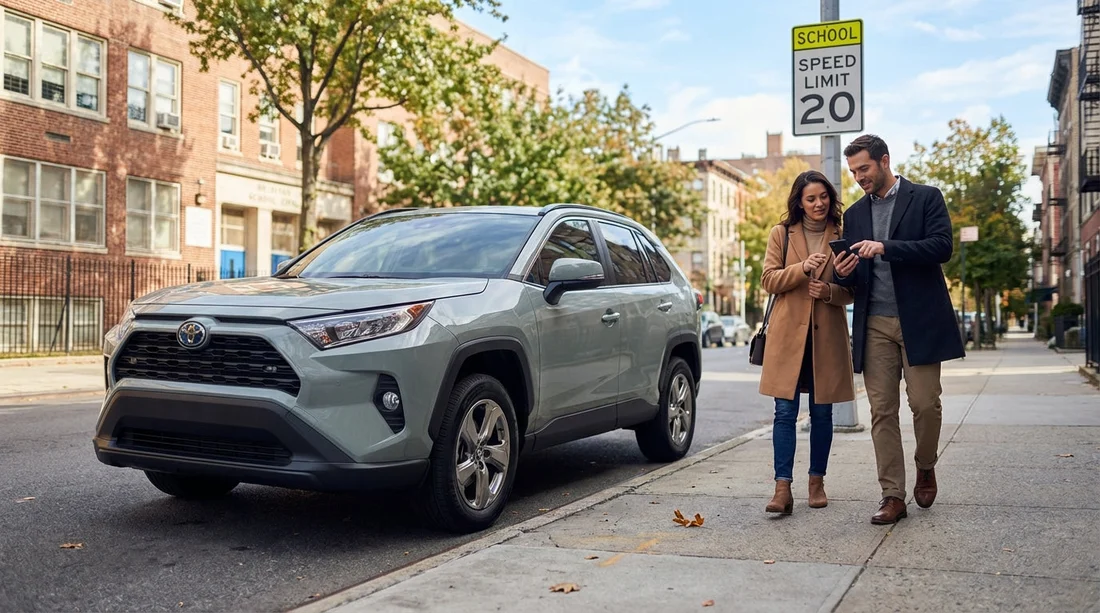
School-zone speed cameras in New York City can surprise visitors because enforcement is automated, signage can feel brief, and the ticket often arrives after your trip. If you are using car hire for New York, it helps to know what the posted school-zone signs mean, when cameras are actually active, and how any fine is usually handled through the hire company.
This guide focuses on NYC, including common enforcement patterns near schools, how limits are applied, and what typically happens once a camera records an alleged speeding event.
What NYC school-zone speed cameras are, and why they matter for car hire
NYC uses fixed, automated speed cameras located in designated school speed zones. The idea is simple, reduce speeding near schools where children cross streets. For drivers, the practical point is that the “enforcement” is not a police stop. It is a camera system that measures vehicle speed and, when it detects a vehicle over the threshold, generates a violation that is later mailed to the registered owner of the vehicle.
With car hire, the registered owner is usually the hire company. That is why the first you hear about it can be days or weeks later, after you have returned the vehicle. This is also why it is important to understand how your route through New York might intersect with school zones, even if you are only driving into the city for a short visit.
If you are arriving through major airports and collecting a rental, these camera rules can affect you from the moment you start driving local roads. Many visitors begin their trip from car hire at New York JFK or from New Jersey airports such as car rental at Newark EWR, then drive into NYC where school zones are common on neighbourhood streets.
Active hours: when NYC school-zone cameras usually enforce
For visitors, the key point is that NYC school-zone speed cameras are typically active on weekdays during school hours, and they are generally inactive on weekends and many holidays. The exact dates and schedules can vary with the school calendar and any programme updates, so treat street signs as the controlling instruction.
In everyday driving terms, assume cameras are operating Monday to Friday during the daytime. The practical habit is to drive as if school-zone enforcement is active whenever you see school-zone speed limit signs on a weekday, especially during morning drop-off and afternoon pick-up periods.
Also note that NYC school zones are not only around primary schools. They can appear near secondary schools, playgrounds, and school-related buildings. Some zones cover multiple blocks, and the camera may not be right next to the school building. You might pass a camera while driving along a corridor route that happens to sit within the school speed zone boundary.
Understanding the posted limits: what “school speed limit” means in NYC
In many parts of NYC, the school speed limit is 25 mph. You may also see standard “City Speed Limit 25” signage, and in a school zone you may see additional school-related signs and speed camera warnings. Where posted limits differ, the posted school-zone signage is what you should follow.
To avoid mistakes, use three checks as you drive:
1) Read the last speed sign you passed. In dense NYC streets, you can cross from one posted context to another quickly. If you saw a school-zone sign, keep that limit until you see a new limit sign.
2) Watch for “Speed Camera” signs. NYC often posts warning signs near camera enforcement areas. A warning does not mean a camera is always directly beside that sign, but it is a strong clue you are in an enforcement corridor.
3) Mind downhill and bridge approaches. Speeds can creep up on gentle downhill stretches, and wide approaches to bridges or expressway entrances can create a false sense that higher speeds are acceptable.
Because many visitors think in kilometres per hour, convert 25 mph to roughly 40 km/h. If you are used to UK driving, remember that many NYC streets are narrow, busy, and filled with frequent stop points. It is easy to keep to 25 mph once you accept that progress is slower than you might expect.
Where enforcement tends to happen: what to look for on the street
NYC’s school-zone cameras are placed throughout the five boroughs. Rather than trying to memorise exact intersections, it is more useful to recognise the types of areas where you are likely to encounter them:
Residential avenues and multi-lane local roads near schools. These are common camera locations because traffic flows faster than on side streets, and there is a higher risk to pedestrians.
Corridors that connect neighbourhoods to bridges and expressways. Some school zones sit near major feeders where drivers accelerate. The camera may be positioned to catch that acceleration.
Streets with frequent bus stops and crossings. If you see crossing guards, heavy pedestrian activity, and school signage, treat the entire stretch as a likely enforcement area.
Near parks and playgrounds associated with schools. Not every playground means a camera, but school-related public spaces often fall within designated zones.
If you are basing your trip out of New Jersey and driving into Manhattan, Brooklyn, or Queens, you may be on local roads before you reach a highway. Visitors collecting from car rental near New Jersey EWR often pass through ordinary neighbourhood streets where school-zone signage is easy to miss if you are focused on navigation.
What triggers a camera ticket: thresholds and practical risk points
Automated speed enforcement typically allows a small buffer over the posted limit before a violation is generated. The precise trigger threshold can change, so the safest assumption is simple, keep to the posted limit in school zones.
In practical terms, the highest-risk moments for visitors are:
Following the flow. If local traffic is moving faster, it can feel safer to keep up. Cameras do not care about the “flow of traffic”.
Turning onto a new street. You may accelerate out of a turn and miss a sign that sets a lower limit.
Looking for parking. Drivers sometimes speed up between gaps, then brake hard when they spot a space. That pattern can push you over the limit briefly.
Night-time assumptions. People often assume school-related enforcement is inactive late in the day. While many programmes focus on school hours, rely on posted signs and weekday caution rather than assumptions.
How a school-zone camera ticket reaches you when using car hire
With car hire, the ticket is generally issued to the registered owner of the vehicle, which is the hire company or its fleet partner. Because the camera violation is processed by mail, the timeline is usually:
1) The camera records the event. It captures the plate, time, location, and measured speed relative to the posted limit.
2) The authority mails a notice to the registered owner. This goes to the hire company’s address on file.
3) The hire company identifies the renter. Using the rental agreement details, they match the date and time to your contract.
4) You are charged or invoiced depending on the hire company policy. Often, the fine amount is passed through to you, and an administrative processing fee may be added for handling the notice.
This is why it is important to keep the payment card you used for the rental active, and to monitor email after your trip. Some providers notify you by email, others charge the card on file and provide documentation on request, and some transfer your details to the issuing authority, which may then contact you directly.
If you are using a larger vehicle, remember that extra mass does not change the rules, but it can change how easily you stay under the limit. Visitors who pick up an SUV for family travel, such as via SUV hire from New Jersey EWR, should allow more braking distance and keep an eye on the speedometer on downhill streets.
Typical costs: the fine and the rental administrative fee
NYC camera violations are generally set as a fixed civil penalty rather than a criminal matter, and they are typically lower than many moving-violation court fines. However, with car hire the total cost to you can include two parts:
The violation penalty. This is the amount set by the issuing authority for the alleged speeding event.
The hire company’s administrative fee. Many hire agreements allow the company to charge a set fee for processing tolls, camera tickets, or violations. This fee is separate from the penalty itself.
Because policies differ, check your rental terms for “traffic violations”, “administration fee”, or “processing fee”. If you want clearer expectations, choosing a well-known provider through a page such as Hertz car hire at New Jersey EWR can make it easier to find standardised policies and documentation, though the enforcement rules in NYC remain the same for everyone.
Will it affect your licence or insurance?
Most NYC speed camera violations are civil penalties issued to the vehicle owner, not points assessed against a driver’s licence in the way that a police-issued moving violation can be. For visitors, that often means no points are added to a foreign licence. However, you still owe the penalty, and unpaid penalties can lead to additional fees.
Insurance impact is more complicated. Because it is usually handled as a civil penalty, it may not appear like a typical conviction, but your personal insurer’s policies vary. The rental company’s processing fee is separate and is not usually covered by insurance.
How to avoid school-zone tickets while driving in New York
Use speed alert features thoughtfully. Many navigation apps can warn about cameras or school zones, but do not rely on them exclusively. In dense NYC streets, GPS can lag, and signs are the priority.
Commit to a “25 mph default” in the city. On most NYC streets, driving at 25 mph or less feels slow, but it matches the environment and reduces ticket risk.
Be extra cautious on weekdays. If you are sightseeing on a Tuesday or Wednesday, assume enforcement is more likely than on a Sunday.
Leave more time. Rushing is the main cause of unintentional speeding. If you are driving from an airport or between boroughs, build in extra time for traffic and parking.
Slow earlier, not later. If you spot school signage, ease off the accelerator smoothly. Sudden braking can create hazards behind you.
What to do if you receive a fine after your trip
Review the notice details. Check the date, time, location, and plate number. Confirm it matches your rental period.
Check how it was processed. If the hire company charged your card, ask for the violation notice and a breakdown of any administrative fee. If you were contacted directly by the authority, confirm whether the hire company transferred liability or simply provided your details.
Pay attention to deadlines. Camera penalties can increase if unpaid. Even if you plan to dispute, note the time limits and required steps on the notice.
Keep your travel documentation. Your rental agreement, receipt, and any emails from the hire company help if you need to query dates or vehicle details.
FAQ
Are NYC school-zone speed cameras active every day? Typically they operate on weekdays during school days and hours, and are usually off on weekends. Always follow posted signs in the zone.
What is the school-zone speed limit I should assume in NYC? In many places it is 25 mph, but you must follow the posted limit on that street. Treat school-zone signs as the controlling instruction.
Will I be stopped by police if a camera catches me speeding? No, camera enforcement is automated. The ticket is normally mailed to the vehicle’s registered owner, then passed to you through your car hire agreement.
How long does it take to receive a camera fine with car hire? Often it arrives weeks later because it is mailed to the hire company first. The hire company then processes it and may charge an admin fee.
Can the hire company charge me extra on top of the fine? Yes, many hire agreements allow an administrative processing fee for handling violations. Check your rental terms for the exact amount and conditions.

























































































