


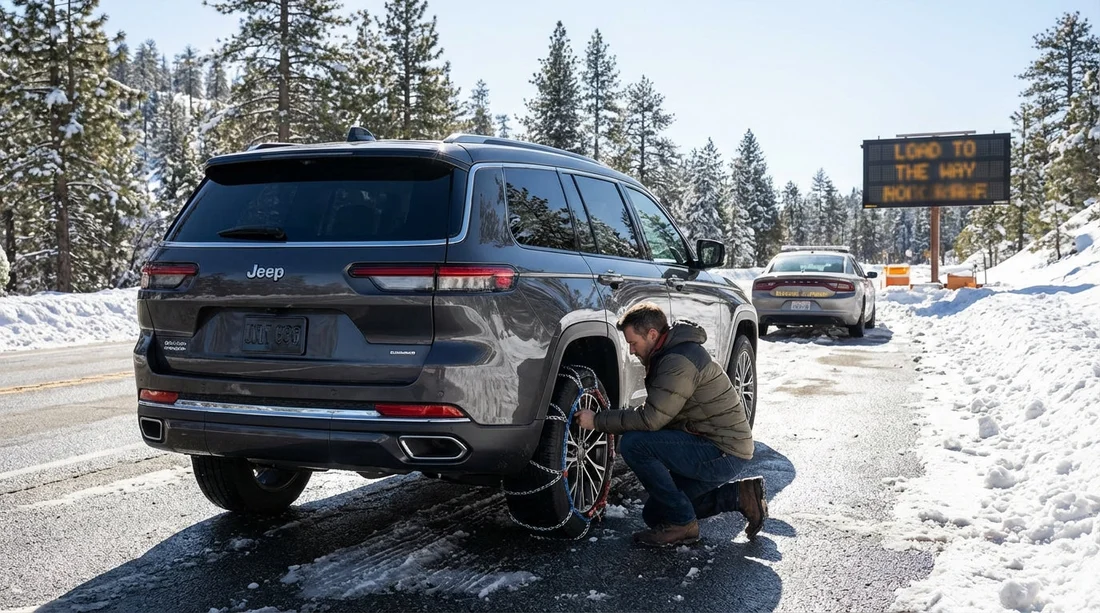
Quick Summary:
- Check Caltrans chain-control levels before leaving Los Angeles and again roadside.
- R1 needs chains for some cars, R2 for most, R3 for all.
- Carry correct chain size, practice fitting, and bring gloves and torch.
- At a checkpoint without chains, expect turnaround or purchase nearby.
Driving from Los Angeles to Big Bear Lake can switch from sunny motorway to alpine winter conditions quickly. When storms roll in, the route is managed through chain controls, temporary road closures, and police or Caltrans checkpoints. If you are using car hire for the trip, understanding how California’s chain-control system works is the difference between an easy mountain day and a long, stressful turnaround.
This guide explains where to check current conditions, what Caltrans chain-control levels R1, R2 and R3 actually mean, and what practical steps to take if you reach a checkpoint without chains. It is written for typical Big Bear approaches from Los Angeles, including CA-330, CA-18 and CA-38.
Before you go: set expectations for winter driving to Big Bear
Big Bear sits at around 2,000 metres elevation. That means temperatures and road conditions can be dramatically different from Los Angeles. Even if it is clear in the city, chain controls may be active in the mountains, especially around the junction of CA-330 and CA-18, and on the final climbs into Big Bear City and Big Bear Lake.
Two practical realities to plan around:
Chain controls can appear with little notice. Caltrans may update requirements as precipitation and road temperatures change, and enforcement ramps up at checkpoints to keep traffic moving safely.
Not all hire cars are equal in snow. Many travellers assume an SUV automatically avoids chains. That is not always true. Tyre tread, drivetrain, and current chain-control level all matter, and R2 and R3 can still require chains on SUVs unless they have qualifying snow tyres or 4WD with specific tread conditions.
If you are collecting from an airport location such as Los Angeles LAX car rental, decide early whether your itinerary might include mountains. That gives you time to choose a suitable vehicle class and to confirm what your hire agreement allows regarding chains and winter driving.
How to check Caltrans chain-control levels and closures
Caltrans manages state highways and publishes real-time updates on chain requirements, incidents, and closures. You will often see roadside electronic signs, but you should confirm details before leaving and again on approach.
Use these steps to check conditions reliably:
1) Identify your route highways. From Los Angeles, the most common Big Bear approaches are:
CA-330 to CA-18, a popular route from the Inland Empire side.
CA-38, a longer approach that can be gentler but still subject to controls.
2) Check chain controls for each highway segment. Chain requirements can differ between CA-330, CA-18, and CA-38 at the same time. A control might start higher up the mountain, so “clear in the valley” does not guarantee “clear all the way”.
3) Confirm closures and incidents, not just chains. A route can be technically open but effectively blocked by a spin-out, a collision, or an avalanche control closure. If you see “road closed” or “no estimated time of opening”, you should pivot early.
4) Recheck just before the climb. Conditions change quickly. If you can safely pull over before the ascent begins, refresh updates so you are not surprised at a checkpoint.
5) Look for checkpoint messaging. When chain controls are active, enforcement typically happens at a staffed point where officers or Caltrans staff wave cars through based on equipment and vehicle type. If traffic is heavy, expect queues and slow progress.
If you are planning the drive right after landing, leave a buffer for delays. When snow hits on a weekend, the stop-and-go lines at chain checkpoints can add significant time even when roads remain open.
What R1, R2, and R3 mean in plain English
Chain-control levels are standard across California, but confusion is common because the rules depend on your vehicle, tyres, and drivetrain. Here is a practical interpretation aimed at visitors using car hire.
R1: Chains required, except some vehicles with snow tyres
Under R1, chains are required on most passenger vehicles unless they have snow tyres (often marked “M+S”) on the drive wheels. 4WD and AWD vehicles with snow tyres may be allowed through without chains, but you should still carry chains because conditions can escalate to R2.
What this means for hire drivers: Do not assume your tyres qualify. Many hire vehicles have all-season tyres that may or may not meet the standard for exemption. At a checkpoint, you may be asked about 4WD, shown signage, and visually assessed. If staff determine your set-up does not qualify, you will be turned around or told to install chains.
R2: Chains required for most vehicles, exceptions are limited
Under R2, chains are required on all vehicles except 4WD or AWD vehicles with snow tyres on all four wheels. Even then, you must carry chains. This is the level most Big Bear visitors encounter during storms.
What this means for hire drivers: A 2WD saloon almost always needs chains under R2. An SUV might still need chains if it is not true 4WD/AWD, or if tyres do not meet the snow-tyre requirement. If you picked up an SUV from SUV rental in Los Angeles LAX, confirm whether the model is AWD/4WD and what tyre markings it has, then plan to carry compatible chains regardless.
R3: Chains required for all vehicles, no exceptions
Under R3, chains are required on every vehicle, including 4WD and AWD with snow tyres. In practice, R3 can coincide with very severe conditions, and roads may close rather than maintain R3 for long periods, especially if collisions stack up.
What this means for hire drivers: If R3 is posted, expect delays and consider postponing. If you continue, you must have chains that fit and be prepared to install them correctly in cold, wet conditions.
Choosing the right hire car for Big Bear conditions
For clear forecasts, many standard cars are fine. For winter weather, a higher-clearance vehicle can help with slush and plough berms, but it is not a substitute for chains when chain controls are active.
Keep these selection tips in mind:
Prefer AWD/4WD when storms are possible. It can make hill starts and traction easier, and may reduce the likelihood you must install chains under R1.
Check wheel and tyre sizes. Chains are size-specific. If you buy chains, you need an exact match to the tyre sidewall numbers. If you carry chains from a previous trip, they may not fit your current hire car.
Think about passenger load and luggage. If you are travelling with a group, extra weight can affect handling and braking. A larger vehicle may be more comfortable, but it also takes longer to stop on slick roads.
Know your pickup point. If you are starting from Orange County, you might collect from Santa Ana SNA car rental and join the mountain routes from a different approach. Plan your route and chain checks accordingly.
What to carry and how to prepare for chain checkpoints
Even if you hope you will not need them, being prepared makes checkpoints much easier.
Carry the right equipment. At minimum, you want:
Correct-size chains or cable chains. Confirm they match your tyre size precisely.
Gloves and a torch. Installing chains is messy and often happens in low light.
A kneeling mat or old towel. Keeps you off wet ground during fitting.
Warm layers. You may be outside the car for a while in freezing wind.
Practise fitting in a safe, dry place. Many people first attempt chains at night, in snow, while cars queue behind them. If you practise once at home or in a car park, you will be far faster and safer when it counts.
Know which wheels get chains. Typically, chains go on the drive wheels. Front-wheel drive cars usually chain the front tyres, rear-wheel drive chains the rear. For AWD/4WD, follow the chain manufacturer guidance and your vehicle handbook guidance, and note that some vehicles have clearance limitations. If you are unsure, avoid experimenting at the roadside and consider turning back if conditions require chains you cannot fit safely.
What happens at Big Bear chain-control checkpoints
When chain controls are active, you may encounter a checkpoint where officials assess whether you can continue. Expect one of these outcomes:
Wave-through. If your vehicle qualifies under the current level and you are carrying chains when required, you may be allowed through without stopping long.
Install chains now. You will be directed into a chain installation area. Do it methodically, then drive a short distance and re-tighten if your chain instructions require it.
Turnaround. If you cannot comply, you will be directed to turn back for safety. This is common for drivers without chains during R2.
Purchase chains nearby. In some areas, vendors sell chains near checkpoints during storms. Availability, sizes, and prices vary, and stocks can sell out. Do not rely on this as your only plan.
If you reach a checkpoint without chains: practical steps
Arriving unprepared is stressful, but you still have options. The key is to stay calm and make a safe decision quickly.
1) Ask what level is in effect and what your vehicle needs. Confirm whether you are under R1, R2, or R3, and whether your specific vehicle is exempt. Do not argue, the staff are enforcing safety rules and traffic flow.
2) Decide between turning back or buying chains. If you are close to a town with open stores and your tyre size is common, buying chains may be feasible. If conditions are worsening, it may be smarter to turn back rather than hunt for stock.
3) If you buy chains, check the box for exact tyre size. Your tyre size is printed on the sidewall, for example 225/65R17. Match every number and letter group. “Close enough” can damage the car or fail under load.
4) Install before you rejoin the main line. Use the designated chain area if provided. Installing on the shoulder in traffic is dangerous. Take your time and make sure chains are centred and secured.
5) Drive gently once chains are on. Accelerate slowly, brake early, and avoid sudden steering inputs. Chains reduce speed capability and can break if driven too fast on bare pavement. If you hear banging, stop somewhere safe and refit.
6) If you are turned around, adjust your plan early. Look for lower-elevation alternatives, postpone the drive, or switch to non-mountain activities in the Los Angeles area. If you are travelling for a ski day, the safest choice is often waiting for ploughing and conditions to improve.
Closures and checkpoint delays: planning the timing from Los Angeles
Weekend storm days can produce a perfect storm of heavy traffic, chain-control stops, and limited parking in Big Bear. A trip that is two to three hours in clear weather can become much longer.
To reduce hassle:
Start earlier than you think you need. Checkpoints and chain installation areas get busier as the morning progresses.
Keep fuel topped up before the climb. Idling in queues consumes fuel and you do not want to hunt for a station in snow.
Pack food and water. If traffic stops due to an incident, you may wait.
Watch temperature swings. Refreezing after sunset can create black ice even after a storm has passed.
If you are organising a longer trip and comparing options, browsing providers such as Avis car hire in Los Angeles LAX can help you understand vehicle classes available for winter-capable driving, though chain compliance still depends on the exact model and current conditions.
Driving technique reminders when chain controls are active
Once you are past the checkpoint, your goal is smooth, predictable driving.
Leave extra following distance. Braking distances increase dramatically on packed snow and slush.
Avoid abrupt lane changes. Snow ruts can grab tyres and reduce control.
Use lower gears on descents. Engine braking helps reduce reliance on brakes.
Respect ploughs and sanders. Do not crowd them, they need room to operate.
Remove chains when no longer required. Driving on clear pavement can damage chains and the vehicle. Use designated pullouts when safe.
With sensible planning, Los Angeles car hire trips to Big Bear can be straightforward, even in winter. The essentials are simple: check conditions often, understand R1 to R3, carry correct chains, and be ready to turn back if the mountain is not cooperating.
FAQ
How do I know whether chain controls are active for Big Bear today? Check Caltrans road condition updates for CA-330, CA-18, and CA-38 before leaving Los Angeles and again before the climb. Electronic roadside signs and checkpoint staff confirm the current level.
What is the difference between R1, R2, and R3? R1 requires chains for most vehicles, with exemptions for some snow-tyre set-ups. R2 requires chains for most vehicles, with limited exemptions for 4WD/AWD on snow tyres, and you must still carry chains. R3 requires chains for every vehicle with no exceptions.
If I have an SUV hire car, can I skip chains? Not reliably. Some SUVs are 2WD, and even AWD/4WD SUVs may need chains under R2 depending on tyre qualification, and they will need chains under R3.
What happens if I arrive at a checkpoint without chains? You will typically be turned around, or directed to buy chains nearby if available, and then fit them in a designated area. The safest option may be to postpone if conditions are worsening.
Can I fit chains at the roadside? Only if it is legal and safe, but it is far better to use a designated chain installation area. Practise fitting beforehand so you can do it quickly without blocking traffic.

























































































