


Quick Summary:
- Use E85 only if the fuel door or manual states flex-fuel.
- Expect 15 to 30 percent fewer miles per tank on E85.
- In Las Vegas heat, keep tank above one quarter for safety.
- If unsure, choose regular unleaded 87 to avoid misfuel claims.
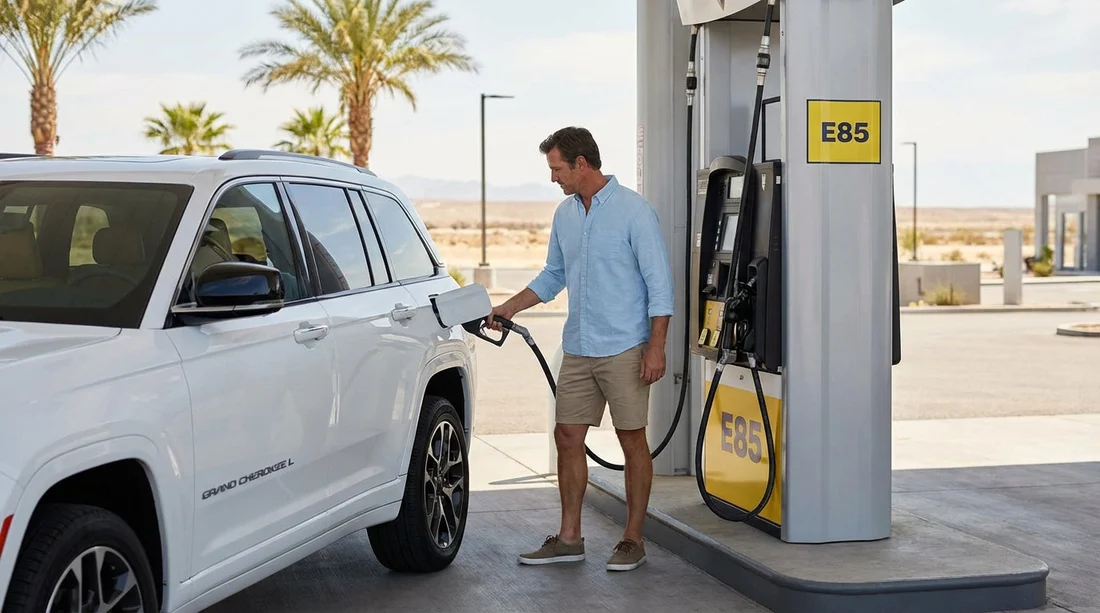
Seeing “E85” on the pump during a Las Vegas car hire can raise a fair question, is it safe, and will it save money? E85 is a high-ethanol petrol blend (up to 85 percent ethanol) sold mainly for flex-fuel vehicles (FFVs). The key point is simple, E85 is safe only in a vehicle designed for it. In a non flex-fuel rental, it can cause driveability issues and may be treated as misfuelling under rental terms.
This guide explains how to confirm whether your rental is flex-fuel, what E85 does to range and costs in desert driving, and the simplest “choose this grade” rule to avoid wrong-fuel damage claims. If you are collecting at the airport, the practical checks are easiest to do before you leave the car park, and you can also review local pick-up options via Las Vegas airport car hire.
What E85 is, and why it matters for a rental
E85 contains much more ethanol than standard US petrol (typically E10). Ethanol has lower energy per litre than petrol, so a car usually travels fewer miles per gallon on E85. Flex-fuel vehicles are built with fuel system components and engine calibrations that can adjust to varying ethanol content. Many are labelled “FlexFuel”, “FFV”, or “E85” somewhere visible.
For car hire, the risk is not just mechanical. If you put the wrong fuel in, even if the car still runs, you could face cleaning, recovery, and downtime charges. With E85, the line is clear: only use it if the vehicle is explicitly flex-fuel. If it is not clearly marked, treat it as non flex-fuel and stick to regular unleaded.
How to confirm your rental is flex-fuel in 60 seconds
Do not rely on what the pump offers, or what you have heard about a model online. Trim levels vary, and rental fleets change. Use checks you can do in the car.
1) Check the fuel door and cap area first
Open the fuel door. Many FFVs have clear wording such as “E85/Gasoline”, “FlexFuel”, or “Ethanol up to E85”. If you see only “Unleaded gasoline only” or an octane recommendation (like 87 AKI), that is not an E85 approval.
2) Look for an exterior or interior badge
Some vehicles have “FlexFuel” badging on the tailgate or near the engine cover. In rentals, these badges can be missing, so treat this as supporting evidence, not the main proof.
3) Use the in-car manual info, if available
If there is a quick reference guide in the glovebox, look under “Fuel” and find an explicit statement permitting E85. If it is a digital manual in the infotainment system, search for “E85” or “ethanol”.
4) Confirm with the fleet label, not a guess
Some fleets include a barcode sticker or spec sheet inside the door jamb. If it lists “FFV” or “Flex Fuel”, that helps. If it does not, do not assume.
5) If still unsure, treat it as non flex-fuel
The simplest way to avoid wrong-fuel allegations is to choose regular unleaded 87 when you cannot confirm flex-fuel status from the car itself.
If you want to compare vehicle classes that often include FFVs, you can review general Las Vegas options at car rental in Las Vegas and statewide availability at car rental in Nevada.
Desert reality: What E85 does to range in Las Vegas driving
Range matters more around Las Vegas than many visitors expect. Long stretches to Red Rock Canyon, Valley of Fire, Lake Mead, Hoover Dam, or Death Valley approaches can mean fewer stations and higher temperatures. E85 typically reduces fuel economy because of its lower energy content. In practical terms, many drivers see about 15 to 30 percent fewer miles per tank compared with regular petrol, depending on the vehicle, speed, and air conditioning use.
In desert heat, several factors compound the range hit:
Air conditioning load increases fuel use, especially in stop and go traffic on the Strip or I-15 congestion. E85 already requires more fuel volume for the same energy, so you notice the drop sooner.
Higher sustained speeds on open highways amplify aerodynamic drag. If you are cruising well above the limit, the range penalty becomes more noticeable, regardless of fuel type, but E85 has less buffer.
Heat soak and hot starts can sometimes feel different on high-ethanol blends. Flex-fuel systems are designed to manage this, but you may still notice a slightly different idle or start behaviour. That is not usually a fault, but it can worry renters if unexpected.
Rule of thumb for planning: If the tank normally gives you 350 miles on petrol, budget closer to 250 to 300 miles on E85. If you are heading out of the metro area, plan fill-ups earlier, and do not aim to run the tank low.
Cost comparison: When E85 can, and cannot, save money
E85 is often priced lower per gallon than regular petrol, but it is not automatically cheaper per mile. The correct comparison is cost per mile, not pump price. Because E85 can reduce mpg by 15 to 30 percent, E85 needs to be roughly 20 percent cheaper than petrol, sometimes more, to break even. If E85 is only slightly cheaper, you may pay more overall while stopping more frequently.
In Las Vegas, prices fluctuate by station and corridor. Rather than chasing the lowest headline price, focus on a simple calculation you can do in your head:
Quick value test: If E85 is at least one quarter cheaper than regular, it may be worth considering in a confirmed FFV. If it is not, regular petrol usually wins on convenience and total cost.
Also consider your schedule. Extra refuelling stops can erase any savings, especially on a short trip where time is valuable.
Simplest “choose this grade” rule to avoid wrong-fuel damage claims
Here is the decision rule that keeps things safe and easy during a car hire in Las Vegas:
If you cannot confirm “E85/FlexFuel” from the fuel door or manual, choose regular unleaded 87.
That is it. Regular 87 is the default grade for most US rental vehicles and is widely available. Premium (91 or 93) is rarely required unless the fuel door explicitly says so. E85 should be treated as optional and only for clearly identified FFVs.
Why this rule works:
It aligns with manufacturer labelling, which is what matters if there is a dispute.
It avoids “close enough” mistakes, like confusing “E15” signage with E85, or assuming a similar model elsewhere was flex-fuel.
It protects you on return, because the car is far less likely to throw a check-engine light from an unsuitable blend.
Practical refuelling tips for Las Vegas heat and highway runs
Keep more fuel in the tank than you would at home. In very hot conditions, aim to refuel at a quarter tank rather than stretching to the warning light. This is mainly a safety habit for long desert routes, and it reduces stress if traffic or detours happen.
Use “Top Tier” style stations where convenient. You do not need to overthink branding, but busy stations often have fresher fuel turnover, which can be helpful with ethanol blends.
Do not mix fuels out of uncertainty. If you have already put some E85 in a confirmed flex-fuel car, topping up with regular is fine, FFVs are built for mixtures. The problem is adding E85 to a car that is not confirmed. If you accidentally fuel a non FFV with E85, stop driving and contact the rental provider for guidance, continuing can increase the chance of warning lights or poor running.
Watch for pump labelling and nozzle differences. E85 pumps are usually clearly marked, but in some stations the layout is busy. Take an extra moment before lifting the nozzle, especially at night.
Which rental types are more likely to be flex-fuel?
In the US, some large SUVs, pickups, and certain V6 sedans have historically been offered as FFVs. However, modern fleet mixes change, and hybrid options change the picture too. Rather than choosing a class purely for flex-fuel potential, choose the vehicle that suits passenger count and luggage, then verify fuel type on the specific car you receive.
If you are travelling as a group, a people carrier can be a practical choice for space and comfort, and you can review options at minivan rental in Las Vegas. If you are comparing suppliers, Hola Car Rentals provides information pages for major brands such as Hertz car hire in Las Vegas and Dollar car hire in Las Vegas.
If the pump offers E85, but your car is not flex-fuel
If the car is not an FFV, do not use E85, even if the engine seems similar to other flex-fuel models. High ethanol content can push fuel trims beyond what the ECU expects, which may trigger rough running, hard starting, misfires, or a check-engine light. In some cases, persistent use can stress fuel system components not designed for that concentration.
From a rental perspective, the bigger issue is documentation. If the fuel door specifies regular unleaded and you used E85 anyway, it is difficult to argue it was reasonable. Sticking to the grade on the fuel door is the safest approach.
FAQ
Can I use E85 in my Las Vegas rental if the pump says it is for flex-fuel cars?
Only if your specific vehicle is clearly labelled as flex-fuel, ideally on the fuel door or in the manual. If you cannot confirm that labelling, use regular unleaded 87.
Will E85 damage a non flex-fuel car immediately?
It may not fail instantly, but it can cause poor running, warning lights, and potential fuel system stress. For car hire, it can also be treated as misfuelling, even if the car still drives.
How much range will I lose on E85 around Las Vegas?
Many drivers see roughly 15 to 30 percent fewer miles per tank. In hot weather with heavy air conditioning and highway speeds, plan towards the higher end of that reduction.
Is E85 cheaper overall in Nevada?
Sometimes, but only if it is substantially cheaper per gallon. Because mpg drops on E85, it often needs to be about 20 to 30 percent cheaper than regular to save money per mile.
What is the safest fuel grade rule for avoiding wrong-fuel claims?
Follow the fuel door label. If it does not explicitly say “E85” or “FlexFuel”, choose regular unleaded 87 and keep the receipt.

























































































