


Quick Summary:
- Deposit holds are set in USD, your issuer converts at its rate.
- FX swings can raise the GBP equivalent, reducing available credit unexpectedly.
- Allow extra headroom beyond the quoted hold to prevent pick-up declines.
- Release timing varies, so holds can overlap with new travel spending.
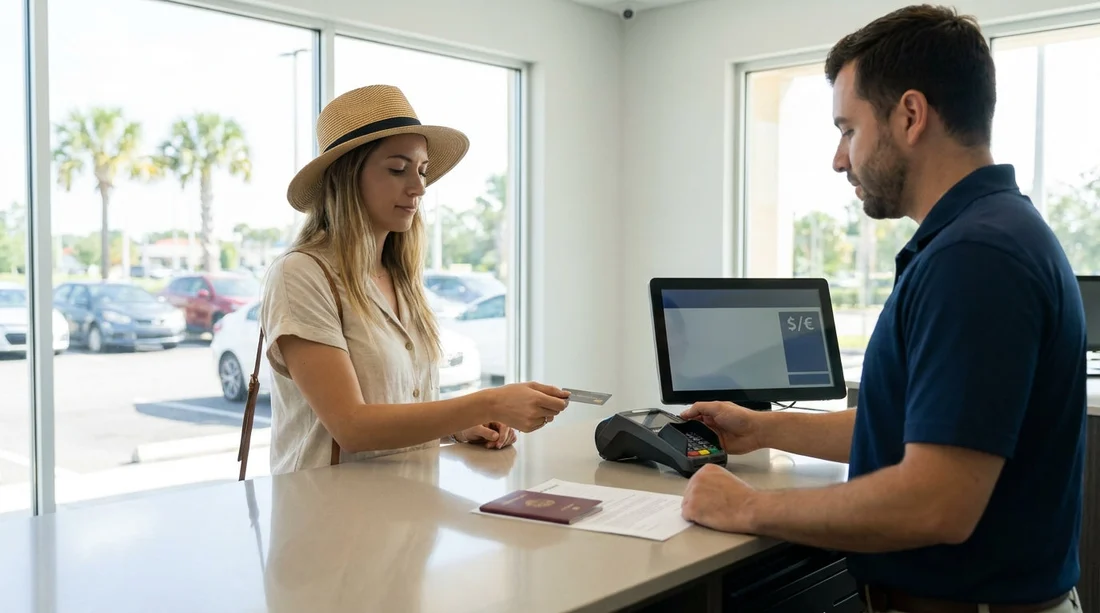
When you arrange car hire in Florida, you may see a price in pounds, euros, or another home currency. However, the deposit hold, often called a pre-authorisation, is usually taken in US dollars at the rental counter. That difference is where exchange rates start to matter. Even if the hold amount in USD is fixed by the supplier, the amount your bank “blocks” on your credit limit in your home currency can move from one day to the next.
This matters most at pick-up. If the available credit on your card is tight, a small FX shift can mean the pre-authorisation cannot be approved. The result is frustration at the desk, delays, or having to change payment methods. Understanding how the conversion works, and planning a sensible buffer, is the simplest way to avoid issues.
What a pre-authorisation really is
A pre-authorisation is not a charge. It is a temporary hold placed by the rental company to cover potential costs, commonly the insurance excess, fuel, tolls, or late return. Your card issuer reduces your available credit by that amount until the hold is released or converted into a final charge.
For car hire in Florida, the hold amount typically depends on the vehicle class, the supplier, the payment method, and the cover you select. If you choose to use a debit card, or you decline certain cover options, some suppliers set a higher hold or may not accept the card at all.
The key point is that your bank treats a hold as a real commitment against your limit. You might still see your balance unchanged, but your available credit can drop sharply.
Why exchange rates can change the hold amount
Even when the rental agent requests a hold of, say, $500, your card statement and available credit are managed in your home currency. Your issuer must estimate what $500 means in that currency, using an exchange rate determined by the card network and your bank’s processing time.
1) Timing of authorisation and posting
The authorisation is requested at pick-up, but the rate used might be based on the day the authorisation is processed by the network, not the exact minute you sign. If markets move, the converted amount can differ slightly from your expectations.
2) Bank and network spreads
Many issuers apply their own rate or a margin over the wholesale rate. Two travellers can see different converted holds for the same USD amount, even on the same day.
3) Dynamic currency conversion at the counter
Some terminals offer to process the transaction in your home currency. This can lock in a rate that is often less competitive. For holds, it can also create confusing differences between what you expect and what is actually blocked. If you are given the choice, it is usually clearer to keep the authorisation in USD and let your card issuer convert.
4) Currency volatility before travel
If you budgeted based on an exchange rate from weeks ago, a weaker home currency means the same USD hold consumes more of your limit. For example, if GBP falls against USD, a $500 hold becomes more expensive in pounds, so it uses more available credit.
How this shows up at pick-up in Florida
At major Florida locations, like Orlando Airport (MCO) or Miami Beach, counter systems typically request authorisations instantly. If your bank declines the hold due to insufficient available credit, you may be asked for a different card, an additional card, or a higher-level cover option that changes the hold structure.
Even if you have a high overall credit limit, other factors can reduce your “available” amount: pending hotel deposits, airline incidentals, or previous travel holds that have not yet dropped off. When FX shifts upward, those existing holds leave you with less headroom than you expected.
Why the hold can look higher than you calculated
Travellers sometimes calculate the expected hold by converting the USD figure using Google or a mid-market rate. The reality can look higher because issuers often use a different rate, and they may round up. Also, some issuers temporarily buffer foreign authorisations, blocking a little extra to protect against rate moves between authorisation and completion.
Another common reason is that the supplier may add amounts for optional extras or local charges that are also pre-authorised, such as a tank of fuel, a toll programme deposit, or an additional driver fee. Those items might be small individually, but in a volatile FX week they can be enough to push the authorisation above your available credit.
Practical ways to avoid deposit-hold problems
Keep more available credit than the minimum hold
Aim for a buffer that can absorb FX movement plus other travel holds. As a rule of thumb, having several hundred dollars’ worth of additional headroom beyond the quoted USD hold helps. The exact figure depends on your card limit and travel style, but the principle is simple: the hold must fit comfortably even if the exchange rate worsens.
Use a credit card in the main driver’s name
Many suppliers require the card to be in the name of the lead renter. If you arrive with a card that cannot be used, the desk may attempt another method that triggers a different hold policy. Keep your primary card ready, and ensure it is authorised for international transactions.
Avoid stacking multiple large travel deposits on one card
Hotels in Florida may place sizeable incidentals holds. If possible, separate hotel deposits and car hire holds across different cards, so one authorisation does not cause another to fail.
Check your card’s foreign transaction settings
Some banks block international authorisations by default. A pre-authorisation can be declined even when funds are available. Confirm your travel notice, app settings, and any required verification steps before flying.
Plan for overlap until the hold is released
Holds do not always disappear immediately at drop-off. Depending on the issuer and the supplier, it can take several business days, sometimes longer, for your available credit to return. If you are continuing travel, that lag can affect later purchases.
Choosing the right pick-up location and supplier in Florida
Florida has a mix of airport and city locations, and processes can vary slightly. Airport branches often have high volumes and standardised procedures, while city branches may be more flexible but still follow the same card rules.
Supplier policies can differ too. For instance, if you are comparing brands for an Orlando arrival, information pages such as Alamo at Orlando MCO can help you understand what to expect at the counter. The most important preparation remains the same: the pre-authorisation is in USD, and your available credit needs to cover the converted amount plus a buffer.
If you are picking up away from the airport, such as in Coral Gables, consider the practicalities of resolving a declined authorisation. In a city location, you may not have as many immediate alternatives within walking distance, so having a back-up card and adequate headroom matters even more.
How to estimate a safer buffer using exchange rates
You do not need to predict the market perfectly. Instead, stress-test your budget. Take the USD hold figure and convert it using a slightly worse rate than today’s. If you are travelling from the UK, you might convert at a rate that assumes the pound is weaker than current levels. Then add room for other pending travel holds on the same card.
FAQ
Will I be charged the deposit hold for car hire in Florida? No, a pre-authorisation is a temporary hold, not a payment. It reduces available credit until it is released or replaced by the final rental charge.
Why did my bank block more than the USD deposit amount? Your issuer converts the USD hold using its exchange rate, may add a buffer, and can round amounts. FX movement and issuer spreads can increase the home-currency equivalent.
How long does it take for a deposit hold to be released? Release timing varies by supplier and bank. It can be a few days, and sometimes longer, after return before your available credit fully restores.
Can I avoid FX impact by paying in pounds or euros at the counter? Some terminals offer this, but the exchange rate may be less favourable. Paying in USD typically keeps conversion with your card issuer, which is often clearer and cheaper.
What is the best way to prevent a declined pre-authorisation at pick-up? Bring a credit card in the lead driver’s name, ensure international transactions are enabled, and keep enough available credit to cover the USD hold plus an FX buffer.

























































































