


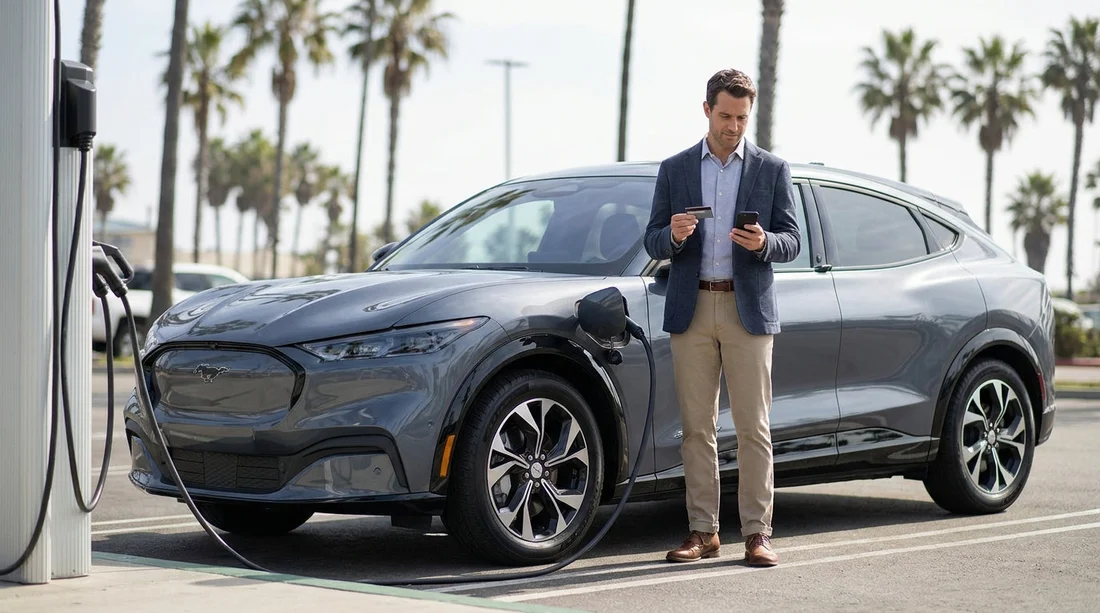
Quick Summary:
- Most California fast chargers accept app payment, RFID, or tap-to-pay cards.
- A credit card is helpful, but debit and mobile wallets often work.
- Install major networks’ apps and add a payment method pre-pick-up.
- Check your rental EV includes a charging card, cable, and instructions.
Picking up an electric vehicle for car hire in California is exciting, but the first charge can be stressful if you cannot authenticate payment quickly. The good news is that most public chargers in the US are designed for ad hoc use, meaning you do not always need a credit card in your hand before you collect the keys. What you do need is a plan, because different networks use different ways to start a session.
This guide explains how payment authentication works at California chargers, what to set up before you arrive, and how to avoid the most common first-charge delays after rental car pick-up.
Do you actually need a credit card to charge a rental EV?
In practice, you do not always need a credit card specifically, but you do need a cashless payment method that the charging network will accept. Many drivers use a credit card because it is widely accepted for both in-app charging and contactless readers. However, most major networks also accept debit cards, and many support mobile wallets like Apple Pay and Google Pay.
Where a credit card can matter is verification. Some charging apps place a temporary authorisation hold before a session starts, particularly on DC fast chargers. Credit cards tend to handle these holds more smoothly than some debit cards, which can have lower daily limits or tighter fraud controls. If you only have a debit card, you can still charge, but it is worth making sure your bank allows US-based online transactions and pre-authorisations.
If you are arranging car hire through Hola Car Rentals for arrivals around Los Angeles, you can compare options for airport pick-up at Los Angeles LAX. Having your payment method ready before you land reduces the chances of waiting around a charger bay while you troubleshoot logins and bank prompts.
How US public chargers authenticate payment
Think of “authentication” as the method used to identify you and confirm you can pay. In California, you will usually see one of these approaches, sometimes several on the same unit:
1) Network app with saved payment
Many chargers require you to start the session in the operator’s app, or in a partner roaming app, using an account tied to a payment method. You scan a QR code, select the charger ID, or use Bluetooth. This is extremely common for DC fast charging.
2) RFID card or key fob linked to an account
Some drivers prefer an RFID card. You tap it on the charger, it authenticates your account, and billing is handled automatically. For visitors, RFID is useful when mobile signal is poor or you want a simple back-up.
3) Contactless bank card, Apple Pay, or Google Pay
“Tap to pay” is increasing across California, but it is not universal. Some DC fast chargers have a card reader that lets you pay without an app. If you see a contactless symbol, you can often use a debit or credit card, or a mobile wallet.
What to set up before pick-up so you can charge straight away
The goal is to be able to start a session within a minute or two of arriving at a charger. Before you reach the rental desk, do these preparations:
Install the most common charging apps and create accounts
Even if you do not know which network you will use first, having accounts created in advance helps, because registration often requires email verification and sometimes identity checks. Add a payment method and confirm it is accepted for US transactions.
Add a mobile wallet and enable device security
If you plan to use tap-to-pay, ensure your phone wallet is set up and you know your passcode. If your bank triggers a security challenge, you want to handle it quickly at the kerbside or charger bay.
Plan your first charge near pick-up, not after you are nearly empty
If you are unfamiliar with the EV or your first charger requires an app you do not have, you will appreciate having buffer. This is especially important after flights when your phone battery and patience are both low.
If you are collecting your vehicle in Northern California, you may want to align your first charging stop with your arrival airport area, for example near Sacramento SMF or the Bay Area where network coverage is dense.
What to ask or check at the rental counter
Most charging issues after car hire pick-up come from missing context rather than missing equipment. Take two minutes to confirm these points:
Is the car supplied with a charging cable for Level 2 charging?
Many rentals include a cable for slower AC charging, which is useful at hotels or public car parks. Confirm whether it is in the boot and whether any adapters are included.
Is there a network charging card provided?
Some rental operators include a branded RFID card or instructions for a specific network. If provided, ask whether charges bill to you directly at the charger, or are passed through later by the rental company.
How is charging billed for this rental?
Sometimes you pay the charging network directly. Sometimes you pay the rental company for energy used, or you are expected to return with a certain state of charge. Clarify expectations so you are not surprised at drop-off.
Arriving through Orange County is another common route, and you can review pick-up options around Santa Ana SNA. Wherever you collect, the same principle applies: get clarity on billing and equipment before leaving the lot.
Common payment snags and how to avoid them
Weak mobile signal at the charger
Some chargers are in underground car parks or areas with patchy reception. If you rely on an app, start the session from a spot with signal, or use an RFID card if you have one.
Bank declines due to fraud controls
Foreign cards and newly used cards can trigger declines. Use a card that is enabled for international e-commerce and US transactions, and consider notifying your bank of travel.
Authorisation holds that look like overcharging
Some networks place a temporary hold that is higher than the eventual cost. This is normal, it should settle to the final amount after completion. Credit cards typically handle this smoothly, whereas debit cards can temporarily tie up funds.
So, what is the simplest approach for visitors?
For most travellers collecting a rental EV in California, the simplest approach is to arrive with at least one major charging app installed, a payment method already added, and a mobile wallet enabled for tap-to-pay where available. A credit card is a convenient default, but a debit card often works as long as it supports authorisation holds and US transactions.
If you are flying into the Bay Area, you can also compare supplier options that may influence the model you get and the charging features it supports, such as Dollar car hire at San Francisco SFO. Different EV models and trim levels can change what charging speed to expect.
The bottom line is that you are unlikely to be blocked purely because you lack a credit card, but you can be delayed if you do not have any accepted cashless method ready. Set up your digital tools in advance, and your first charging stop after pick-up should be routine.
FAQ
Can I pay for EV charging in California with a debit card?
Often, yes. Many networks accept debit cards in their apps, and some chargers accept contactless debit at the unit. Make sure your bank allows US pre-authorisations and online payments.
Do all fast chargers accept tap-to-pay without an app?
No. Some chargers have contactless readers, but others require you to start the session in the network app or with an RFID card. Having at least one app set up is the safest option.
Will a rental EV come with free charging or a charging card?
It depends on the rental company and the specific programme. Some provide a network card or in-car enrolment, but many expect you to pay the network directly. Ask at pick-up how charging is billed.
What happens if my card is declined at the charger?
Try a different payment method, switch to another network if nearby, or use a contactless reader if the charger supports it. It also helps to check your banking app for fraud prompts or travel blocks.
Should I charge immediately after pick-up?
If the vehicle’s battery level is low or you are unfamiliar with the car, charging soon after pick-up is sensible. It gives you time to learn the payment flow before you are relying on it.

























































































