


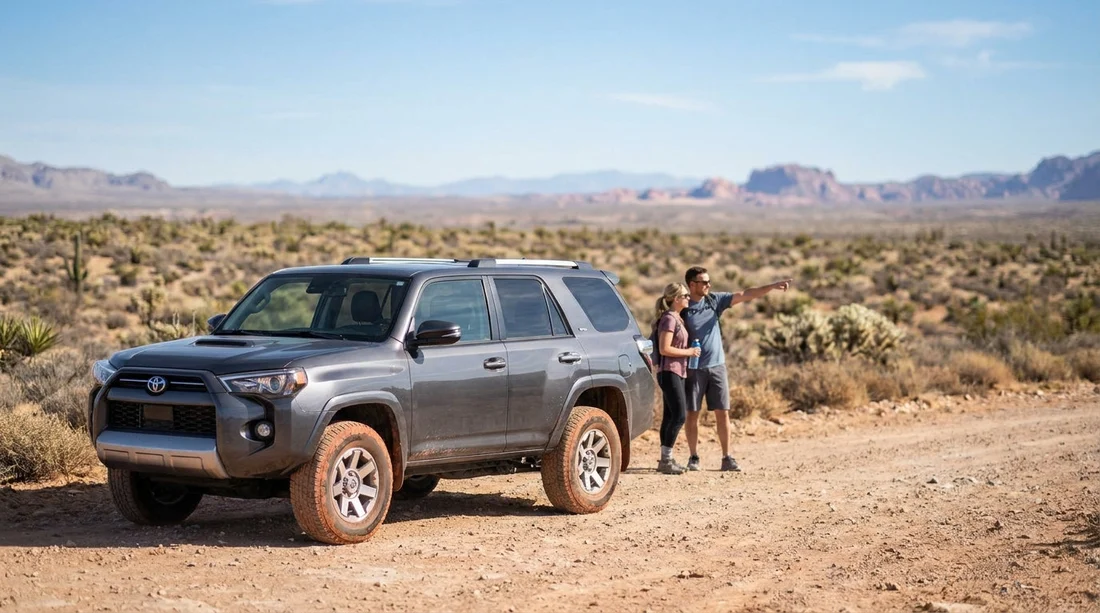
Quick Summary:
- For paved desert sights near Las Vegas, 2WD is usually sufficient.
- Choose 4WD only for deep sand, washouts, or rough, rutted tracks.
- Ask your car hire provider about permitted roads and tyre cover.
- Off-road driving can void cover, even when using a 4WD.
When you are planning desert day trips while arranging car hire in Las Vegas, it is easy to assume a 4WD is essential. In reality, most popular day-trip destinations are reached on fully paved highways, where a standard 2WD saloon, SUV, or people carrier is more than capable. The bigger question is not “Do I want 4WD?”, but “Will I leave the tarmac, and what does my rental agreement allow?”
Las Vegas sits close to desert landscapes that range from smooth scenic drives to rugged, remote tracks. Understanding the difference helps you choose the right vehicle, avoid invalidating your cover, and keep your trip stress-free.
If you are comparing options for arrivals and collections, start with the location that matches your plans, such as car hire in Las Vegas or car hire at Las Vegas Airport. The right pick often comes down to where you will drive, not just the badge on the tailgate.
When 2WD is enough for desert day trips
For most visitors, 2WD is enough because the headline experiences are on paved routes maintained for regular traffic. These roads are designed for touring, coaches, and everyday vehicles, not specialist off-road rigs.
2WD is typically sufficient when you are sticking to paved scenic drives and viewpoints. Many desert lookouts, visitor centres, and photo stops are accessed via highways and well-surfaced park roads.
2WD is also a good fit for short day trips on main roads. If your route is mostly interstate and state highways, traction is rarely the limiting factor, and comfort matters more.
In other words, if your day trip is “drive out, enjoy the scenery, return before dark”, you are usually choosing between vehicle sizes, not drivetrains. A compact or mid-size car can also be easier to park, cheaper to fuel, and less tiring in city traffic back in Las Vegas.
When 4WD can be worth considering
A 4WD can be useful, but only for specific situations. Even then, it is not a free pass to drive anywhere. Many car hire agreements restrict unpaved roads regardless of vehicle type.
Consider a 4WD if your itinerary genuinely includes loose surfaces, such as deep sand, gravel climbs, or very soft shoulders where 2WD may struggle to maintain momentum.
It can also help on rutted or uneven tracks, such as washboard surfaces, rock-strewn access roads, and routes with small washouts where extra traction and clearance matter.
It is worth separating “4WD” from “high clearance”. Many problems on rough roads are caused by scraping underneath the car, not spinning wheels. A 2WD SUV with good clearance can sometimes be a more practical choice than a low-slung 4WD.
The real issue, off-road restrictions and cover
The most important detail when arranging car hire is that “4WD available” does not automatically mean “off-road allowed”. Rental terms commonly restrict driving on unpaved, unsurfaced, or “non-maintained” roads. If you break that rule, you may be responsible for recovery costs, underbody damage, tyres, windscreen chips, and more.
Off-road restrictions often affect cover in three ways.
Insurance exclusions: Damage may not be covered if the incident occurred on an unpaved road, even if it was only a short section.
Damage categories frequently excluded: Tyres, wheels, glass, underbody, and tow charges are common pain points. Desert gravel can cause chips and punctures quickly.
Contract compliance: If you drive where you are not permitted, supplemental cover options may be invalidated. That can turn a minor scrape into a major bill.
This is why the best approach is to plan the route first, then pick the vehicle. If a destination requires a dirt track, check whether your provider allows it. If it does not, choose an alternative viewpoint or tour option that stays on paved roads.
What to ask at booking, and why it matters
Before you finalise your car hire in Las Vegas, ask clear, practical questions. You are trying to remove ambiguity, because “off-road” can be defined differently by different companies.
Ask these questions in plain terms.
Are unpaved roads permitted at all? Some agreements ban them entirely. Others allow certain graded roads but not trails.
Are there named restricted areas or roads? Some companies list specific regions where driving is not allowed, regardless of road condition.
What happens if I get a puncture? Find out whether tyre and wheel damage is excluded, and whether roadside assistance covers tyre changes or towing.
Is windscreen and underbody damage covered? Desert routes can mean flying stones and hidden rocks. Underbody strikes can be costly and are often excluded.
Do I need to carry chains in winter? If you may encounter snow at higher elevations, confirm local requirements and whether the rental company permits chain use.
Is there a mileage limit or fuel policy that affects longer day trips? Most Nevada itineraries are mileage-friendly, but it is still worth confirming.
If you want to compare suppliers and vehicle categories, Hola Car Rentals publishes landing pages that can help you orient your options, including car rental in Las Vegas, Budget car rental in Las Vegas, and Enterprise car hire in Las Vegas.
How to decide quickly, match the car to the road
If you are unsure whether you need 4WD, use this simple decision approach.
Step 1, list your stops and check the last mile. Many places have a paved road almost all the way, then a short unpaved access to a viewpoint. If that last section is unpaved and your contract does not allow it, you should plan a different stop.
Step 2, consider timing and weather. Desert rain can create flash-flood risk and damage unsealed roads quickly. Even if you are not “off-roading”, water over the road and soft shoulders can become hazardous.
Step 3, be honest about experience. 4WD does not replace judgement. If you have never driven on sand or gravel, your safest option is usually to keep to paved routes.
Step 4, prioritise comfort and safety over capability. Air conditioning performance, luggage space, and visibility matter a lot in desert heat. A reliable 2WD on good tyres is often the best choice.
Bottom line, do you need a 4WD for Las Vegas desert day trips?
For most desert day trips from Las Vegas that stay on paved roads, you do not need a 4WD. A 2WD vehicle is normally the most cost-effective and comfortable option, and it keeps you aligned with typical rental restrictions. Choose 4WD only when your planned route truly requires extra traction or clearance, and only if your rental terms explicitly permit the roads you intend to use. If there is any doubt, change the route, not the contract.
FAQ
Is a 4WD required to visit desert viewpoints near Las Vegas? No, most popular viewpoints and visitor areas are reached by paved roads, so 2WD is usually enough.
Does renting a 4WD mean I am allowed to drive off-road? Not necessarily. Many car hire agreements restrict unpaved or non-maintained roads regardless of vehicle type.
What should I check in the rental terms before planning a dirt-road stop? Confirm whether unpaved roads are permitted, and check exclusions for tyres, underbody damage, glass, and towing.
Is AWD the same as 4WD for desert day trips? No. AWD can help on loose surfaces, but it may not provide the same low-speed control as 4WD, and restrictions may still apply.
What is the safest alternative if my destination needs a rough track? Choose a paved-access viewpoint, or use a guided tour designed for that terrain and access.

























































































