


Quick Summary:
- Check the seat shows FMVSS 213 compliance on its permanent label.
- Confirm your child’s weight and height match the seat’s stated limits.
- Request a child seat early, as Florida availability varies by branch.
- Bring your own seat if you need a specific model or fit.
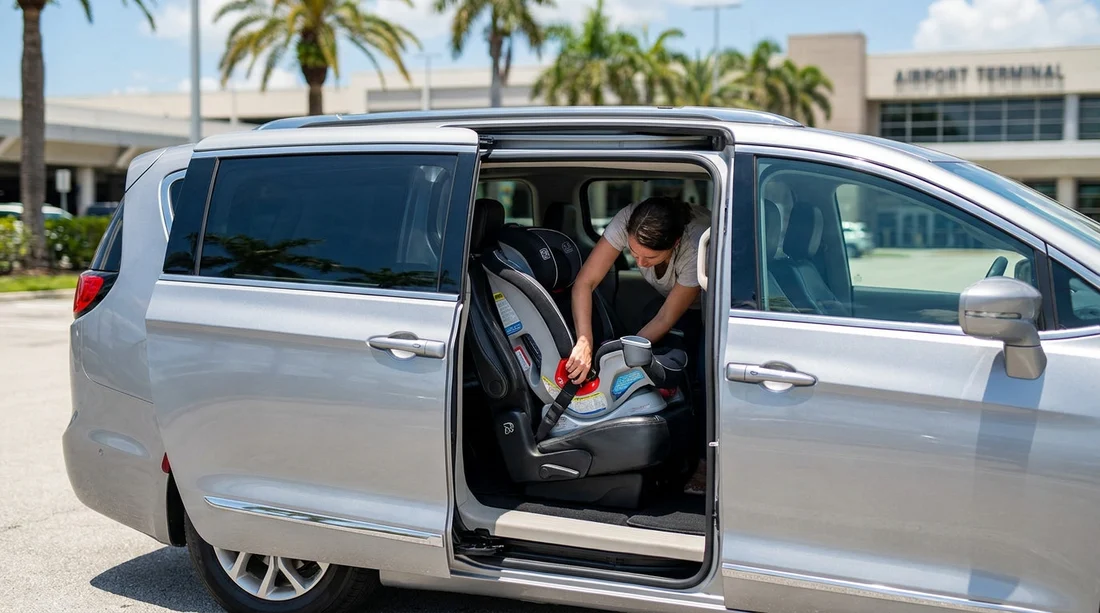
When you arrange car hire in Florida with children in tow, it is natural to wonder whether a rental child seat actually meets US safety standards, and what you should check before you drive away. Child restraints supplied by major rental providers in the US are generally intended for the US market and should be certified for use here. Still, it is wise to verify the labelling, confirm the seat is appropriate for your child, and understand how rental seat availability works at busy Florida locations.
This guide explains the safety standard you should look for, the practical checks you can do at the counter and on the car park, and when bringing your own seat may be the better option for your family’s needs.
What US safety standard should a rental child seat meet?
In the United States, child restraint systems sold for road use must comply with Federal Motor Vehicle Safety Standard 213, often written as FMVSS 213. Seats that comply will have a manufacturer label stating that the seat conforms to all applicable federal motor vehicle safety standards, usually referencing FMVSS 213.
Florida law focuses on the correct use of an appropriate child restraint, rather than asking you to identify a specific testing standard. If you cannot find the label or it is illegible, ask for a different seat.
If you are collecting at a major airport, such as via car rental at Orlando MCO or car rental at Miami Airport MIA, expect higher demand and faster turnarounds. That makes it even more important to do your own quick checks rather than assuming everything is perfect.
Safety labelling to look for before you leave the lot
A proper inspection takes only a few minutes. Start with the label, then check whether the seat is suitable for your child’s size and for your rental car’s belt system.
1) The FMVSS 213 compliance statement
Look for a permanent label, often on the side or back of the shell, stating the seat meets all applicable federal motor vehicle safety standards. Many seats also show the model name, manufacture date, and a serial number.
2) Weight and height limits, and seat type
Rental fleets may supply infant seats, convertible seats, or booster seats depending on what you request and what is in stock. Confirm the child’s current weight and height fits the listed range.
3) “Do not use after” guidance and condition
Some manufacturers include an expiry or useful life statement. Check for cracks, missing padding, frayed harness webbing, or a buckle that does not click securely.
4) Instructions and parts
Make sure the harness, chest clip (if present on that model), and any belt path guides are intact. A booster should have the proper belt positioning guides and a stable base.
How availability works with child seats in Florida car hire
Child seats are commonly treated as an optional extra rather than guaranteed equipment. Even if you request one as part of your car hire booking, supply can depend on the specific branch, the day’s returns, and the type of seat you need.
Request the seat as early as possible, and be clear about the type you need. Build in time at collection so you can check the seat properly.
If you are collecting on the Gulf Coast, the same logic applies at car rental at Tampa TPA. Airport branches are busy, and seat inventory can fluctuate hour by hour.
Fitting and compatibility checks that matter
A seat can meet FMVSS 213 and still be unsafe if it is installed incorrectly. You should know the basics so you can confirm it is right for your child and your vehicle.
Seat belt or LATCH compatibility
If you are using the vehicle seat belt, ensure you route it through the correct belt path and lock the belt if required by the car. The seat should not move more than about an inch side to side at the belt path when pulled firmly.
Rear facing vs forward facing
Follow the seat’s label and instructions for minimum and maximum limits. If the rental seat you receive does not suit your child’s current stage, ask to swap it.
Booster basics
The lap belt should sit low on the hips, not the stomach, and the shoulder belt should cross the chest and shoulder, not the neck or face.
When bringing your own seat may be better
Hiring a seat can be convenient, but it is not always the best choice. Bringing your own seat can be safer and less stressful in several common situations.
You need a specific fit or specialised features
If your child needs extra support, has medical considerations, or simply fits best in a particular model, relying on a rental seat of unknown brand can be a gamble.
You want to control the seat’s history
With rentals, you usually cannot confirm whether a seat has been dropped, mishandled, or involved in an incident. Your own seat offers more certainty.
You are doing multiple legs of travel
Having a familiar seat can simplify safe travel. It also helps if you are collecting from a non-airport location where stock may be smaller, for example when arranging a larger vehicle via van rental in Downtown Miami for a group and their luggage.
When a rental seat can still be a sensible choice
There are also good reasons to use a rental seat. If you are travelling light, managing several children, or want to avoid carrying bulky equipment through the airport, renting can be practical.
If you are comparing providers through Hola Car Rentals, you may see options tied to specific suppliers, such as Hertz car rental in Florida, where child seat extras may be offered depending on location and vehicle class.
FAQ
Do rental car child seats in Florida have to meet US safety standards?
Seats provided for road use should be US compliant, and the key marker is the FMVSS 213 compliance statement on the seat’s permanent label.
Where can I find the safety label on a child seat?
It is usually on the side or back of the seat shell, sometimes near the belt path. If you cannot find a compliance label, request a different seat.
Can I rely on my reservation to guarantee a child seat?
Not always. Child seats are often an optional extra subject to availability at the branch, so it is sensible to request early and allow time to inspect and fit it.
What should I do if the rental seat looks damaged or incomplete?
Do not use it. Ask the counter for a replacement seat, and only leave once you have a seat with intact harness, buckle, and clear instructions.
Is it better to bring my own child seat for Florida car hire?
It can be, especially if you want a known history, a specific model, or a guaranteed fit. A rental seat can still work well if it is correctly labelled, in good condition, and properly installed.

























































































