


Quick Summary:
- Assume metal chains are safest, socks may be refused at controls.
- Check Caltrans R1, R2, R3 levels before driving into mountains.
- Confirm your hire car’s tyre size and chain clearance in advance.
- Buy correctly sized chains and practise fitting them before snowfall.
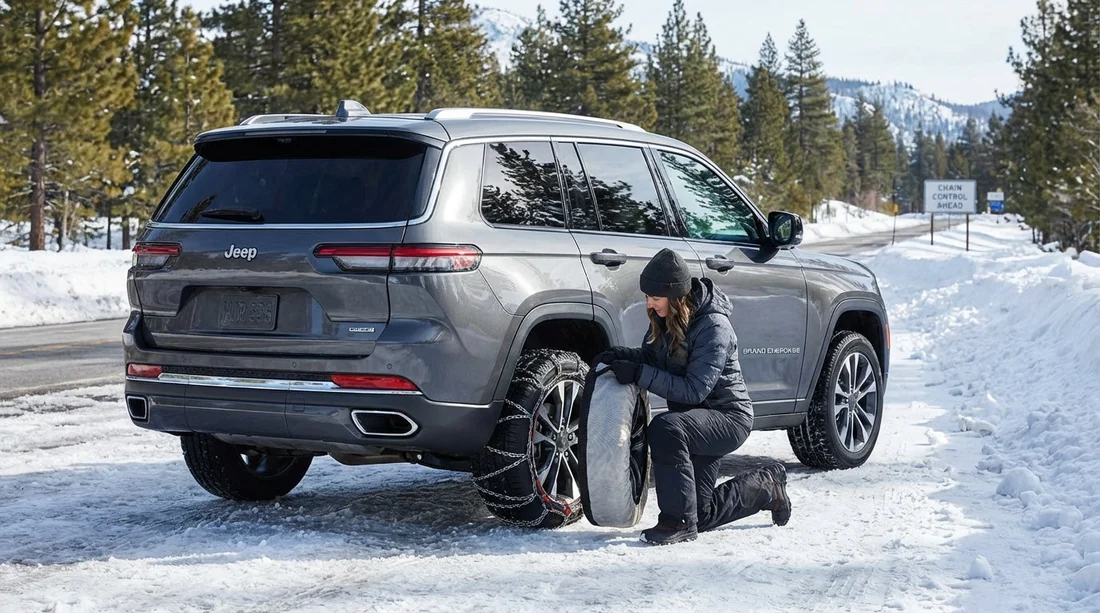
Winter driving in California can switch from dry motorway to blizzard conditions in a single climb. If you have a California car hire and you are heading towards mountain routes such as the Sierra Nevada, the big practical question is whether “snow socks” will get you through chain control, or whether you need traditional chains. The short, reliable answer is that chains are the default expectation, and socks sit in a grey area that can vary by enforcement and product certification.
This guide explains what Caltrans chain control typically means on the ground, what police and checkpoints often accept, and how to check what your specific hire vehicle can legally and physically use. It also covers what to buy and carry before you set off, so you are not trying to solve it in a windy turnout with low visibility.
What “chain control” means in California
During winter storms, Caltrans can require “traction devices” on certain highways. You will see electronic signs and roadside boards stating chain requirements, and you may encounter staffed chain control checkpoints where vehicles are waved through or turned back.
Caltrans uses three common levels:
R1: Chains or traction devices are required on some vehicles, typically those without adequate traction. In practice, this can mean you may proceed without chains if you have certain tyres or a capable vehicle, but you must still carry chains in many cases.
R2: Chains or traction devices are required on all vehicles except 4WD/AWD with snow tyres on all four wheels. Even if you qualify for the 4WD/AWD exception, you are often expected to carry chains because conditions can worsen quickly.
R3: Chains or traction devices are required on all vehicles, with no exceptions. Caltrans notes this is rare, but when it happens it is serious, and travel may be effectively impractical for many.
For a car hire driver, the important takeaway is that “traction device required” is not just a suggestion. If you cannot comply, you may be turned around, cited, or you may end up stuck and blocking the road. Also, chain requirements can be imposed for short sections, including approach roads to resorts, not only major passes.
Are snow socks legally “traction devices” in California?
Snow socks, sometimes sold as textile traction covers, are designed to slip over the drive wheels and increase grip on snow and ice. In some places they are formally accepted as an alternative to chains, but in California the situation depends on whether the product qualifies under the state’s traction device rules and whether the checkpoint staff accept it for the current conditions.
Caltrans signs and messaging often use broad language such as “chains or traction devices”, which can sound like socks should qualify. However, enforcement at checkpoints is practical and conservative: officers and Caltrans staff want something they recognise, that is rated for the vehicle, and that is capable in the current snowpack. Metal chains are widely recognised. Socks are less consistent, and some products are not rated or labelled in a way that makes quick roadside verification easy.
What this means in real-world terms is:
Socks might be accepted under lighter requirements, especially if they are a clearly rated, well-known traction product and conditions are not severe.
Socks may be refused if staff consider them insufficient, if they cannot confirm suitability, or if conditions are deep, icy, or rapidly worsening.
R3 is the riskiest scenario for socks. Even if a sock is technically a traction device, you do not want to arrive at an R3 checkpoint with something that may be questioned.
If your travel plans are time-sensitive, do not gamble on borderline acceptance. For most visitors with a California car hire, carrying correctly sized chains is the safest way to reduce the chance of being turned back.
What police and chain control checkpoints typically accept
Acceptance is shaped by three things: the chain requirement level (R1 to R3), the specific vehicle type, and the severity of the storm at that moment. In general, you can expect the following at checkpoints:
Traditional chains are the clearest pass. When an officer sees a chain box with the right tyre size, the conversation is short. Some checkpoints may not physically inspect fitment, but you can be instructed to install them immediately, and some roads have installation areas right before the steepest grades.
Cable chains are commonly accepted. Cables are still “chains” for most practical purposes and are often used where clearance is tighter. They can be easier to fit than heavy chains but still require correct sizing.
Alternative devices can be questioned. Auto socks and other textile covers may be treated inconsistently. If your product documentation is unclear, you may lose time explaining, or you may be refused.
Improper sizing is a frequent problem. A traction device that does not match your tyre size is effectively useless at chain control, even if you bought it in good faith. This is why you should confirm tyre size early, not at the last petrol station.
Keep in mind that even if you are waved through at a checkpoint, you can still be required to install later if conditions worsen. Carrying devices and knowing how to fit them matters as much as having them.
How to check your hire car’s chain requirements
There are two separate issues: what the road requires, and what your hire vehicle allows. Many modern cars, particularly those with low-profile tyres or limited wheel well clearance, have restrictions. Some manufacturers specify “no chains” for certain wheel and tyre combinations, or require a specific low-profile device.
Use this checklist before you leave the city:
1) Find the tyre size. Look at the sidewall, it will read something like 225/45R17. Write it down. You will need this to buy or verify any traction device.
2) Check the vehicle handbook or door-jamb information. Some cars include explicit wording about chains, clearance, and maximum link size. If the car does not have a handbook in the glovebox, take a photo of the tyre size and search the make, model, and year later when you are stationary.
3) Consider drivetrain, but do not overtrust it. AWD and 4WD can help you move, but they do not improve braking the way traction devices can. Also, chain control rules can still require you to carry chains, even if you do not install them.
4) Confirm any hire company policy you were given. Some hire agreements restrict chain use because of vehicle damage risk. That does not change Caltrans requirements, but it changes what you should plan for: you may need to select a vehicle that is chain-compatible if you know you will be driving into chain control areas.
If you are picking up near major gateways to mountain routes, it is worth reading the local guidance and preparing early. For instance, travellers collecting in Southern California often start from Los Angeles LAX or Santa Ana SNA, while Northern California trips may begin from Sacramento SMF or the Bay Area.
What to buy before you hit mountain roads
If your trip includes elevations where chain controls are common, purchase traction equipment before you climb. Mountain towns sell out fast during storms, and prices rise when demand spikes.
Choose the right type:
Chains: Best for predictable acceptance at checkpoints and stronger traction. They can be noisier and rougher on the vehicle, and they require practice to fit.
Cables: Often easier to fit and better for tighter clearance. Traction may be slightly less aggressive than heavy chains, but acceptance is generally strong.
Socks: Lightweight and easy to store. They can be helpful for short, low-speed stretches, but you should not assume they will satisfy chain control in every scenario.
Buy for your exact tyre size. Do not buy “close enough”. Sizing charts must match the tyre sidewall number.
Buy two, not one. For most passenger vehicles, you fit traction devices to the drive wheels. If you do not know whether your car is front-wheel drive, rear-wheel drive, or AWD, check before you buy.
Get gloves and a kneeling pad. Fitting chains is cold, wet work. A head torch and a small tarp can also make a big difference at night.
Practise fitting once, in daylight. Do a dry run in a safe, flat area before you go. You will be faster and safer when it is snowing.
Finally, consider the kind of vehicle you are hiring. A higher-clearance option may be more forgiving for traction devices and snow build-up, and it may provide more space for luggage and winter gear. Larger groups sometimes start with a people carrier or van, for example via minivan rental in San Francisco SFO, which can make winter packing simpler.
How to check chain control status before you drive
Plan to check conditions several times, not just once. Weather shifts quickly in the mountains, and chain control can be applied, lifted, and re-applied in the same day.
Use road signs and official alerts. Electronic message boards on approach highways are your last clear warning before you commit to a route. Pay attention to closure notices as well as chain notices, because closures can strand you between services.
Allow extra time. Chain installation areas can cause long queues. If you arrive near dusk, expect slower operations.
Carry fuel and phone power. Keep the tank comfortably above empty, and bring a charging cable. If traffic stops for long periods, you want heat and communications.
Know when to turn back. If you have only socks and the road is moving towards R2 or R3, do not push deeper into the mountains hoping it will be fine. Waiting out the storm at lower elevation can be the safer decision.
Using chains or socks safely on a hire car
Traction devices can damage a vehicle if used incorrectly. For a car hire, that matters, because damage may become your responsibility.
Never exceed the recommended speed. Most chains and cables have low speed limits, often around 30 mph, and sometimes lower. Faster driving can break the device and damage bodywork.
Install on a safe surface. Use designated chain-up areas, turn on hazard lights, and keep clear of traffic. If you cannot safely fit the device, do not attempt it on a narrow shoulder.
Remove promptly on clear pavement. Chains on bare road can shred quickly and harm tyres and suspension components. If the road transitions back to wet asphalt, pull into a turnout and remove them.
Listen for slapping or vibration. That can indicate a loose chain. Stop and re-tension. Driving on a loose chain is how wheel arches get damaged.
If you are travelling from the south after picking up, keep in mind that mountain routes are also popular from San Diego. If your trip begins there, browse options like car hire in San Diego SAN and then build a winter kit before heading inland and upward.
So, do you need chains, or will socks do?
For most visitors, the best planning assumption is: carry chains or cable chains that fit your exact tyre size, and know how to fit them. Socks can be a useful backup for brief low-speed traction needs, but they are not the most dependable answer when you are facing a staffed chain control checkpoint and a fast-moving storm.
If you want the lowest-risk approach for a California car hire winter trip, prioritise compliance and predictability. That means chains that match the vehicle, used at low speed, removed on clear pavement, and paired with conservative decisions about whether to proceed when chain levels escalate.
FAQ
Q: Are snow socks accepted at California chain control checkpoints?
Acceptance varies. Some checkpoints may treat socks as a traction device in light conditions, but many drivers find chains or cables are the most consistently accepted option.
Q: What do R1, R2, and R3 mean for my hire car?
R1 is the lightest requirement, R2 commonly requires chains unless you have AWD/4WD with snow tyres, and R3 requires chains on all vehicles. If you cannot comply, you may be turned back.
Q: Do I have to carry chains if I drive an AWD SUV?
Often yes. Even if AWD qualifies you to proceed under some conditions, you can still be expected to carry chains because rules and conditions can change quickly.
Q: Where do I find my tyre size so I buy the right chains?
Look on the tyre sidewall for a code such as 225/45R17. Match that exact size to the chain or cable packaging and sizing chart.
Q: Can I install chains on my hire car without causing damage?
Yes if they are correctly sized, properly tensioned, and used only on snowy roads at low speed. Practise fitting before your trip and remove them as soon as roads clear.

























































































