


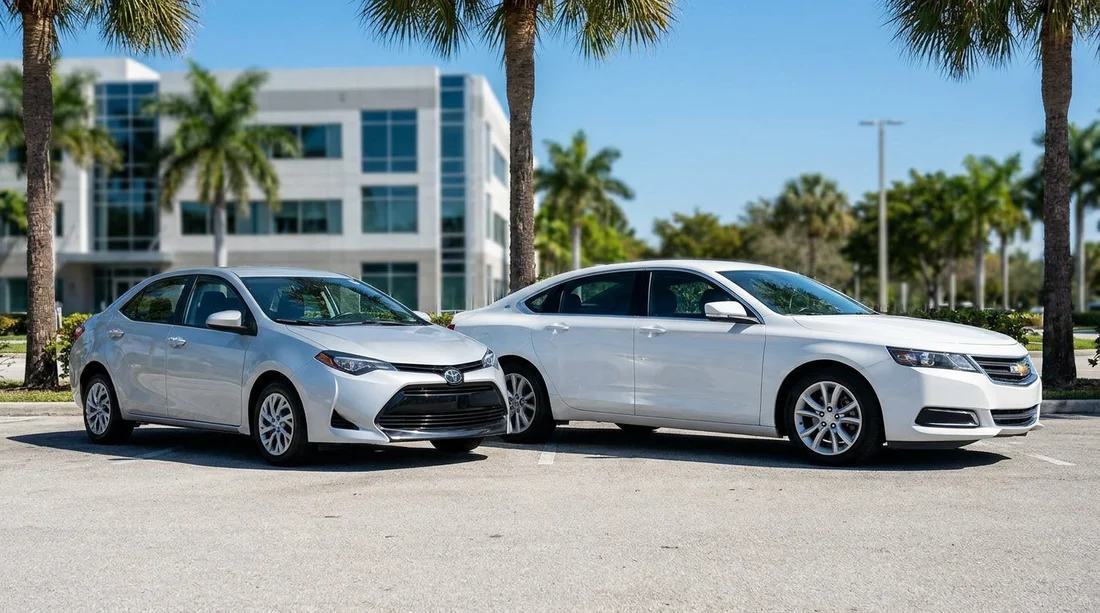
Quick Summary:
- Standard cars suit four adults with light luggage, and easy city parking.
- Full-size cars add rear-seat width and boot length for larger suitcases.
- Pay extra when driving long distances, carrying five adults, or more bags.
- Check category notes, not model names, because US classes vary by supplier.
When you’re arranging car hire in Miami, “standard” and “full-size” can look similar on a booking screen. Both are mainstream saloons or mid-size SUVs in US terms, both are comfortable at highway speeds, and both usually come with an automatic gearbox and air conditioning. The difference is mostly about space, seat width, and how relaxed the car feels when it’s fully loaded with people and luggage.
Miami is a place where the details matter. You might be collecting from the airport, squeezing into a hotel car park in South Beach, then heading out to the Keys with luggage and beach gear. Choosing the right size category can save money, reduce stress, and make driving more comfortable.
If you’re comparing pick-up points, Hola Car Rentals has location pages such as car hire at Miami Beach airport area and Payless car hire at Miami MIA, and the category definitions you see there are typical of the US market. Still, the key is understanding what the class is meant to provide, not chasing a specific badge.
How US rental size categories work in practice
In the United States, rental categories are based on “class expectations” rather than a fixed set of dimensions. A “standard” from one supplier might be close to a “full-size” from another, especially when fleets change. That’s why booking pages usually show “or similar”.
As a rule of thumb, standard is one step above intermediate, and full-size is one step above standard. The jump is often about shoulder room, rear legroom, and boot length. If you travel with large suitcases, prams, or bulky sports kit, boot shape matters as much as litres of capacity.
Because Miami has a mix of short urban hops and long, straight highway driving, you’ll feel those differences quickly. A standard can be ideal for getting around Miami Beach and popping between neighbourhoods. A full-size often feels more settled for longer runs out towards Fort Lauderdale or down US-1, especially with five people on board.
Standard rental cars, what you typically get
A standard rental car in Miami is usually a mid-size saloon, sometimes a liftback, and sometimes a smaller SUV depending on fleet availability. The cabin is designed for four adults in comfort, with a usable middle seat for short distances. The boot typically handles one large suitcase plus a couple of smaller bags, but it can get tight if everyone brings hard-shell luggage.
Standard is often the sweet spot when you want reasonable comfort, good fuel economy, and simpler parking. In busy areas, a slightly shorter length and tighter turning circle can make manoeuvres less stressful, particularly in multi-storey car parks with narrow ramps.
If your itinerary is mostly city driving, beach stops, shopping, and dining, standard usually covers it without paying for space you do not need. It is also a sensible choice if you plan to valet park frequently, since a smaller footprint can reduce the chances of awkward scrapes in crowded lots.
Full-size rental cars, what you typically get
Full-size generally means a larger saloon or a larger two-row vehicle with a wider rear bench, more rear legroom, and a longer boot. The extra space is not just about comfort, it can be the difference between fitting luggage properly or having bags stacked high and blocking rear visibility.
You’ll notice the benefits when:
First, you have three adults in the back. A wider rear seat and flatter bench make the centre position less of a squeeze. Second, you have bigger suitcases. A longer boot can take two large suitcases more easily, or accommodate a large case plus a cooler and beach chairs. Third, you’re doing longer drives. A slightly heavier car can feel quieter at speed, with less road noise and a more relaxed ride.
If you’re planning to collect at Miami International Airport, comparing suppliers can help you see what “full-size” means in their fleet. You can review options like National car hire at Miami MIA alongside other brands. The important point is to read the category notes and passenger and luggage guidance, not just the example vehicle image.
Passenger and luggage space, the real differences
Most booking screens show “5 seats” for both standard and full-size, which can be misleading. In reality, the fifth seat is often the deciding factor. A standard can carry five, but it may feel tight for adults, particularly on longer trips. A full-size is more likely to provide the shoulder room that makes five workable.
Luggage is similar. Both categories might claim two large bags, but boot shape and hinge design matter. Some saloons have smaller openings that make it harder to load big hard-shell suitcases. A full-size boot is often longer, and the opening may be wider, so you can fit luggage without forcing it or compromising rear visibility.
In Miami, consider your “real luggage”, not the idealised version. Beach bags, shopping, a pushchair, and a cooler can quickly add up. If you’re staying a week and doing day trips, a little extra boot room can make the trip more comfortable.
When paying extra makes sense in Miami
Upgrading from standard to full-size can be good value in certain situations. It makes sense when you’re paying for comfort across many hours of driving, or when space reduces day-to-day hassle.
Choose full-size more often if any of these apply:
You are travelling with five adults. Even if it is “only” 30 minutes, Miami traffic can make short distances feel long. You have two or more large suitcases plus additional bags. You are doing longer drives, such as day trips up the coast, or heading out early and returning late. You want a calmer, quieter drive on highways, where a larger cabin and wheelbase can feel less tiring.
Standard is often better value if you’re mostly in Miami Beach, Brickell, Wynwood, and Coral Gables, where parking and tight turns are common. If you’re comparing areas, see what’s available around car hire in Coral Gables to match the vehicle size to the streets and parking you expect.
Typical driving and parking considerations
Miami driving mixes wide highways with dense neighbourhood streets. A full-size car is rarely “too big”, but it can be less convenient in tight garages, especially if you’re not used to US-sized parking bays. If your accommodation has compact spaces, or you expect frequent parallel parking, a standard can be noticeably easier.
On the other hand, air conditioning performance, seat comfort, and cabin space become more valuable in hot, humid weather, especially with passengers in the back. A full-size can feel more comfortable when everyone is in the car after a day out, when you’re tired and the roads are busy.
If you’re heading north and want a convenient collection point, comparing car hire in Fort Lauderdale options can help you decide whether the price difference between categories is worth it for your route and group size.
How to compare categories before you commit
To make a confident decision when booking car hire in Miami, use a simple checklist.
Start with people. Count adults, then think about how often the middle rear seat will be used. If it’s a regular seat, lean towards full-size. Next, count luggage pieces and consider shape. Hard-shell suitcases and prams take more “usable” volume. Then check your driving plan. If you’re doing mainly short trips with lots of parking stops, standard usually wins. If you’re doing longer drives or carrying more gear, the full-size upgrade can be worth it.
Finally, remember that “standard” and “full-size” are categories, not guarantees of a specific model. If you care about a particular feature, such as a larger boot opening or extra rear headroom, focus on the category description and luggage guidance, and consider whether a different class like a minivan might be more appropriate for bigger groups.
FAQ
Is a standard car always cheaper than a full-size in Miami? Usually, yes, but pricing varies by date, demand, and fleet availability. Sometimes the difference is small, which is when extra space can be good value.
Will both standard and full-size cars fit five people? Both categories often list five seats, but comfort differs. Standard suits four adults best, while full-size is more practical for five adults.
How many suitcases fit in a standard vs full-size rental car? A standard typically fits one large suitcase plus smaller bags comfortably. A full-size more often takes two large suitcases with less stacking and better visibility.
Does “full-size” mean an SUV in the US? Not necessarily. Full-size often refers to a larger saloon, though fleets can include larger two-row vehicles. Always rely on the category guidance, not the photo.
When should I choose standard for car hire in Miami? Choose standard if you prioritise easier parking, have lighter luggage, and mainly drive around the city and Miami Beach rather than doing long, luggage-heavy road trips.





























































































