Quick Summary:
- Find the deposit hold line and note the exact amount shown.
- Confirm what the hold covers, including fuel, tolls, and extras.
- Check when the hold is placed and when it is released.
- Verify card and driver requirements, plus limits that affect eligibility.
A credit-card deposit hold is one of the most important parts of a Florida car hire agreement to understand before you sign at pick-up. It is not the same as the rental charge, and it is not always taken as a “payment”. Instead, the rental company asks your card issuer to temporarily ring-fence a set amount of your available credit as security.
This guide walks through where the hold amount usually appears, what it commonly covers, and the checks you can do at the counter so you know what to expect on your card statement.
Where to find the deposit hold on your agreement
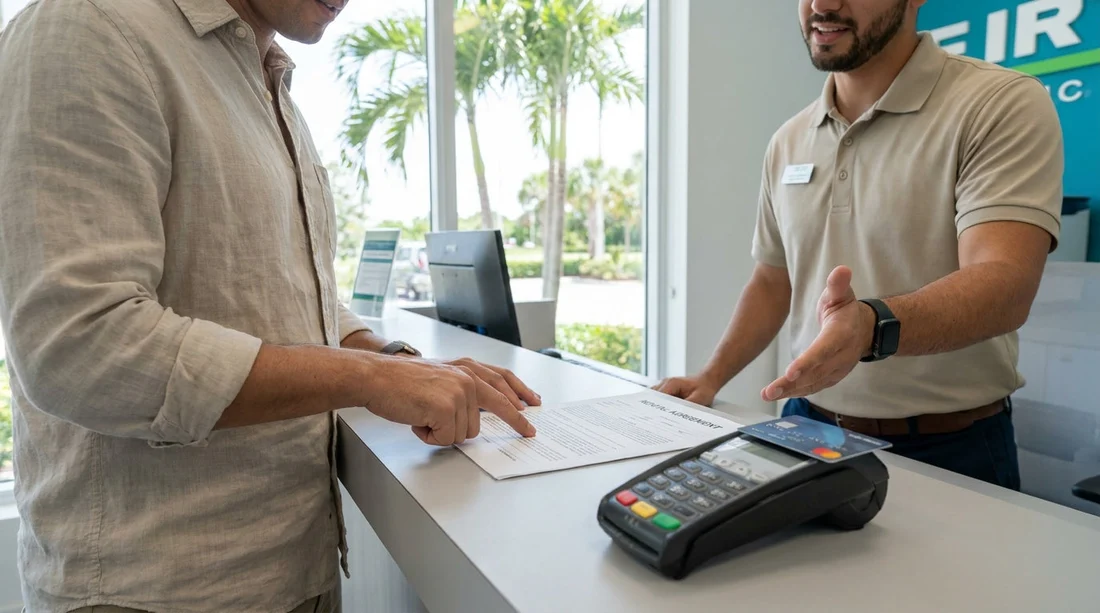
At pick-up in Florida, your car hire paperwork may be presented as a printed rental jacket, a single-page agreement, or an electronic signature screen. In each format, the deposit hold details tend to show up in a few predictable places.
1) The financial summary section. Look for a table or box listing “Estimated Charges”, “Payment”, “Deposit”, “Security Deposit”, “Authorization”, or “Pre-Authorization”. The hold amount is often shown separately from the rental total, or as a line that says the card will be authorised for “rental charges plus deposit”. If it is a combined number, ask the agent to break it down into rental cost and hold portion so you can compare it with your available credit.
2) The payment method and authorisation wording. Agreements often include a paragraph stating that you authorise an amount to be held and that the final charge may differ due to fuel, tolls, damage, or extensions. This paragraph is important because it tells you whether the company is authorising a fixed deposit, or a flexible amount that can change based on options you add.
3) The “additional products” section. Extras such as additional driver, GPS, child seats, toll programmes, and roadside assistance can change the authorisation amount. Even if an extra is charged daily, some companies adjust the hold upwards to reflect the higher total exposure.
If you are collecting near major hubs, the agreement format may vary slightly by brand and desk location. For example, paperwork at an airport counter can look different from an off-airport desk used for car hire in Doral or coastal pick-ups such as car hire in Miami (MIA). Regardless of format, you should still be able to identify a deposit or authorisation figure before signing.
What the deposit hold usually covers in Florida
Deposit holds exist to cover risk that is hard to price precisely at the start of the rental. In Florida, the most common items a hold is designed to protect against include fuel differences, tolls, damage responsibility, extensions, and certain fees that can be processed after return.
The key takeaway is that a deposit hold is generally not a prediction of what you will spend, it is a buffer linked to risk. That is why two customers paying similar daily rates can see different hold amounts, especially if one has extras, a different insurance selection, or a different payment card type.
How to confirm the exact hold amount before you sign
At pick-up, the best protection against surprises is to confirm the number and the reason. Use a simple, consistent set of questions, and match the answers to what you see on the agreement screen or printed page.
Ask for the authorisation amount as a single figure. Say: “What is the total amount you will authorise on my card today, including any deposit hold?” This ensures you get the number that will reduce your available credit.
Ask whether it is “deposit only” or “rental plus deposit”. Some desks authorise the estimated rental charge up front and then add a deposit on top. Others only hold a deposit and charge the rental on return. Your cash flow and credit utilisation look different under each approach.
Check the card type acceptance and name match. Many Florida rentals require a credit card in the main driver’s name for the deposit hold. If you plan to use a different driver’s card, a prepaid card, or certain debit cards, confirm acceptance first, as it can affect the deposit amount or require extra checks.
Look for language about “multiple authorisations”. If you are picking up at a busy location, for example car hire at Fort Lauderdale Airport (FLL), it is worth confirming whether changing the vehicle category at the desk triggers a new authorisation. Sometimes the original hold remains until it naturally expires, even after a new hold is placed.
Timing: when the hold is placed and released
Agreements often mention that the release timing is controlled by your bank or card issuer, not only by the rental company. There are three timing points to check.
When it is placed. The hold is typically placed at pick-up, right after card verification. Ask whether it will appear as “pending” or “authorised” and whether you will see one authorisation or more than one.
What happens at return. On return, the company finalises the rental charges and requests that any unused portion of the hold be released. If the final charges are lower than the authorised amount, you should see the pending amount drop off and the final charge post, but the exact sequence can vary by bank.
If you are travelling to theme park areas and using toll roads heavily, confirm how tolls are billed after return and whether they can appear as a separate later charge. This is a common question for people arranging car hire near Disney Orlando (MCO), where routes often include toll segments.
Common agreement details that change the deposit hold
Two agreements for the same model can produce different holds. Before you sign, scan these details and confirm them verbally if anything is unclear.
Vehicle class and value. Higher-value categories often carry higher holds because potential exposure is greater. If you are upgraded or switch class at the desk, ask whether the deposit hold changes.
One-way rentals and drop-off changes. Changing the return location can change the estimated charges. If you adjust drop-off plans after pick-up, that can also lead to additional authorisations.
Payment method at pick-up. Even if you prepaid online, the desk may still require a credit card for the deposit hold. Confirm whether the card used for the hold must be the same card as the booking card, and whether the deposit can be held on a different card to separate it from travel spending.
How to protect yourself from surprises
Most deposit-hold issues come from not matching the desk’s numbers to what you expected. A few practical habits help.
Take a photo of the agreement screen or keep the printed agreement. You want a record of the authorised amount and the products selected. This is useful if you later need to reconcile pending holds with your bank.
Ask for a breakdown of anything you do not recognise. If there is a line item you did not expect, pause before signing. It is easier to fix at the desk than afterwards.
If you are comparing desk policies across areas, you may notice small differences between locations and brands, for example at car hire in Miami Beach with Avis. The agreement is the source of truth for your rental, so treat the authorisation figure and the selected options as the final confirmation before you sign.
If you prefer a different provider in the same area, you can also compare how policies are presented on agreements for car hire in Miami Beach with Hertz before you decide.
FAQ
Q: Is a credit-card deposit hold the same as a charge?
A: No. A hold is an authorisation that reduces available credit, while a charge posts as a completed transaction. Holds often show as pending and may disappear once released.
Q: Why is the hold higher than my estimated rental total?
A: The hold often includes a buffer for fuel differences, toll exposure, possible extensions, or damage responsibility. Extras and vehicle class can also increase the authorisation.
Q: Can the rental company change the hold after I sign?
A: It can change if the contract changes, for example you extend the rental, add products, change vehicle class, or adjust return location. Ask how additional authorisations are handled.
Q: When should the hold be released after I return the car?
A: The rental company typically releases it after finalising charges, but the bank controls when it disappears from pending transactions. Keep your return receipt in case you need to follow up.
Q: What should I do at pick-up to confirm the hold amount?
A: Ask for the total amount to be authorised today, confirm whether it is rental plus deposit, and check the agreement lines for deposits, selected extras, and payment method before signing.