


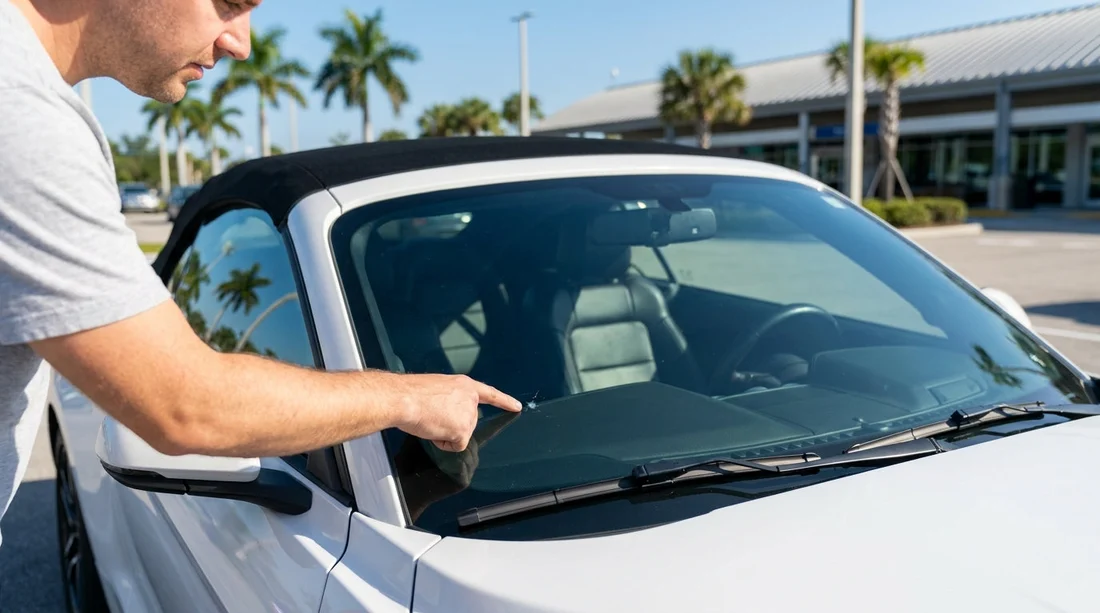
Quick Summary:
- Inspect the full windscreen inside and outside under bright, even light.
- Look for chips, cracks, starbursts, and old resin repairs near edges.
- Photograph damage with wide and close shots before leaving the bay.
- Get any marks noted on your agreement before you drive away.
Before you pull out of the lot with car hire in Florida, a two minute windscreen check can save time, stress, and disputes later. Windscreens pick up small stone chips easily, and a tiny mark can spread into a crack quickly with heat, motorway speed, or heavy air conditioning. The key is spotting anything that already exists, then making sure it is recorded properly on your paperwork or in the rental company’s check out process.
This guide is a practical, pre drive checklist you can use whether you are collecting near Miami, Orlando, or elsewhere in Florida. It focuses on what to look for, where to look, and how to document chips so there is a clear record from the start.
Start with the right conditions before you inspect
Try to inspect the windscreen in bright, even light. If you are in a shaded garage or under a canopy, step the car forward slightly, if allowed, so light hits the glass. If it is raining, use the wipers once and wait for the screen to clear, because droplets can hide small chips. At night, use your phone torch at an angle rather than shining it straight on, as angled light makes pits and repairs more visible.
If you are collecting around Miami, the pickup environment can vary between covered parking and open air. For collections in the city, it helps to arrive with enough time to check carefully, for example when arranging car rental Downtown Miami pickups where lighting changes by level and bay.
Walkaround checklist, what to check on the windscreen
Do one slow scan from the outside, then repeat from the driver’s seat. Each viewpoint reveals different issues.
1) Chips and pits
Look for tiny circular pits, half moon chips, and larger cone shaped chips. Chips can be as small as a pinhead, but still matter if they sit in the driver’s line of sight or near an edge. Run your fingernail gently across suspicious marks from the outside, if you can feel an indentation it is more likely to be a chip than dirt.
2) Cracks, including hairline cracks
Check for straight cracks, curved cracks, and branching cracks. Hairline cracks can appear as faint white lines, especially when light hits at an angle. Pay special attention to the lower corners, where cracks may start and creep upward.
3) Starbursts and bullseyes
These look like a small impact point with radiating lines, or a ring with a centre. They may be repairable, but they should still be recorded. If a starburst sits near the edge, it can spread faster than one in the middle.
4) Previous repairs and resin fills
Old repairs often look like a slightly cloudy circle, a faint ripple, or a shiny patch. They may be perfectly fine, but they must be documented as pre existing. If you see multiple repairs, take extra photos to show their number and location.
5) Edge damage and perimeter stress points
Examine the black dotted band and the perimeter where the windscreen meets the frame. Chips within a few centimetres of the edge are more likely to become cracks because the glass is under stress. Also check around the rear view mirror mount area, as impacts there can be missed from the outside.
6) Wiper sweep zone and driver sightline
Inspect the area directly in front of the driver, as damage there can affect visibility and may be treated differently by some operators. Also check the arcs where the wipers sweep, because that is where sand and grit can create fine scratching that is obvious when driving into sun.
7) Scratches and sand pitting
In Florida, coastal roads can mean windblown sand. Look for widespread tiny specks or haze, particularly on ex fleet cars. Fine scratching may not be charged as damage, but if it is heavy it is worth noting because it can cause glare.
How to document windscreen chips so they are clearly recorded
Documentation matters as much as inspection. Aim for evidence that shows the mark, its location on the car, and the vehicle’s identity.
Take photos in this order:
First, take a wide shot of the whole front of the car showing the windscreen, bonnet, and number plate. Next, take a mid range shot showing the chip’s position, for example the passenger side lower corner. Then take a close up, ideally with focus locked and your phone held steady. If your camera struggles, step back slightly and zoom in, as some phones focus better that way.
Include a reference for size:
If allowed, place a coin or your fingertip near the chip without touching the glass, then take a photo. Do not press on the chip. The goal is to show scale.
Capture the vehicle details:
Photograph the VIN plate area if visible, or a sticker on the door jamb, plus the dashboard mileage at pickup. If you are picking up near a business district, keep the process efficient, for instance at car rental Brickell locations where traffic flow may encourage quicker exits.
Store evidence safely:
Keep photos in a dedicated album and do not edit them heavily. If your phone supports it, keep time and location data switched on. Also email a few key images to yourself so you have a backup.
Getting chips noted before you leave, what to ask for
Once you have found anything, have it recorded before you drive away. Depending on the operator, this may be a paper diagram, a digital checkout, or an app based condition report.
Be specific about location and type:
Ask for wording that identifies the damage clearly, for example “small chip, 3mm, lower passenger side edge” or “old resin repair, centre upper area”. Vague notes like “scratch” can be disputed later.
Confirm you receive a copy:
Ensure you have the updated agreement or confirmation screen, not just a verbal assurance. If you are collecting from a leisure oriented hub, the pace can be busy, so it is worth double checking, for example at van rental Disney Orlando collections where families may be loading quickly.
Extra Florida factors that can worsen existing chips
Florida conditions can make minor glass issues worsen fast.
Heat and temperature swings:
A chilled cabin and a hot windscreen can increase stress around a chip. For the first drive, avoid blasting the coldest air directly at the screen. Bring the temperature down gradually.
Roadworks and gravel shoulders:
Stone chips often come from loose aggregate. If you must pass a vehicle throwing debris, do it smoothly and increase your distance afterwards.
If you find a chip after leaving, what to do
If you notice a chip soon after departure, pull over safely and take photos straight away, including a wide shot that shows surroundings. Then contact the rental provider using the method on your agreement and ask how to submit evidence. The earlier you report it, the easier it is to show it existed at pickup, particularly if your timestamped photos support that.
If you are collecting via an airport area and need clear handover processes, it helps to understand how pickup checks typically work at places such as car hire airport Doral locations, where vehicle turnover can be rapid and documentation is especially important.
FAQ
How small is “small enough” to ignore on a rental car windscreen? Even a tiny chip is worth recording, especially if it is in the driver’s view or near an edge. If you can feel it with a fingernail or see it clearly in angled light, photograph it and ask for it to be noted.
Should I check the windscreen from inside the car too? Yes. Some chips are easier to spot from inside because reflections change, and light catches the impact point differently. Do a quick scan from the driver’s seat across the whole glass, including the top corners.
What photos are most useful if there is later a disagreement? A wide front of car photo showing the number plate, a mid shot showing the chip’s location on the screen, and a close up showing the chip detail. If possible, add a short video panning from the number plate to the chip.
Is a cloudy circular mark on the windscreen a problem? It is often an old resin repair. It may be stable, but it should still be documented as existing at pickup. Take photos in angled light so the repaired area is visible.
Will Florida heat make an existing chip spread into a crack? It can. Heat, cold air blasting onto hot glass, and vibrations at speed can all worsen a chip. Keep the cabin temperature changes gradual and leave extra distance on highways to reduce stone impacts.





























































































