


Quick Summary:
- Confirm the seat matches your child’s weight, height and age range.
- Check for damage, missing parts, recalls and an in-date expiry label.
- Install tightly, confirm the correct belt path, and test movement at base.
- Adjust harness and chest clip, then do a short, quiet test drive.
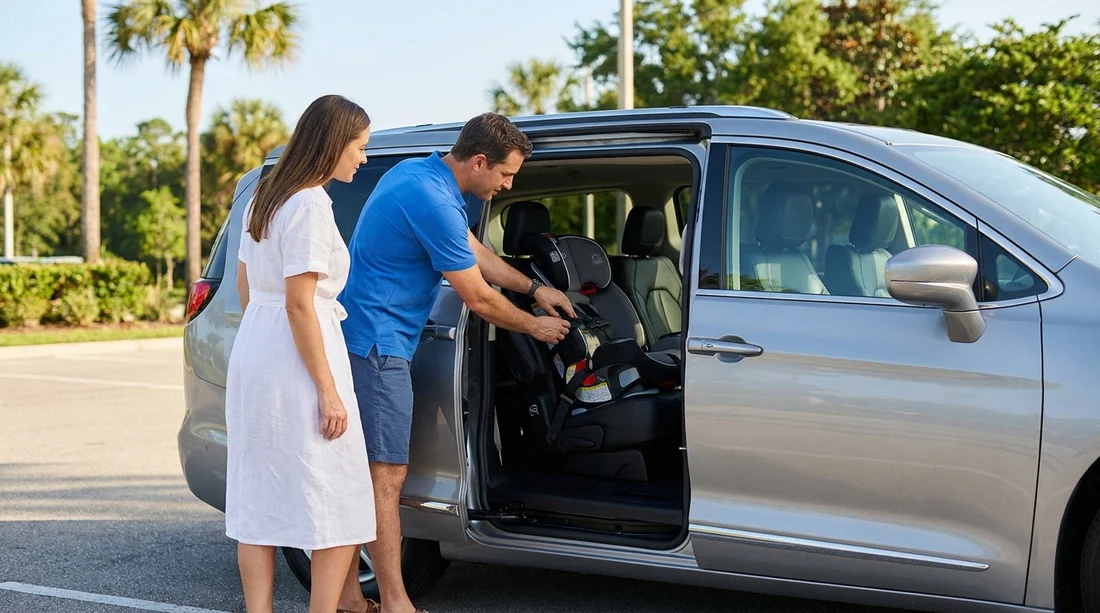
Picking up a rental car in Orlando often comes with a long drive ahead, perhaps straight from the airport to a resort. If you have added a hired child seat to your car hire, it is worth taking a few minutes in the car park to confirm it is the right seat, in good condition, and installed correctly. A child seat that is the wrong size, out of date, or loosely fitted can reduce protection in a sudden stop or crash.
Orlando is also a place where fatigue and distraction are common, after flights and queues. Doing a structured check before you drive off helps you avoid having to pull over later on busy roads. If you are collecting at the airport, the most convenient moment is often before leaving the pick-up area, so you can ask staff questions while you are still on site. If you are collecting at the terminal, see practical airport collection notes on car hire at Orlando MCO.
1) Confirm you have the correct seat type for your child
Start with the basics. The seat must be appropriate for your child’s current weight and height, not just their age. Look for labels that show limits and configuration options, for example rear-facing only, convertible (rear and forward-facing), or booster.
Weight and height limits: Find the sticker or moulded label and ensure your child fits within both. If you cannot locate the label, treat that as a problem to resolve before leaving.
Harnessed seat versus booster: A booster requires the vehicle seat belt to fit properly across the shoulder and hips. A harnessed seat uses its own harness. If you have a child who still needs a harness but receive a booster, ask for a different seat.
2) Inspect overall condition and cleanliness
A hired child seat should look structurally sound and complete. Cosmetic scuffs are common, but cracks, missing components, or sticky adjustment mechanisms are not. Do a slow, hands-on inspection in good light.
Shell and base: Check for cracks, splits, deep gouges, or stress whitening around belt paths and attachment points. Look underneath the base and around the recline mechanism.
Harness straps: Straps should be flat, untwisted, and free from fraying or cuts. Pull the adjuster to confirm it tightens and loosens smoothly.
Buckle and chest clip: The buckle should click positively and release reliably. The chest clip should not be broken and should hold position.
Smell and residue: Strong odours, mould, or sticky residues are hygiene and safety concerns. If you are uncomfortable with the condition, request an alternative seat.
3) Check expiry date, labels, and recall information
Child seats are not designed to last forever. Plastics can degrade and standards can change. Most seats include an expiry date or a “Do not use after” date, typically on a sticker on the back, bottom, or side. Confirm the seat is in date.
Expiry: If the label shows the seat has expired, do not use it. Ask for a replacement.
Model identification: Note the brand and model name. There should also be a manufacturing date and a model number. If key labels are missing, it becomes harder to confirm correct use and recall status.
4) Make sure you have all required parts and the manual
Many installation errors come from missing parts or guesswork. Before you start installing, check the seat came with everything it needs for your intended method, and ideally has instructions available.
Manual: Some seats store a paper manual in a slot, others rely on labels. If there is no manual, look for an instruction label on the shell. If you cannot find clear instructions, it is worth asking for guidance or a different seat with instructions.
For boosters: If it is a high-back booster, check belt guides are intact. If it uses a clip or guide for shoulder belt positioning, make sure it is included.
5) Install it correctly in your rental car
Correct installation is the most important step. Use either the vehicle seat belt or the lower anchors (LATCH) system, depending on what the child seat allows and the weight limits specified for lower anchors. Choose one method, do not combine them unless the manufacturer explicitly permits it.
Choose the safest position you can use properly: The centre rear seat can be ideal if you can achieve a secure installation and there is an appropriate belt or anchor. Otherwise, behind the passenger is often convenient for loading. Avoid front seating positions if possible, especially for rear-facing seats because of airbags.
Follow the correct belt path: Seats have different belt paths for rear-facing and forward-facing. Threading the belt through the wrong route is a common, serious error. Confirm the belt is locked if required, either by pulling the shoulder belt all the way out to engage a locking retractor, or by using a built-in lock-off on the seat.
Tightness test: After tightening, grasp the seat at the belt path and try to move it side-to-side and front-to-back. You are aiming for minimal movement, typically no more than about 2.5 cm.
Angle and recline: For rear-facing seats, confirm the recline indicator is within range. Too upright can cause head slump in younger children, too reclined can reduce crash performance.
If you are unfamiliar with US rental vehicles, take a moment to locate the lower anchors and top tether anchors. Minivans and SUVs can vary. If your trip includes a larger vehicle, it can help to read general seating considerations before you travel, such as those on minivan rental options or SUV hire.
6) Fit your child and adjust the harness properly
Even a perfectly installed seat will not protect well if the harness or belt fit is wrong. Do a proper fit check before you leave the car park.
Harness height: Rear-facing harness straps should usually come from at or below the shoulders. Forward-facing harness straps should usually come from at or above the shoulders. Check the seat’s label because designs differ.
Harness tightness: Tighten until you cannot pinch a fold of webbing vertically at the shoulder. Remove bulky coats that can compress in a crash and leave slack.
Chest clip position: Place it level with the child’s armpits. Too low can allow the harness to spread.
For booster fit: The lap belt should sit low on the hips and upper thighs, not across the tummy. The shoulder belt should cross mid-shoulder and chest, not cutting into the neck or slipping off the shoulder. If you cannot achieve this, you may need a different booster style.
7) Do a final pre-drive safety sweep
Before you pull away, run through a final sweep that takes less than a minute.
No twists: Check the harness and vehicle belt are flat.
Secure buckles: Re-check the buckle click and that the chest clip is latched.
Loose items: Put heavy bags in the boot or secure them. In a crash, loose items can become dangerous projectiles.
Short test drive: Drive slowly for a minute, listening for rattles that could indicate a loose installation. Then re-check tightness at the belt path.
If you are doing a multi-state trip after Orlando, remember that vehicle models and seat belt systems can differ between rentals. It can be useful to compare collection processes across locations such as car hire in Georgia or budget car hire at JFK.
FAQ
Should I use LATCH or the seat belt in my Orlando rental car? Use whichever method the child seat allows and you can install most securely. Do not use both unless the seat manual explicitly permits it, and watch for lower-anchor weight limits.
How tight should the installed child seat be before I drive off? Test at the belt path. It should have very little movement, roughly no more than 2.5 cm side-to-side or front-to-back. If it slides more, reinstall and tighten.
What if the hired child seat has no expiry label or key instructions? Missing labels make it hard to confirm safe use. Ask for a different seat with intact labels and instructions, or request assistance before leaving the car hire facility.
Can I place a rear-facing child seat on the front passenger seat? It is safer to use the rear seats. If you must use the front, ensure the airbag can be disabled and the seat can be installed correctly, but this is generally best avoided.
Do I need to re-check the seat during my holiday? Yes. Re-check installation and harness fit daily, and after any seat adjustment, passenger change, or if the seat has been removed for luggage or cleaning.





























































































