


Quick Summary:
- Choose USD at the card terminal to avoid DCC mark-ups.
- Let your bank convert, card networks usually use better rates.
- Check your card’s foreign transaction fee before paying for car hire.
- Ask for a USD receipt so totals match your rental agreement.
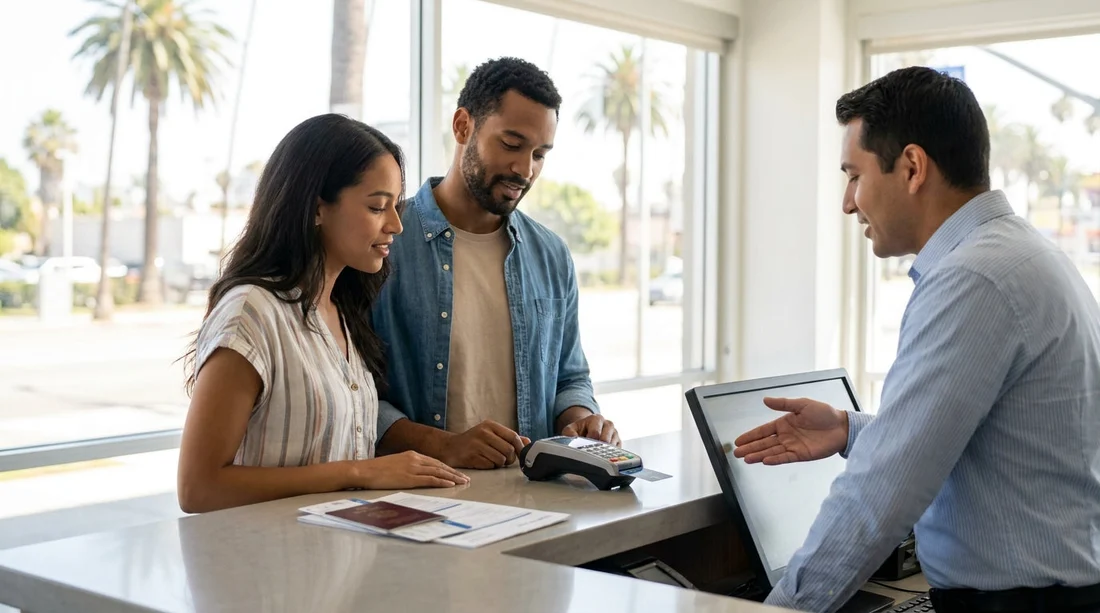
When you’re picking up a car hire in Los Angeles, one small choice can change the final price, whether you pay in USD or in your home currency at the payment terminal. Many travellers see a screen prompt offering to charge the total in pounds, euros, or another familiar currency. It sounds convenient, but it is often the more expensive option because of something called dynamic currency conversion, also known as DCC.
DCC is when the merchant’s payment system converts the charge from USD to your home currency on the spot. The exchange rate applied is set by the DCC provider, not by your card network or bank, and it commonly includes an extra margin. In practice, choosing your home currency can mean paying a higher exchange rate than you would have received by paying in USD and letting your card provider do the conversion.
This matters at several points during a Los Angeles car hire. You might pay a deposit or preauthorisation at pick-up, additional costs during the rental, and the final balance on return. If any of those are processed with DCC, the total can creep up without you noticing, especially if you are tired after a flight or dealing with queues.
What dynamic currency conversion looks like at the counter
DCC typically appears as a choice on the card reader. You will see two amounts, one in USD and one in your home currency, with a prompt like “Pay in USD” or “Pay in GBP”. Sometimes there is also a line showing the exchange rate and a percentage mark-up. Other times it is hidden in small print or only available if you press a details button.
It is easy to assume that the local branch is offering a helpful service. In reality, the extra margin often benefits the merchant and the DCC provider. Your bank’s conversion, using the Visa or Mastercard rate plus any bank fee, is frequently cheaper and more transparent. That is why, in most cases, paying in USD is the sensible default when paying for car hire in Los Angeles.
Why paying in USD can be cheaper
When you pay in USD, the transaction is processed as a normal foreign currency card payment. Your card network converts the amount, and your bank applies its own pricing. For many UK travellers, the network rate is close to the mid-market rate, and the bank adds either a small foreign usage fee or none at all, depending on the card.
When you accept DCC, you are agreeing to an exchange rate offered by the terminal. This rate can be noticeably worse than the network rate, and it can include a mark-up that is hard to spot in the moment. Even if the difference seems small, it can add up on higher totals, such as week-long rentals, one-way fees, additional driver charges, or upgrades.
If you are collecting at LAX, it helps to know in advance that the most cost-effective choice is usually USD. If you are comparing pick-up options, you can review information for car rental at Los Angeles Airport (LAX) and keep the currency decision in mind for the payment stage.
How to make the right choice quickly at the card terminal
At the moment of payment, aim to do three simple checks. First, confirm which currency is being charged. Second, choose USD if given the choice. Third, request a receipt showing the amount in USD so the paperwork matches the rental agreement.
If a staff member selects the home currency option for you, it is reasonable to ask for the charge to be processed in USD instead. In many cases, this is just a setting on the terminal. Staying calm and specific helps, for example, “Please charge in USD.”
Does this advice change if you prepaid online?
If you prepaid your car hire online in your home currency, the currency decision has already been made for that part of the cost. However, you may still encounter charges at the counter, such as deposits, upgrades, additional driver fees, young driver fees, or optional protections. Those counter transactions are where DCC can reappear.
Even if the deposit is only a preauthorisation, the terminal may still offer DCC. A preauthorisation is not always billed immediately, but it can still be recorded in a way that later affects the final transaction. The safest approach is to keep everything in USD at the counter unless you have a specific reason not to.
What if you’re hiring outside LAX, like Santa Ana?
Not every traveller flies into LAX. Some people land at other regional airports, such as John Wayne Airport in Santa Ana, especially if they are heading to Orange County or nearby coastal areas. The same principle applies: if the terminal offers to bill in your home currency, choosing USD is usually the better-value option.
You can compare pick-up logistics and local considerations for car rental in Santa Ana (SNA). Regardless of location, the key is to recognise DCC when it appears and choose USD so your card network, rather than the terminal, handles the conversion.
Choosing rental brands and staying consistent with charges
Different rental desks may have different payment terminals and scripts, but DCC can appear across brands. The practical approach is to have a rule for yourself: pay in USD in the United States unless there is a clear, evidenced reason not to.
If you are researching suppliers at LAX, you can read more about options like Alamo car hire in California at LAX. Regardless of which desk you use, the currency choice is still yours at the moment of card payment.
If you expect to upgrade for luggage space or freeway comfort, planning ahead can help you avoid last-minute counter surprises. See SUV hire in California at LAX, and keep any on-the-day price difference charged in USD.
FAQ
Should I pay in USD or my home currency for car hire in Los Angeles? In most cases, pay in USD. It usually avoids dynamic currency conversion mark-ups and lets your card network or bank apply the exchange rate.
What is dynamic currency conversion (DCC) and why can it cost more? DCC is when the card terminal converts the USD amount into your home currency. The exchange rate often includes an extra margin, making the total higher than paying in USD.
Will paying in USD stop my bank charging foreign transaction fees? No. Your bank may still charge a foreign usage fee, depending on your card. Even so, paying in USD can still be cheaper than accepting DCC.
If I prepaid online, do I still need to worry about DCC at pick-up? Yes. Deposits, upgrades, additional drivers, and other counter charges can still be processed with DCC unless you choose USD.
How can I check whether DCC was applied? Look at the receipt and your banking notification. If the charge is shown in your home currency instead of USD, DCC may have been used.





























































































