


Quick Summary:
- Check the rental agreement fuel line, then repeat it aloud.
- Match the pump label to the fuel flap label before leaving.
- Confirm dashboard fuel door icon, range and any hybrid warnings.
- Photograph the agreement, fuel flap and odometer at pickup.
Misfuelling is one of the easiest ways to turn a smooth car hire pickup into an expensive delay, especially after a long flight, in an unfamiliar car park, or when you are juggling luggage and passengers. California adds a few extra twists because you will see petrol, diesel, hybrids, plug-in hybrids and full EVs across airport fleets, and the same model name can exist with different powertrains. The good news is that you can confirm the correct fuel type in under two minutes if you use a consistent, repeatable routine.
This guide gives you a counter-and-car checklist you can follow at any California pickup location. The goal is simple, the fuel type on your rental agreement must match what is physically printed on the car, and it must also match what you see on the dashboard.
Why confirming fuel type matters for car hire in California
Putting the wrong fuel in a vehicle can cause anything from a warning light and a tow, to a complete fuel system drain and repair. Even if the engine does not start, you can still face downtime, recovery charges and a replacement vehicle process. With car hire, you also have the added pressure of time, because you might be heading to a hotel, a national park drive, or straight into Los Angeles traffic.
California rental fleets are diverse. At major airports you may be handed a compact petrol car, a diesel SUV in some categories, a hybrid for better city mileage, or an EV if you booked that class. Because badges on the boot are not always obvious, the most reliable confirmation comes from three sources you can verify immediately, the agreement, the fuel flap area and the instrument cluster.
The counter checklist, confirm fuel type before you take the keys
Start at the counter or kiosk. Your aim here is to make sure the paperwork is unambiguous. If anything is missing or vague, ask for clarification before you walk away.
1) Find the fuel line on the rental agreement. Look for wording such as “Fuel: Gasoline”, “Fuel: Diesel”, “Fuel: Electric”, “Fuel: Hybrid”, or a similar field. Some agreements show a code or an abbreviation, but you should be able to get a clear plain-language answer. If it only says “Full to Full” without specifying the fuel type, treat that as incomplete and ask.
2) Confirm the vehicle details match the keys. Compare the make, model, registration details and vehicle identification section on the agreement to the key tag and windscreen sticker. This is not just for fuel, it helps avoid taking a different car from the bay that happens to look similar.
3) Ask how the car is powered if it is a hybrid or EV. Hybrids still take petrol, plug-in hybrids take petrol plus charging, and EVs are electric only. The agreement should reflect this, but if you see “Hybrid” ask whether it is plug-in and whether any charging card or instructions are provided.
4) Repeat the fuel type to yourself and note the return requirement. In California car hire, the common arrangement is returning with the same fuel level. Knowing the fuel type and the return level from the start reduces end-of-trip surprises.
If you are collecting from a large hub such as Los Angeles LAX or San Francisco SFO, it is especially important to do this at the counter because you may walk a long way to the car and then feel rushed by other drivers waiting to leave.
The car checklist at the bay, match the agreement to the fuel flap
Once you reach the vehicle, do not start by setting up sat nav or pairing Bluetooth. Start with fuel confirmation while your mind is still focused on the task.
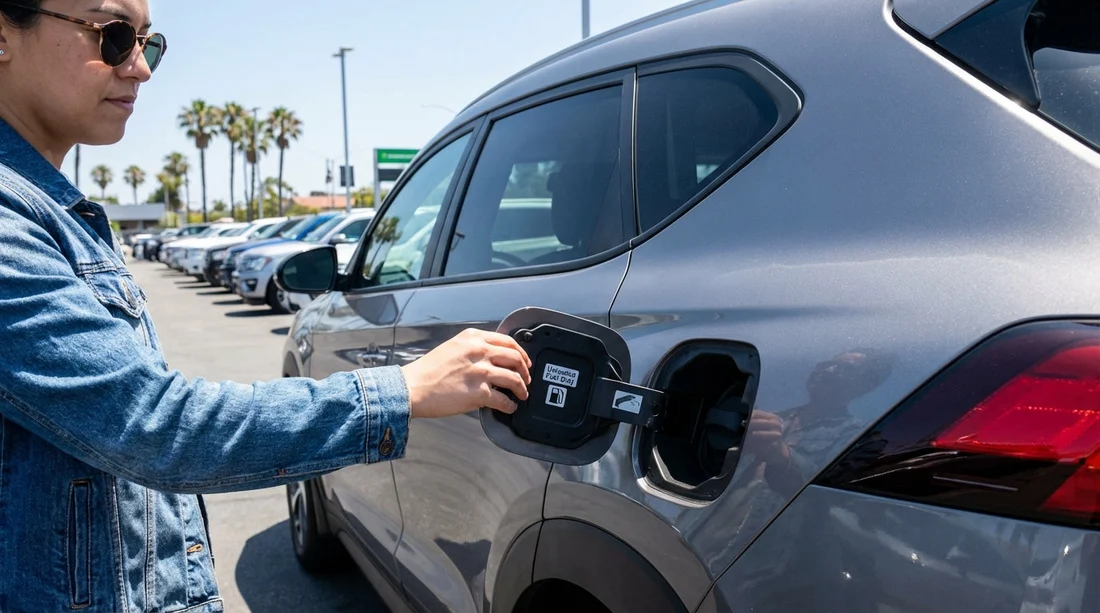
Step 1: Check the fuel door and flap labels. Open the fuel door. On many cars, the inside of the flap or the door jamb has a label that states the required fuel. Look for explicit wording like “Gasoline only”, “Diesel fuel only”, “Unleaded only”, or an octane requirement. For EVs there will be no fuel flap, but there will be a charging port door and usually a label about charging.
Step 2: Compare that label to the agreement. This is the single most important match. If the agreement says diesel but the flap indicates petrol, stop and call the desk before moving the vehicle. Do not assume the agreement is right, and do not assume the label is wrong. Mismatches happen when cars are swapped in a hurry.
Step 3: Locate any “nozzles and misfuel prevention” cues. In the US, petrol nozzles and diesel nozzles can be similar at some stations, so rely on labels rather than nozzle size. If you see a “Diesel” cap or a green diesel label, that is helpful, but still confirm using the written fuel requirement.
Step 4: Check the filler cap area for an octane note. Most petrol cars in California are fine with regular unleaded, commonly 87 AKI at the pump. Some vehicles require premium. If the label says 91 or 93, note that now, because choosing the wrong octane can affect performance and may breach guidance for that vehicle.
Step 5: Take a quick photo set. Photograph the open fuel door with the label visible, then the agreement fuel line on your phone, then the odometer and fuel gauge. These photos can save time if any disagreement arises later.
If you picked up around San Diego SAN or Sacramento SMF, you may be leaving straight onto highways. That makes it even more important to resolve any mismatch before you merge into traffic.
Dashboard confirmation, use the instrument cluster as your final check
The instrument cluster can confirm what the car expects, and it can also alert you if the vehicle is not a simple petrol-only setup.
Look for the fuel type cues. A standard petrol or diesel car will show a fuel gauge and a range estimate. A hybrid may show an “EV” mode indicator, battery level, or energy flow screen. A plug-in hybrid will typically show battery state of charge in addition to a fuel gauge. An EV will show battery percentage and estimated range, and may not show any fuel gauge at all.
Check the fuel door icon direction. Many drivers use the small arrow next to the fuel pump icon to remember which side the filler is on. While this does not confirm petrol versus diesel, it helps prevent confusion during refuelling when you are tired. Combine this with your photo of the flap label so you know both the side and the fuel type.
Review any “check fuel cap” messages. If the car shows a warning about the fuel cap being loose right after you open and close it, confirm it is properly seated. This is separate from fuel type, but it is an easy fix before you drive off.
If it is a hybrid or EV, find the charging information screen. For plug-in hybrids and EVs, locate the charging port release and the charging status screen now, not later at a hotel. Knowing how to open the charge port is part of confirming what the vehicle actually is.
What the agreement and the fuel flap should match, a simple rule
Use this rule every time, in every car hire pickup bay in California, the agreement’s fuel line must match the fuel flap label or charging port type, and the dashboard must support that powertrain. If any one of those three does not align, treat it as unresolved.
Examples of mismatches that should stop you immediately include, agreement says petrol but the flap says diesel, agreement says hybrid but there is no fuel flap label and only an EV charging port, agreement says electric but the car has a petrol filler and a conventional fuel gauge.
Common California fuel terms that cause confusion
Gas, gasoline, petrol. In California you will usually see “gas” or “gasoline” on paperwork and at stations. For UK travellers, that means petrol.
Unleaded. Most petrol is unleaded. The pump will show grades such as 87, 89, 91. If the fuel flap label specifies a minimum, follow that.
Diesel. Less common in many US rental categories than in Europe, but it exists. Never assume an SUV is diesel or petrol by size alone.
Hybrid. Typically petrol plus electric assistance. You still refuel with petrol unless it is an EV.
Plug-in hybrid. Petrol plus a chargeable battery. You may need to return it with a certain battery level, or simply return with the same fuel level, depending on the agreement.
EV, electric. No petrol or diesel. Charging is the “refuelling” process.
If you still feel unsure, do a two-question confirmation
Before you leave the lot, ask a staff member these two questions, and do it while standing by the fuel door or charge port.
1) “Can you confirm what fuel goes in this exact car, petrol, diesel, or electric?” Point to the vehicle and, if possible, the registration or bay number.
2) “Can you show me where it is written on the car?” This ensures you are not relying on memory or assumptions. Staff will usually point directly to the label on the flap, or confirm that it is an EV by showing the charge port.
Refuelling day-of-return, avoid last-minute mistakes
Most misfuelling incidents happen at the end of a trip when drivers are rushing to the airport and searching for the nearest station. Use what you recorded at pickup to stay consistent.
Use your photo of the fuel flap label. Compare it to the pump before you lift the nozzle. For petrol, choose the correct grade. For diesel, ensure the pump is clearly marked diesel.
Choose a well-lit station. Airports and freeway exits in California can be busy. A calmer environment reduces mistakes.
Stop if anything feels off. If the nozzle does not fit smoothly, or the cap label does not match what you are holding, do not force it. Re-check your photo and the flap label.
What to do if you discover a mismatch after leaving
If you notice that the agreement says one fuel type but the car labels show another, do not refuel until it is resolved. Pull over safely and call the rental provider using the number on your agreement. Explain that you have a documentation mismatch and share the photos you took. In most cases, they will update the paperwork or swap the vehicle. Continuing without clarifying can complicate any later dispute.
FAQ
How can I confirm fuel type fastest at pickup in California? Check the agreement fuel line, then open the fuel door and read the label inside. Finish by confirming the dashboard shows a matching setup, fuel gauge for petrol or diesel, charge screen for EVs.
Does “gas” on the agreement mean petrol? Yes. In California rental paperwork and at stations, “gas” or “gasoline” refers to petrol. Diesel will be stated explicitly as diesel.
Where is the fuel type written on the car? Most commonly it is printed inside the fuel door, on the filler cap, or on a label near the filler neck. EVs will instead have a charging port and charging information screens.
What if the agreement says petrol but the fuel flap label says diesel? Do not drive off. Return to the desk or call lot staff, show them the label and ask for corrected paperwork or a vehicle swap. Take clear photos for your records.
Are hybrids refuelled with petrol or diesel in California car hire? Most hybrids in California rental fleets are petrol hybrids, but you should not assume. Confirm by reading the fuel flap label, and check whether the vehicle is a plug-in hybrid with a charging port.





























































































