


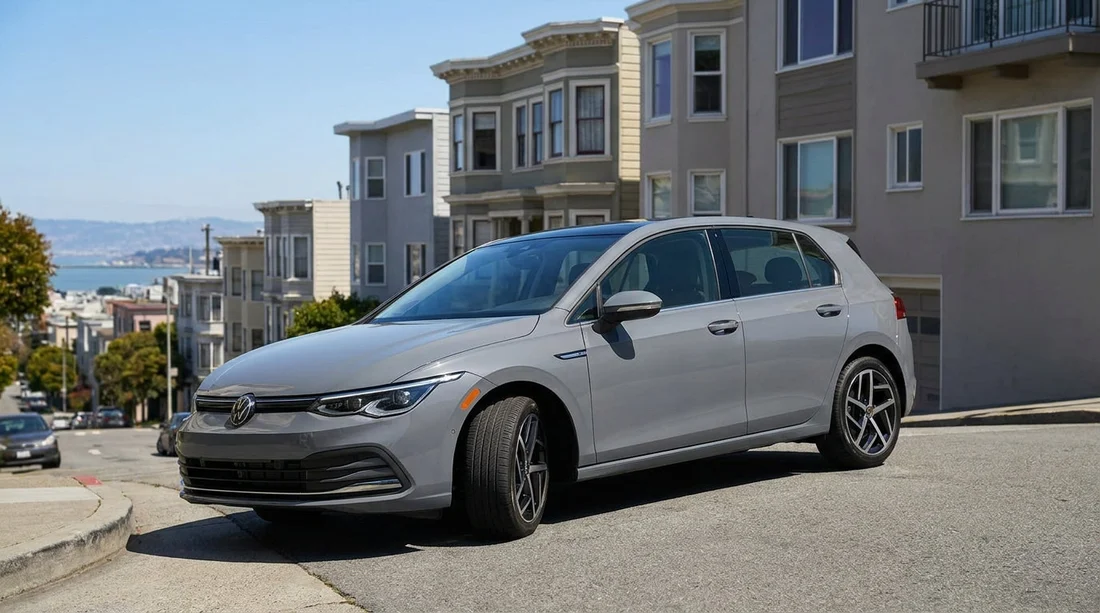
Quick Summary:
- Choose compact width to handle tight streets, kerb gaps, and garages.
- Pick an automatic with hill-start assist, or strong low-speed pull.
- Check garage clearance and ramp turns, especially in city car parks.
- Prioritise visibility, cameras, and sensors over extra size in traffic.
San Francisco is a city where the map does not tell the full story. A short drive can include sharp gradients, sudden stop signs on hills, one-way streets, and parking spaces that look designed for something smaller than modern cars. Choosing the right size for your car hire is less about passenger count alone and more about matching the vehicle class to the city’s real constraints: hill starts, narrow lanes, tight turning circles, and garage limits.
This guide breaks down common rental car categories and explains what works best for steep streets and parking in San Francisco, plus what to check before you collect the keys.
Understand the key constraints: hills, width, and clearances
Hill starts and frequent stopping are a daily reality. Many residential streets are steep enough that you will stop at a sign while pointing uphill, then need a controlled pull-away without rolling back. For this reason, the transmission choice and the car’s low-speed torque matter as much as the overall size.
Narrow streets and tight corners show up in neighbourhoods with closely parked cars, steep cross-streets, and limited sightlines. A vehicle that is too wide increases stress when passing delivery vans, cyclists, or when turning into a tight uphill lane.
Garage height and turning ramps can surprise visitors. City car parks and hotel garages may have low beams, tight spiral ramps, and sharp entry angles. Taller vehicles can be fine, but only if they fit the stated clearance and can physically make the turns without scraping.
If you are collecting near the airport, it helps to compare options and policies on a dedicated page such as San Francisco SFO car rental, then choose a class that fits where you will actually park in the city.
Vehicle classes and how they handle San Francisco
Mini and economy (small hatchbacks, subcompacts) are often the easiest match for urban San Francisco. Their narrow body makes it simpler to thread through tight residential streets and to fit into short kerbside spaces. They also typically have lighter steering, which helps when manoeuvring on slopes. The trade-off is less power, which can feel strained with a full load on the steepest climbs, and smaller windows and mirrors on some models.
Compact and midsize (sedans and small crossovers) sit in the sweet spot for many travellers. You gain more stable road feel and stronger acceleration for hills, while staying manageable for street parking. A compact sedan can be easier to judge than a tall crossover when parallel parking, because you can see kerbs and corners more clearly. If you expect longer drives outside the city, this class also offers a calmer ride without becoming awkward in garages.
Standard and full-size (larger sedans) can be comfortable but bring two practical downsides in San Francisco: width and length. A few extra centimetres can be the difference between a relaxed pass and a white-knuckle squeeze, especially on streets lined with double-parked cars. Longer cars also reduce your margin when fitting into short spaces on a hill. If you want the comfort, prioritise models with strong parking sensors and confirm your accommodation’s parking dimensions first.
SUVs and 4x4s are popular, but city fit depends on the exact size. A small SUV can work well, giving better visibility and easy entry, while still fitting most spaces. Larger SUVs can become tiring in multi-storey car parks with narrow ramps. Height is the other variable, as many garages post a clearance that can be close to the roofline of a tall SUV with roof rails.
People carriers and vans make sense for big groups, but they are the hardest to park and the most likely to conflict with garage limits. If you truly need the seats or cargo space, plan your parking carefully, favour open lots, and expect to spend more time searching for suitable spaces. For group travel where a van is unavoidable, review the options on van rental at San Francisco SFO and confirm your planned parking locations can accept the vehicle’s height and length.
What matters most for hill starts and steep descents
Automatic transmission reduces workload in stop-start hill traffic. If you are used to manuals, you can manage, but steep stop signs plus close following traffic can add pressure. Many visitors find an automatic more comfortable for city driving.
Hill-start assist and auto-hold features can prevent rollback when moving off. Not every model has them, so treat them as a bonus rather than a promise. If you do not have these features, practise a gentle move-off on a quiet incline first and leave a little extra space to the vehicle behind.
Engine response at low speeds matters more than top speed. A smaller engine can be fine, but with four adults and luggage it may feel underpowered on long climbs. If you are carrying a full load, a compact or midsize often feels more relaxed than an economy model.
Parking realities: kerbside spaces, garage ramps, and street width
Kerbside parking is easier with a shorter car, but visibility and sensor technology can offset size. Rear cameras, front sensors, and a tight turning circle are more valuable than a long bonnet and wide mirrors. If you are not used to parallel parking on a slope, a compact car with a clear rear view will reduce stress.
Garage height and width can be the deciding factor. A taller vehicle may technically fit the height limit but struggle on the ramp if the turning radius is tight. If your hotel parking is underground, ask for the posted clearance and whether there are tight spiral ramps.
Street width in neighbourhoods varies. Some residential blocks effectively become single-lane when both sides are parked. A narrower vehicle reduces the need to stop and yield repeatedly, which matters on hills where restarting can be awkward.
If you are comparing providers at the airport, pages such as Budget car rental at San Francisco SFO and Payless car rental at San Francisco SFO can help you review what classes are typically available and then pick the size that fits your parking plan.
Choosing by itinerary: city-only versus day trips
If you will mostly stay in the city, favour the smallest class that comfortably fits your passengers and bags. A compact automatic is often the easiest all-round choice: it copes well with hills, fits tight spaces, and still feels stable on faster roads.
If you will add day trips to places outside San Francisco, you may appreciate a midsize for comfort and luggage space. The key is not to overcorrect into a full-size car if you still plan to park in dense neighbourhoods at night.
Practical checklist before you finalise your car hire class
1) Where will you park most nights? A hotel garage with tight ramps points towards compact or midsize. Street parking in busy areas also favours smaller classes.
2) How many people and how much luggage? Aim for a class that fits everything without stacking above window level, which reduces visibility on steep roads.
3) Do you want driver aids? Prioritise rear camera, parking sensors, and blind-spot monitoring for dense streets and frequent lane changes.
4) Are you comfortable with hill starts? If not, choose an automatic and avoid the largest vehicle you can, because it will feel heavier on steep grades.
FAQ
What is the best car size for driving and parking in San Francisco? For most visitors, a compact automatic is the best balance. It is narrow enough for tight streets, easy to park, and strong enough for steep climbs with passengers.
Is an SUV a good idea for San Francisco hills? A small SUV can work well, especially for visibility and comfort. Larger SUVs can be harder to park and more likely to conflict with garage ramps and height limits, so check your parking plan first.
Do I need a powerful engine for steep streets? You do not need high horsepower, but you do want responsive low-speed pull. If you will carry four adults and luggage, consider compact or midsize rather than economy for a more relaxed climb.
Are manual cars difficult in San Francisco? They can be, mainly because of frequent stop signs on steep inclines and tight following traffic. If you are not fully confident with hill starts, an automatic car hire option is usually easier.
How do I avoid clearance problems in garages? Confirm the posted height limit where you will park, then choose a vehicle class with comfortable margin. Remember that tight spiral ramps and narrow entries can be as limiting as height.





























































































