


Quick Summary:
- Ask to pay in USD and decline any home currency conversion.
- Check the card terminal shows USD before you tap or sign.
- Ask for a receipt in USD and keep it for disputes.
- Use a card with low overseas fees to reduce total costs.
When you pick up a car hire in Florida, you may be asked whether you want to pay in US dollars or in your home currency. That choice can be the difference between paying the expected amount and paying more than you planned. The culprit is often Dynamic Currency Conversion, known as DCC, a payment service that converts the charge from USD into your home currency at the point of sale.
DCC can appear at airport desks, downtown branches, and even on card machines that look routine. Because it is presented as a “convenience”, travellers sometimes accept it without realising it can add a margin on top of the exchange rate and, in some cases, extra fees. Understanding what DCC is and how to decline it is one of the simplest ways to keep car hire costs predictable in Florida.
What Dynamic Currency Conversion (DCC) is
DCC is an optional service offered by some merchants and payment processors. Instead of charging your card in the local currency (USD in Florida), the transaction is converted immediately into your home currency, such as GBP or EUR, and you see that amount on the terminal or receipt.
It sounds helpful because it gives you an instant figure in familiar money. The trade-off is that the conversion is not performed at your card issuer’s rate. The DCC provider sets its own exchange rate, usually including a markup. That markup is the main reason the total can rise compared with paying in USD and letting your bank convert it later.
Why DCC can increase your total for car hire in Florida
The key issue is the exchange rate. Card schemes and card issuers typically convert foreign currency transactions at a competitive rate, sometimes with a small foreign transaction fee depending on your card. DCC replaces that with the merchant’s offered rate, which frequently includes a higher spread. Even if your card has no foreign transaction fees, DCC can still cost more because the conversion rate itself is worse.
1) A marked-up exchange rate. The offered “guaranteed rate” often builds in a percentage uplift. On a week-long car hire, that uplift can be noticeable.
2) Confusing totals at the desk. When a terminal displays your home currency, it may be harder to compare against your voucher, quote, or rate breakdown which is usually in USD for Florida pick-up locations.
3) DCC applied to deposits. Many rentals require a pre-authorisation deposit. If DCC is applied, the converted figure in your home currency may be larger, and conversion margins can make the final settled amount feel unpredictable.
4) Reduced control over exchange timing. Paying in USD lets your bank handle the conversion at settlement. With DCC, the conversion is locked in immediately, even if the rate is unfavourable that day.
Where you are most likely to encounter DCC in Florida
DCC is most common in high-travel environments where staff serve international customers all day. In Florida, that often includes airport counters and busy urban areas. If you are collecting at Miami International Airport, it is worth being extra alert to the currency choice on the terminal, especially during peak arrival periods when transactions are rushed. If you are arranging a pick-up via car rental at Miami Airport, plan to slow the payment step down and confirm the currency before you approve anything.
Equally, you may see it in city branches where international visitors are frequent. If you are collecting centrally, such as via car hire in Downtown Miami, the same rule applies, verify the charge is processed in USD.
What to request when paying by credit card at pick-up
To avoid DCC, you need a simple script and the confidence to repeat it. The request is straightforward, ask to be charged in US dollars and decline any conversion to your home currency.
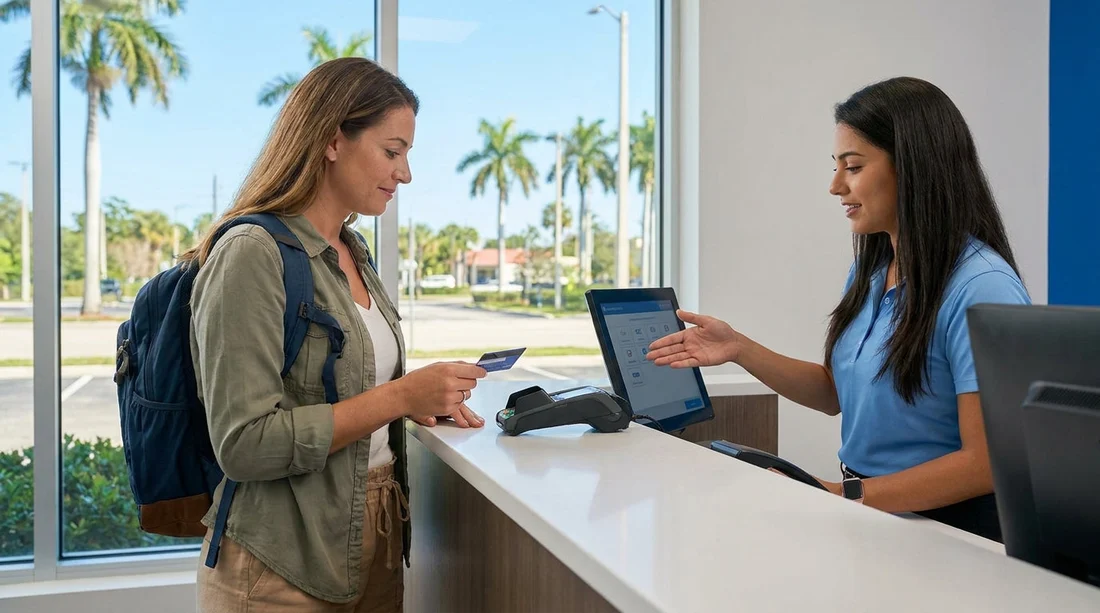
At the desk, say clearly: “Please charge my card in USD. I do not accept Dynamic Currency Conversion.” If the staff member asks you to choose a currency on the terminal, select USD. If they are completing the transaction themselves, ask them to confirm the terminal is set to USD before you tap or insert your card.
Then check the terminal screen. Many devices show a prompt like “Pay in GBP or USD?” or “Convert to your home currency?” If you see your home currency, that is a red flag. Choose USD, or ask the agent to restart the transaction in USD.
Finally, check your printed receipt. It should show the amount in USD without an additional converted total. If it shows both currencies, look for wording that indicates conversion was applied. If you spot it immediately, request a reversal and reprocess the payment in USD while you are still at the counter.
Practical checklist for avoiding DCC, step by step
Before you travel: Use a card you trust for overseas spending. If you have a card that charges foreign transaction fees, DCC can still be worse, but you may prefer a fee-free travel card to reduce overall costs.
At the counter: Keep your focus on the payment moment. Staff may be handling licence checks, insurance questions, and vehicle class confirmations. When it is time to pay, re-state your preference for USD.
On the terminal: Do not approve the transaction until you confirm the currency. If you are unsure, ask the agent to show you the USD amount line.
For deposits: Ask whether the deposit is a pre-authorisation in USD. A deposit should generally be a hold, not a completed sale, but it can still be presented with DCC choices on some terminals. Decline conversion the same way.
How DCC differs from your bank’s foreign transaction fee
Travellers sometimes accept DCC to “avoid bank fees”, but DCC does not eliminate fees in a reliable way. If your bank charges a foreign transaction fee, paying in USD may add that fee. However, DCC frequently costs more than the bank fee because the exchange rate markup can be larger than the fee percentage.
If your card has no foreign transaction fees, DCC is even harder to justify because you would be giving up your bank’s exchange rate with no compensating benefit. For most travellers, the best default is to pay in the local currency, which in Florida is USD.
Does DCC affect different vehicle types and locations?
DCC is not tied to the type of vehicle, it is tied to the payment processing setup. Whether you choose a compact car, an SUV, or a minivan, the same payment rules apply. If you are comparing options such as SUV hire in Florida or family-friendly rentals, the way to avoid DCC remains the same, pay in USD and verify on the terminal.
Likewise, Fort Lauderdale pick-ups can present the same prompts as Miami. If your plans involve Broward County and you are arranging car rental in Fort Lauderdale, watch for DCC language at both pick-up and any in-person amendments.
FAQ
Is Dynamic Currency Conversion illegal in Florida? No. DCC is a permitted service, but it should be offered as a choice. The important point is that you can normally decline it and pay in USD.
What exact words should I use to avoid DCC at car hire pick-up? Say, “Please charge in USD only, I do not accept Dynamic Currency Conversion.” Then confirm the terminal screen shows USD before you approve the payment.
Can DCC apply to the security deposit as well as the rental charge? Yes. A deposit or pre-authorisation can still trigger a currency choice on some terminals. Treat it the same way, decline conversion and keep everything in USD.
If I pay in USD, will my bank definitely give me a better rate? Often, yes, but it depends on your card. Even where a foreign transaction fee applies, the overall cost is frequently lower than a DCC exchange rate markup.
What should I check on the receipt to confirm DCC was not used? Look for the transaction currency being USD only, with no converted home-currency total and no wording indicating conversion or “guaranteed exchange rate”.





























































































