Quick Summary:
- Stop fully behind the line, then proceed in strict arrival order.
- If two arrive together, yield to the vehicle on your right.
- Going straight usually goes before turning left across oncoming traffic.
- Signal clearly, scan left first, and avoid confusing courtesy waves.
If you are a UK driver picking up car hire in Florida, a four-way stop can feel unfamiliar at first. In the UK you may be more used to roundabouts, give-way markings, and traffic lights managing priority. In Florida, many neighbourhood junctions and smaller intersections rely on a simple rule set: every approach has a STOP sign, every driver must stop, and drivers take turns. The good news is that once you know the right-of-way order, four-way stops become predictable and calm.
Before you set off from the airport, it helps to remind yourself of two US basics that affect judgement at four-way stops. First, you will be driving on the right, so your natural “look right first” habit must become “check left, then right, then left again” because the closest traffic is from your left. Second, US intersections often have wider lanes and larger vehicles, so leave yourself time and space to read what others are doing.
What a four-way stop is, and how to spot one
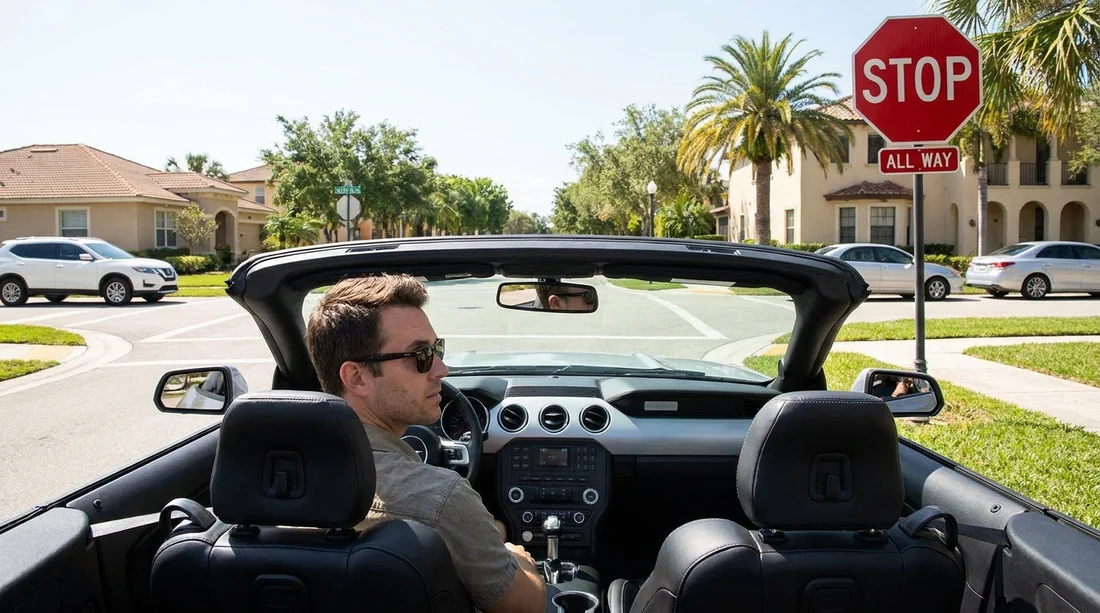
A four-way stop is an intersection where every direction has a STOP sign. In Florida, you will often see an additional small plate reading “4-WAY” or “ALL WAY” under the red sign. Even if you do not see the plate, treat it as a four-way stop if you can clearly see STOP signs facing the other approaches. You must make a complete stop, not a rolling “California stop”. A full stop means the wheels stop turning, ideally behind the stop line or before the crosswalk if there is one.
At many junctions the stop line is set back from the corner. Stop there first, then creep forward only if you need a better view, and stop again before entering the pedestrian crossing area. This matters in Florida because pedestrians can appear from either side, and they may expect you to stop at the marked line.
The core right-of-way rule: first to stop, first to go
The easiest way to think of a four-way stop is as a queue. The first vehicle to arrive and come to a complete stop gets to go first. The second goes next, and so on. Your job is to decide your place in that sequence. Watch for the moment each other vehicle fully stops, not just when it rolls up to the sign.
If you are collecting a vehicle around Miami, you may face frequent four-way stops on grid streets. Areas near Miami car hire locations often mix tourists, delivery drivers, and locals who expect decisive movement. Being accurate with the order helps you fit in smoothly.
What if two cars arrive at the same time?
When two vehicles stop at the same time, the standard tie-break rule is: yield to the vehicle on your right. For a UK driver, this can feel counterintuitive at first because you are used to different priority patterns at mini-roundabouts and junctions. At a four-way stop in Florida, “to the right” means the driver whose approach is immediately to your passenger side.
How turning changes priority at a four-way stop
The arrival order still matters, but turning paths can conflict. If two vehicles stop at the same time from opposite directions, and one is going straight while the other is turning left, the vehicle going straight generally proceeds first. The left-turning vehicle yields because it must cross oncoming traffic.
If you have picked up a larger vehicle, such as from an SUV rental in Doral, allow extra space for turning. Bigger vehicles may swing wider, and your sightlines can be different compared with a small hatchback common in the UK.
Common mistakes UK drivers make at US four-way stops
1) Not stopping fully. Florida drivers and police expect a complete stop. Rolling through can also lead to mis-reading the arrival order, which increases the risk of a side impact.
2) Looking the wrong way first. In the UK, checking right feels natural. In Florida, your closest threat is usually from the left because traffic is on the right-hand side of the road. Train yourself to look left first as you approach, then scan all sides at the stop.
3) Overusing “courtesy”. Waving someone through when it is actually your turn can create two problems. The other driver may not trust your wave and remain stopped, or they may go while a third driver assumes you are proceeding. Predictability is safer than politeness.
4) Forgetting pedestrians and school zones. Four-way stops are common in residential areas. Children may step into crossings quickly, and drivers behind you may not see them. Treat every crosswalk as live.
Practical scan routine you can use every time
A simple routine reduces stress, especially on your first day with car hire in Florida.
This routine is particularly useful after long flights into Orlando or Tampa, when fatigue makes judgement slower. If you are collecting a vehicle via car hire at Orlando Airport or car hire at Tampa Airport, plan a short, low-pressure first drive to practise these stops on quieter streets before hitting busier roads.
How to handle aggressive or impatient drivers
Most four-way stop friction comes from mismatched expectations. If another driver edges forward, honks, or tries to take your turn, do not escalate. Let them go if needed, then re-establish the order with the remaining vehicles. Being “right” is less important than avoiding a collision in an unfamiliar rental car.
If you ever feel unsure, wait for a clear gap. A small pause is rarely a problem, but entering at the wrong time can lead to a side impact claim, which is exactly what you want to avoid on holiday.
FAQ
Do I always have to stop completely at a four-way stop in Florida? Yes. Come to a full stop behind the stop line or crosswalk, then proceed only when it is your turn and the way is clear.
Who goes first if we stop at the same time? Use the tie-break rule: yield to the vehicle on your right. If it is still unclear, wait and proceed only when the other driver’s intentions are obvious.
If I am turning left, do I ever have priority? You can go when it is your turn in the arrival order, but you must still yield to any oncoming vehicle going straight when you would cross its path.
Can I wave another driver through to be polite? It is better to follow the standard order. Waving can confuse other approaches, and confusion at four-way stops is a common cause of low-speed collisions.
What is the biggest UK-driver adjustment at US four-way stops? Judging “first to stop, first to go” while scanning left first for traffic. Combine a full stop with a deliberate scan and you will fit in quickly.