


Quick Summary:
- LDW covers damage or theft costs, not everyday roadside service call-outs.
- Roadside assistance can cover flats, dead batteries, lockouts, and towing.
- Read your rental terms for exclusions, limits, and approval requirements.
- Choose roadside cover for remote routes or more predictable out-of-pocket costs.
When arranging car hire in California, it is easy to assume that Loss Damage Waiver, often shortened to LDW, will protect you from every problem on the road. LDW is valuable, but it is not the same thing as breakdown assistance. The two products solve different problems, and the difference matters when you are on a tight schedule, travelling with family, or driving longer distances between cities.
This guide explains what LDW typically covers, what roadside assistance usually covers, where the gaps often are, and how to decide whether an optional roadside package is worthwhile before you sign.
What LDW usually covers on a rental car
LDW is generally a waiver that reduces, or removes, the amount you pay if the rental vehicle is damaged or stolen. It is usually linked to collision damage and theft risk rather than mechanical issues. Think of LDW as protection against the cost of repairing or replacing the vehicle after a covered incident, not a promise that someone will come out to help you get moving.
In many agreements, LDW can cover damage from a collision, vandalism, or certain types of loss. It can also cover theft of the vehicle, subject to conditions such as proper reporting and not leaving keys unsecured. However, LDW frequently includes exclusions, and some of those exclusions overlap with common roadside situations. For example, damage caused by using the wrong fuel, ignoring warning lights, or driving on prohibited roads may be excluded. Similarly, tyre and windscreen damage are sometimes treated separately, even when you have LDW.
The key point is that LDW is usually about financial liability for vehicle damage, not about service delivery. Even if LDW means you owe nothing for covered damage, you may still have to arrange assistance, pay a call-out fee, or reimburse towing and service charges depending on the agreement and the cause of the incident.
What roadside assistance typically covers
Roadside assistance is designed to get you moving again, or to tow the vehicle to an approved location, when something prevents you from driving safely. Coverage varies by provider, but it often includes practical support such as:
Help with a flat tyre, including fitting a spare if available, or towing if not. Jump-starts for a dead battery. Assistance if you lock the keys inside the car, or if you misplace the keys. Fuel delivery if you run out of fuel, usually with you paying for the fuel itself. Towing after a mechanical breakdown, often to the nearest approved workshop or rental location.
It may also include coordination, meaning a 24 hour phone number that handles dispatch and payment arrangements. That coordination can be the real value in California, where distances can be large, and where breakdown services can be expensive, slow, or difficult to organise if you are unfamiliar with the area.
Why LDW does not replace roadside assistance
LDW and roadside assistance address different risks. LDW deals with the cost of damage or theft. Roadside assistance deals with the inconvenience and expense of being immobilised. You can have excellent LDW coverage and still face a costly tow, a locksmith charge, or a service fee for a battery call-out.
A simple way to test the difference is to ask, what is the problem right now? If the problem is that the car is damaged and you are worried about repair costs, LDW is relevant. If the problem is that you cannot drive the car, roadside assistance is relevant. In real situations, both can matter at the same time. For example, if you hit debris on a freeway and the tyre fails, LDW might not cover the tyre, and it also will not necessarily cover the tow. Roadside assistance might organise the tow or tyre help, but it will not automatically waive the cost of a replacement tyre if that is excluded.
Common scenarios for car hire in California
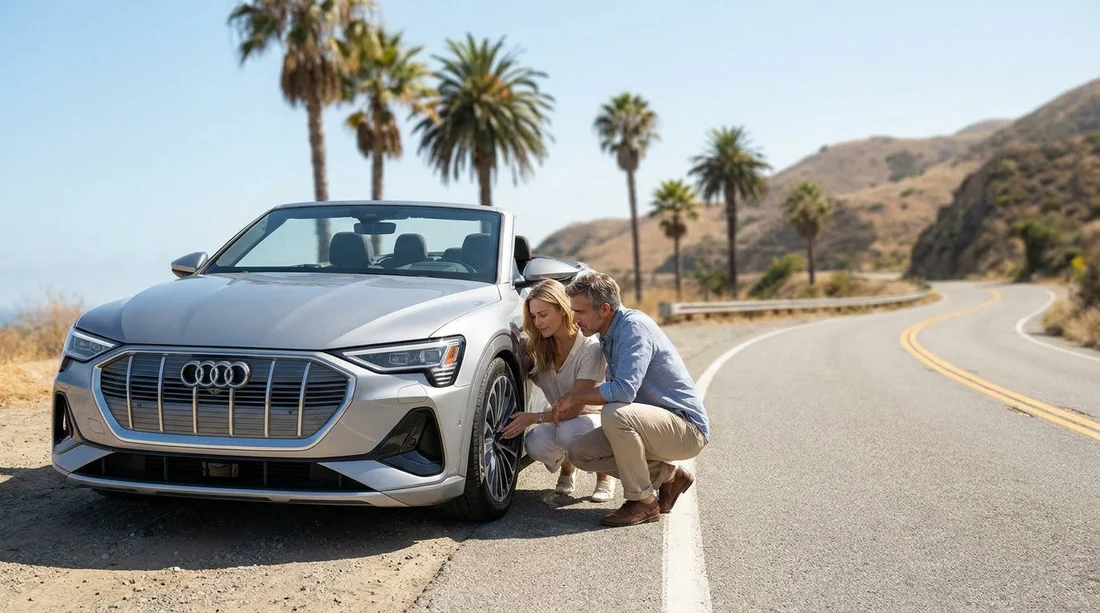
Flat tyre on a highway shoulder. Many travellers assume a flat tyre is a damage event covered by LDW. Often it is treated as wear, misuse, or a separate category. Roadside assistance is the feature that usually sends someone, or arranges towing, so you are not stuck waiting and searching for help.
Dead battery in a hotel car park. Batteries can fail without warning. LDW is typically irrelevant because there is no collision damage. Roadside assistance may cover a jump-start and, depending on rules, replacement or towing.
Keys locked in the car. Lockouts are common on trips with luggage and children. LDW normally does not cover locksmith services. Roadside assistance often does, but sometimes with limits or only if a spare key can be delivered.
Running out of fuel. This is usually considered driver responsibility. Roadside assistance may deliver fuel and help you reach a station, while you pay for the fuel and possibly a service charge if it is excluded.
Accident with an undriveable car. LDW may reduce your financial liability for the damage, but it does not always mean towing is free. Roadside assistance can streamline towing and instructions on where the car must be taken.
What to check before you sign
The right decision depends on the exact wording of your rental agreement and the type of trip. Before finalising your car hire, look for these items in the coverage details:
Towing rules. Is towing included after a mechanical breakdown, after an accident, or both? Are there distance limits? Do you need prior authorisation before calling a tow truck?
Tyre and windscreen treatment. Are tyres excluded from LDW? Is there separate cover for glass? These are frequent pain points on longer California drives.
Key replacement and locksmith charges. If keys are lost, is replacement covered, and what fees apply? Some policies cover lockout service but not replacement keys.
After-hours support. Breakdown issues do not schedule themselves. Make sure there is a clear contact route at night and on weekends, and confirm whether roadside dispatch is included or billed back to you.
Driver responsibility exclusions. Wrong fuel, running out of fuel, ignoring warnings, or driving where prohibited can trigger exclusions that affect both LDW and assistance eligibility.
How this affects your Hola Car Rentals planning
Hola Car Rentals works with multiple partners and locations, so the most practical approach is to match your cover choices to your route and pickup point, then read the specific inclusions for that booking. If you are collecting near Silicon Valley, review your options for car rental at San Jose SJC or car hire at San Jose SJC, especially if you expect motorway driving and busy car parks where lockouts are common.
If your trip starts in Northern California, check details when arranging car rental at Sacramento SMF, where you may be heading towards mountain roads or longer rural stretches. For Southern California family travel, larger vehicles can be practical, and it is sensible to weigh assistance options alongside a minivan rental at Los Angeles LAX, since tyres, keys, and towing can be more complicated with heavier loads.
No matter the pickup location, the best decision comes from separating two questions: what do I pay if the car is damaged, and who helps me when the car cannot move? LDW primarily answers the first question. Roadside assistance primarily answers the second.
FAQ
Does LDW include towing in California? Not always. LDW usually addresses damage costs, while towing rules are often listed separately and may require authorisation or include limits.
If I get a flat tyre, will LDW cover it? Often tyres are excluded or treated as a separate item. Roadside assistance is more likely to help you get moving, but you may still pay for tyre replacement.
What is the difference between breakdown assistance and accident support? Breakdown assistance focuses on immobilising issues like battery, tyres, or mechanical failure. Accident support may involve claims steps, towing instructions, and replacement vehicle processes.
Do I need roadside assistance for city driving only? It depends. Even in cities, lockouts and dead batteries are common. Assistance can be useful if you want faster help and clearer fees.
Can I call my own tow truck instead of the rental provider? Sometimes, but many agreements require you to contact the provider first. Calling independently may risk non-reimbursement or policy breaches.





























































































