


Quick Summary:
- Most EV rentals do not include free charging, you usually pay.
- Charging costs vary by network, time, and speed, not only kWh.
- Hotels may offer free Level 2 charging, but confirm access rules.
- Budget for idle fees and parking at busy California charging sites.
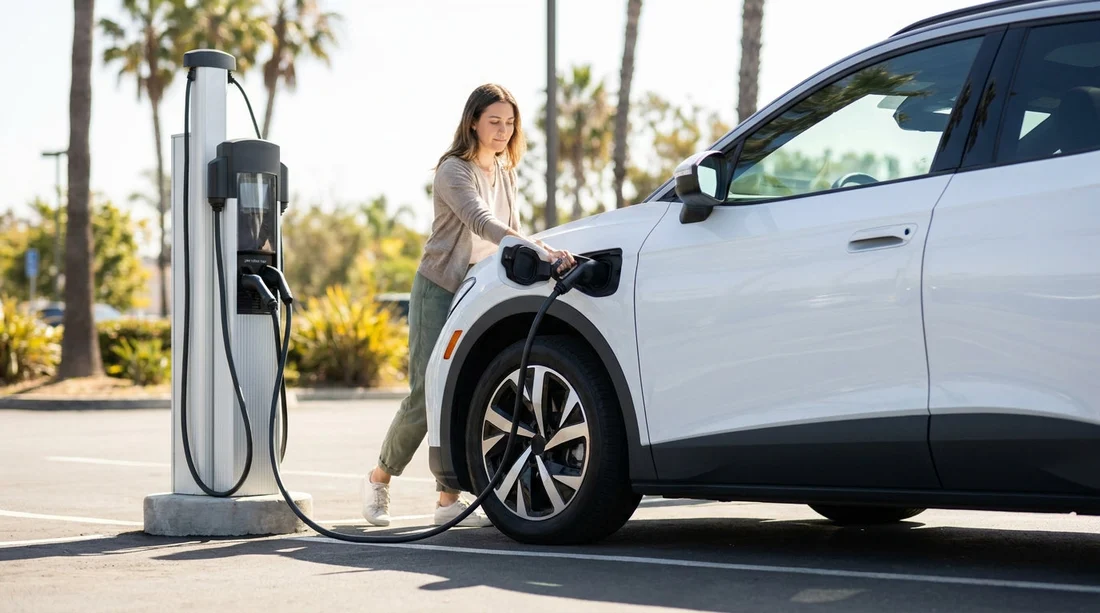
Electric rental cars can be a brilliant fit for a California road trip, but charging is the part that catches many travellers out. Unlike petrol where the pump price is obvious, EV charging can involve different networks, tariffs, app requirements, and extra fees. The key budgeting question is simple, does your rental include free charging, or do you pay per session. In most cases for car hire in California, you should expect to pay for public charging yourself, with only occasional perks or promotions included by a rental brand, a hotel, or a specific location.
If you are collecting a vehicle near a major airport, it helps to plan charging early, because your first charging stop may be determined by where you are staying and the routes you take. Hola Car Rentals consolidates options across key gateways such as Los Angeles LAX, San Francisco SFO, and San Jose SJC, which are all areas with dense charging infrastructure, plus busy pricing and parking patterns.
Do EV rental cars in California include free charging?
Typically, no. Most electric rental cars are supplied with a charged battery at pick up, but public charging is paid by the driver. Some rentals may include a limited charging credit, discounted rates with a partner network, or an optional prepaid charging product. These inclusions change frequently, and they can be limited to certain brands, vehicle categories, or dates.
Instead of assuming charging is included, treat any free charging as a bonus and confirm it in writing. For budgeting, plan as if you will pay for every public session, then reduce the estimate if your booking confirmation clearly states a credit amount or a specific free charging programme.
Common ways you may be charged at California EV stations
California charging costs are not one universal price. You may see any of these methods, sometimes combined:
Per kWh pricing: You pay for the electricity delivered. This is the most intuitive method. If your rental is efficient and you charge only what you need, it can be the best value.
Per minute pricing: You pay for the time connected. This can be good if your car charges quickly and the charger delivers strong power, but expensive if charging slows at high battery percentages.
Session fees: Some networks add a fixed start fee or minimum charge on top of energy or time. This is why short top ups can cost more than expected.
Idle fees: If you leave the car connected after charging completes, many networks add idle fees per minute. In popular California locations, this is used to keep bays available.
Because of these structures, the same 25 minute stop could cost very different amounts depending on the charger type, the time of day, and whether the car is already at a high state of charge. A practical approach is to plan fewer, longer sessions when you need them, and to avoid charging above about 80 percent unless you genuinely need the extra range for the next leg.
Level 2 versus DC fast charging, what you are paying for
Most drivers will use two charging types. Understanding the difference helps you budget and choose the right stop.
Level 2 (AC) charging: Common at hotels, shopping centres, and car parks. It is slower, often adding range over hours. Pricing varies, and sometimes the electricity is free but you pay for parking. If you are staying overnight, Level 2 can be a low stress way to start the morning with more range.
DC fast charging: Found along highways and in high traffic areas. It is much faster and usually more expensive. This is what you use on longer drives or when you need a quick top up between destinations. It is also where idle fees and queues can matter most.
A helpful budgeting rule is to treat DC fast charging like a motorway service stop, you are paying for convenience and time. If your itinerary allows, balancing some overnight Level 2 with occasional fast charging can reduce overall spend.
Apps, contactless payment, and deposits
Many California chargers require an account with the network, even when contactless card payment is available. As a traveller, you may need to download one or two apps, add a payment method, and sometimes pre load funds or accept a temporary authorisation. That authorisation can look like a deposit and may take time to clear, so keep a buffer in your card balance if you are charging frequently.
When you collect the car, ask for the return requirement in simple terms, the target percentage, how it is measured, and what happens if you miss it. If your trip ends at an airport, remember that the last fast charger near a major terminal can be busy. Drivers collecting or dropping off around car hire at LAX often find it easier to top up earlier in the day rather than leaving it to the final hour.
Situations where you might get free or discounted charging
While uncommon as a standard inclusion, free or discounted charging can appear in a few scenarios:
Promotional credits: A rental brand may include a temporary partnership credit. Always check the terms, expiry, and whether it covers idle fees or parking.
Accommodation perks: Some resorts include charging in the room rate, but bays may be limited.
If you are comparing vehicle categories for car hire, also consider practicality. For larger groups, you may decide a different vehicle type makes sense for luggage and stops, for instance a minivan rental in California might reduce time spent charging. For those set on an EV, choosing a model with stronger fast charging performance can reduce time based fees and lower the chance of idle charges.
Tips to keep charging costs predictable
Charge little and often on fast chargers: Stop earlier, charge to around 60 to 80 percent, then continue.
Use overnight charging whenever possible: Even paid hotel Level 2 can be cheaper than repeated fast charging.
Watch for idle fees: Set a phone alert for when charging nears completion.
Plan your final top up: Do not leave return charging to the last moment near airports.
Keep payment methods ready: Having at least one charging app set up can prevent higher priced emergency options.
California is one of the easiest places in the US to drive an EV, but convenience comes from planning. If you treat charging as pay as you go unless clearly stated otherwise, you can budget confidently and avoid surprises during your trip.
FAQ
Is charging ever included with an electric rental car in California? Sometimes, but it is not the default. You might see a credit, discount, or partner offer, but most drivers pay for public charging sessions themselves.
Do I pay per session or per kWh at California charging stations? It depends on the network and site. Some charge per kWh, others per minute, and some add a session fee on top.
Are there extra fees beyond the advertised charging rate? Yes. Common extras include idle fees if you stay plugged in after completion, and parking fees at certain car parks or destinations.
Can I rely on free hotel charging to avoid public chargers? Not always. Hotel chargers may be limited, reserved for guests, or tied to paid parking. Confirm availability and any rules before you depend on it.
What should I do to avoid return recharge fees? Check the required return state of charge at pick up, then plan a convenient top up earlier than your final stop, especially near busy airport areas.





























































































