


Quick Summary:
- Most UK ISOFIX seats clip onto US LATCH lower anchors securely.
- Confirm lower anchors and a top tether point in your chosen seat.
- Check support leg rules if the car has underfloor storage boxes.
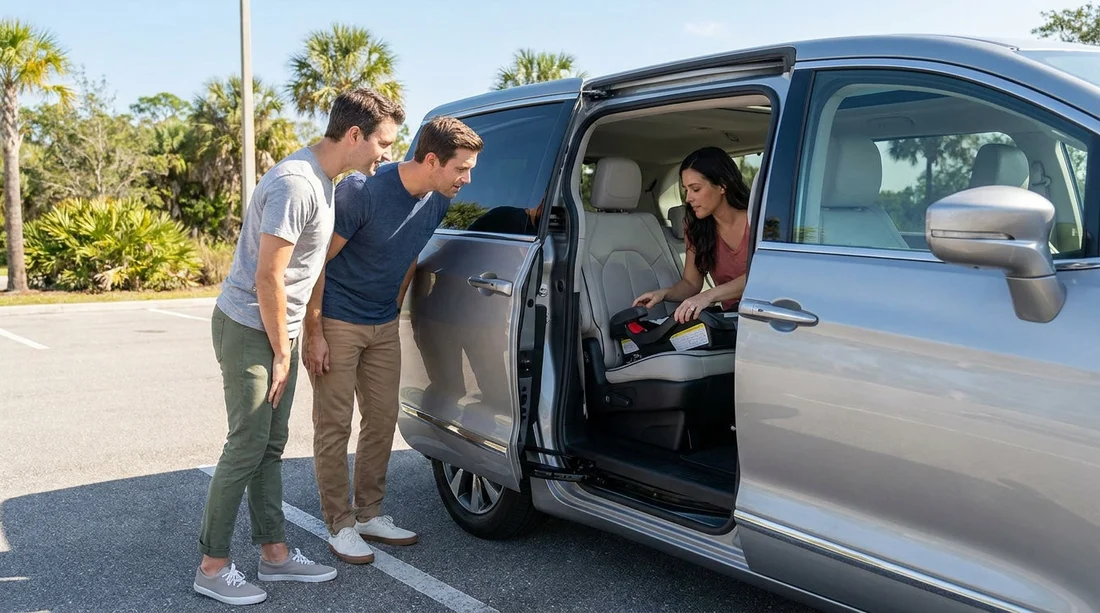
- Test-fit at pick-up for tightness, correct recline, and tether routing.
If you are travelling from the UK and arranging car hire in Florida, it is sensible to ask whether your UK ISOFIX child seat will work in a US rental car. The reassuring answer is usually yes, because ISOFIX and the US system, LATCH, are built around the same international anchorage standard for the two lower attachment points. The important caveat is that US vehicles also rely heavily on a top tether for forward-facing child seats, and the location and availability of that tether anchor can vary by seating position.
This guide explains ISOFIX vs LATCH in plain terms, what to confirm when you collect your rental car, and what to check before fitting your own seat so you can travel safely and confidently.
ISOFIX vs LATCH, what is the real difference?
ISOFIX is the common term used in the UK and much of Europe for the built-in child seat anchorage system. LATCH stands for Lower Anchors and Tethers for Children and is the US term. In practice, the two lower anchor points are the same concept and are based on the same underlying geometry, so a child seat with ISOFIX connectors will generally attach to the lower anchors in a US car.
Lower anchors: In both systems, there are two metal bars located in the crease between the backrest and the seat base. Your ISOFIX connectors clip onto these bars. In many US cars, the anchors can be buried behind upholstery and are marked with small icons.
Top tether: US guidance strongly emphasises the top tether for forward-facing seats, and many forward-facing seats require it for full performance. In the US, the top tether anchor might be behind the head restraint, on the parcel shelf, on the rear of the seatback, on the floor, or in the cargo area behind the seat.
Support leg and load leg: Some UK ISOFIX seats use a support leg that braces on the vehicle floor. US vehicles can have underfloor storage compartments in front of rear seats in some models, and bracing onto a storage lid may be prohibited by your child seat manual.
Will your UK ISOFIX seat fit in a Florida rental car?
For most modern US rental cars in Florida, a UK ISOFIX seat will connect to the lower anchors, because those anchors are present in at least two rear seating positions. The seat will fit in the sense that it can attach. The more important question is whether it can be installed correctly in the seating position you need, with the correct tether or support arrangement, and within the car seat’s stated limits for using anchors.
If you are collecting your vehicle at a major hub such as Orlando Airport or driving onward after time in Miami Beach, build in a few minutes at pick-up for a careful installation check before leaving the car park.
What to confirm at pick-up, before you drive away
1) Find the lower anchors in your chosen seat position. Look for small tags or symbols at the seat bight. Push your fingers into the crease to feel for the metal bars. If you cannot find them quickly, try the other rear outboard seat.
2) Confirm a top tether anchor for forward-facing use. If your child will be forward-facing, locate the tether anchor and make sure you can route the strap exactly as your seat manual describes. If you are choosing a larger people carrier for luggage and family space, it can be helpful to consider a minivan rental in Florida because these models often have clearer family-oriented anchorage layouts.
3) Check for a floor storage compartment if your seat has a support leg. If there is a lidded box in the footwell area under the support leg, stop and check your child seat manual. If prohibited, choose a different seating position or use an installation method that does not rely on a support leg, if your model allows it.
4) Confirm head restraint and seat shape compatibility. Some US vehicles do not allow complete head restraint removal, and some head restraints angle forward aggressively, which can push the child seat away from the vehicle seatback. If the fit leaves a gap that your manufacturer disallows, use a different position or vehicle.
5) Check for accessible, locking seat belts as a back-up. Even if you plan to use ISOFIX or LATCH, confirm the seat belts work with your seat if you need to switch positions. Most US vehicles have switchable locking retractors, meaning you can pull the belt fully out to engage a locked mode for child seat installation.
What to check while fitting your own seat
Tightness test: Grip the seat at the belt path and try to move it side-to-side and front-to-back. You are aiming for minimal movement at the belt path.
Correct recline: Rear-facing seats often have an indicator for the correct angle. US vehicle seats can be more sloped than UK cars, which can change recline. Use your seat’s allowed recline range and adjustment methods rather than improvising.
Top tether tension: For forward-facing, attach the tether to the correct anchor and remove slack, without over-tightening. Make sure it is not twisted and is routed as instructed.
Lower anchor weight limits: Many child seats have a maximum child weight for using the lower anchors, after which you must switch to a seat belt installation. If your child is close to the threshold, check your manual before relying on anchors.
If you anticipate frequent airport runs or longer drives across the state, choosing a vehicle class with more rear legroom can make correct installation easier. For example, families arriving via Tampa Airport often find mid-size SUVs or minivans simpler for rear-facing space.
Common Florida rental car scenarios and solutions
Small saloons and compact SUVs: ISOFIX connectors usually clip in fine, but you may struggle with rear-facing space. Try installing behind the passenger seat and moving that seat forward slightly, while keeping safe airbag distance for the front passenger.
Three rows (SUVs and minivans): Great flexibility, but tether anchors can be limited to specific seating positions. Before you commit to a third-row install, locate the tether anchor and confirm the routing path. If you are picking up around Miami, a people carrier option like van rental in Miami can be useful when you need both luggage capacity and predictable family seating layouts.
Rear centre seat: The rear centre often lacks lower anchors in US cars, or the anchors are borrowed from the two outboard positions and may not be permitted for use together. If your manual allows a centre belt install, that is often the practical solution.
FAQ
Q: Are ISOFIX and LATCH anchors the same spacing?
A: Yes, the lower anchors use the same standard spacing, so UK ISOFIX connectors usually attach to US LATCH lower anchors without issue.
Q: Do all US rental cars in Florida have LATCH?
A: Most modern cars do, but not every seating position will have lower anchors. Nearly all will have anchors in the rear outboard seats, while the centre seat may rely on the seat belt.
Q: My UK seat has a support leg, is that a problem in US cars?
A: It can be, especially if the vehicle has an underfloor storage compartment where the leg would sit. Check your seat manual, and choose another position or installation method if the manufacturer prohibits it.
Q: If I cannot use the lower anchors, can I install with the seat belt?
A: Usually yes, provided your child seat permits seat belt installation. US belts typically lock for child seats by pulling the belt fully out, then letting it retract tight.
Q: Should I test-fit the seat before leaving the rental car park?
A: Yes. Confirm you can find the anchors, attach the tether if needed, and achieve a tight fit at the belt path before you drive away.





























































































